
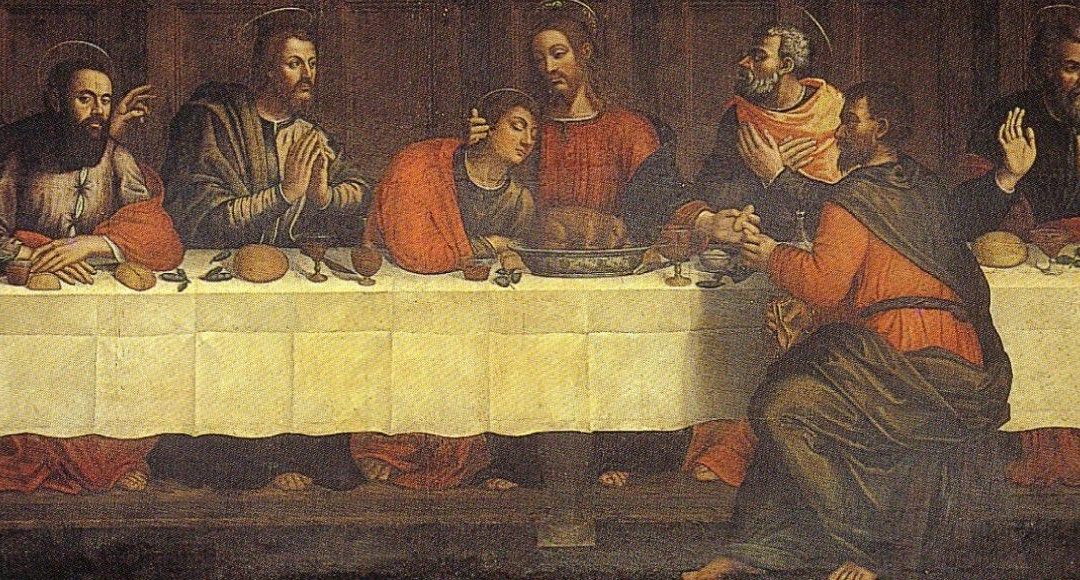
A.G. “Is that really you Plautilla? It is so difficult to recognise you when the only image of you that I have is a blanked out face in the corner of one of your frescos”. Whatever were you trying to say about yourself when you painted that?
 Plautilla Nelli
P.N. Well, as you probably know Artemesia, Nuns are not allowed anything that suggests vanity – so No Mirrors, and when I painted this the best image of me that I could see is a smudge within the Holy Water – and in any case, painting an image of myself would suggest the Sin of Vanity! It is enough for me that I know that I am the paintress, and I have gone so far as to paint that message on the walls of my own Last Supper.
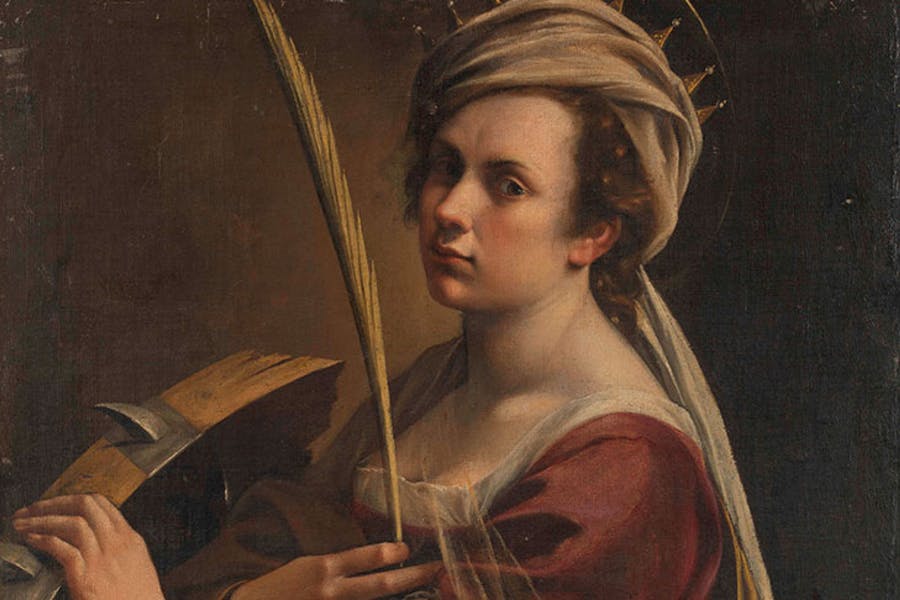 Artemisia Gentilischi
 A.G.”Oh, my Heavens, Plautilla, may I call you Plautilla? or should I say Mother Superior as you held that role in your Convent?
I guess that I wouldn’t get very far in your world under Convent rules? I have painted my own image in practically every painting I have ever done! It saves me time and also money spent on getting a model, and I really don’t know another woman with an expression as strong and determined as mine can be, especially when I am feeling grim!
I suppose that I am vain because I want the world to recognise my face and appreciate my work as a woman artist working alone, and not just an acolyte of my father, Orazio and now hated Agostino Tassi,
What a contrast with you! Locked-down since you were a child of 14 in the Dominican Convent of Santa Caterina da Siena, which was known as “di Cafaggio” because it was “fenced-in”. You, you made the most of your skills and created a masterpiece in a Convent – the only known Last Supper to be painted by a woman, aided and supported by other women artists.
To me, as a woman of the world, it seems so sad that your major work was only shared with the other Sisters in your confraternity and the workmen who came in to hang it in your Cenaccola!”

Nelli’s Last Supper before restoration
P.N “You are right about that, Artemesia – and just look at what has happened to it over the years? Taken off its stretcher it was folded up and left in an attic, then found and badly restored to be hung in the museum of Santa Maria Novella, Unfortunately, it was situated in a perfect place to absorb all the dirty smelly moisture rising from the 1966 Arno flood which caused the canvas to rot. How I cried to see it like this – so many thousands of tiny brush strokes falling away from the canvas being lost forever.
The work! The painstaking hours of application by myself and my coterie of Sisters helping me, all of us working with only skinny size 2 and size 3 sable brushes on a 21-foot canvas, all lost!…All Lost…… It was just misery to see it …for once I was grateful not to be alive and compelled to paint it all again!”

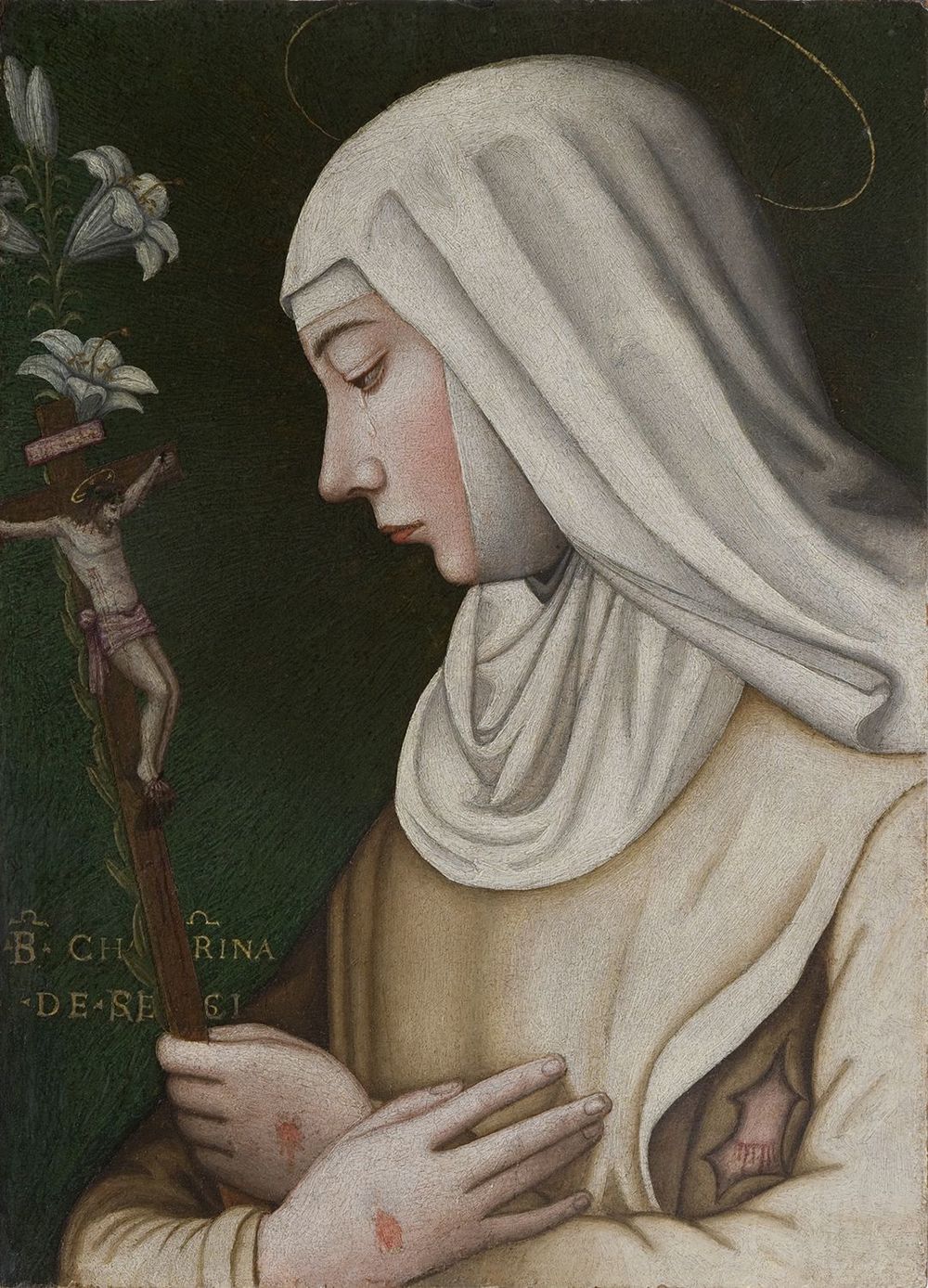
P.N. “But, whilst I weep for my lost work on this I must tell you that I wasn’t always locked-in. In my early life in the Convent, once I had established my template for paintings of one of our Patron Saints of Florence, Saint Catherine of Siena, I took literally hundreds of commissions and sales of this image and once they even allowed me to go as far afield as Rome to discuss a commission. Other women began to choose our Convent because it would enable them to paint. Ultimately, it was rumoured that there wasn’t a home in Florence that didn’t have one of these paintings in their entrance hall.
The money raised helped the Convent become self-sufficient and being able to paint gave the Nuns a sense of purpose and usefulness that was quite frankly, unobtainable through scrubbing floors and saying prayers.
A.G.”We couldn’t be much more different really! Whilst you were famous for your piety, and for your Religious work, I became notorious for my rape, my trial and the violence of the images I created after my dreadful experience with Agostino Tassi.
Seven-months that trial went on for – seven wasted months from 1611 into 1612 and then several weeks of agony whilst my fingers healed. The wretch accused me of lying and denied even being alone in the house with me! They tortured me by tying up my hands with ropes that very nearly dislocated my fingers …As a fellow artist, you can imagine how afraid I was that I would never be able to paint again?
Fortunately, the prosecutor allowed other witnesses and Tassi was uncovered for taking my virginity by force and other crimes ..not the least being his plan to murder his wife and committing incest with his sister-in-law! He even wanted to steal some of my father’s paintings – and they had seemed such good friends!. Tassi was only sentenced to be imprisoned for two years, but somehow he managed to get the sentence reduced and was at liberty, still carrying on in Rome, despite his sentence of exile, within a year.
My father was so embarrassed by the family scandal he had me married off and I, the victim, was the one to be exiled in 1612! Fortunately, my husband Pierantonio Stiattesi lived in Florence where I quickly gained good commissions from Cosimo II de Medici, Grand Duke of Tuscany and from the nephew of the Great Michelangelo, also called Michelangelo Buonarotti. I was the first woman artist to be admitted to the Florence Accademia di Belle Arti.
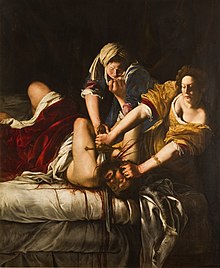 Judith decapitating Holophernes
I have tried to track the history of my first painting of Judith and Holofernes. I painted it in 1612, so I guess it was a revenge painting as Tassi had promised to marry me in 1511 and then changed his mind after he had raped me. They say Hell has no fury like a woman scorned – Tassi certainly got the message that I was kinda mad at him! I found that my second painting of this scene was purchased by Anna Maria Louise de Medici – I believe that she loved her own husband so maybe she bought it in memory of her mother – Marguerite Louise of Orleans (c. 1645–1721) who had detested her husband Cosimo III de Medici so much that after several violent separations she returned to France to stay in a Convent rather than live with him as her consort! It is now the only painting by a woman artist that is continuously on display in the Uffizi gallery and I am pleased to see that it still has the power to shock and horrify the visitors.

A.G So, returning to the reason that I got in touch, was excited to hear about the recent Restoration of your Capolavoro, The Last Supper, I am so pleased that the image has created excitement in the art world as well as highlighting the fact that women can paint a big picture and that women can collaborate on a large work in paint, as well as they can in needlework. The fact that the restoration was organised by Advancing Women Artists, a foundation established by women who have created a platform to promote women artists from across the ages, and that the four-year restoration was completed by a woman Rosella Lari, fills me with womanly pride – which I hope that you feel too”.
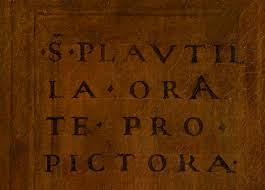
P.N.“I most certainly did!- I might have avoided Vanity but I certainly suffered from the Sin of Pride when I completed this work. I couldn’t prevent myself from writing S. Plautilla – orate pro pictora, which translates as ‘pray for the paintress” (NB specifically feminine!) on the wall behind the disciples.
I was proud then, and I am proud now – completely without any sense of guilt – I just hope that other women artists continue to believe in themselves and continue to produce works of art that they can be proud of putting their name to for centuries to come.

With my thanks to Advancing Women Artists for all their work in the maintenance of Art by Women, Kings High School for my interest in Walter Savage Landor and enabling me to win a biography of the writer in this year’s raffle, and Rosella Lari for her fabulous restoration.
Postscript The germ of this idea came from reading a couple of “Imaginary Conversations” written by an English writer who was born in a part of my old school in Warwick and who lived, spectacularly quarrelled with his friends, family and neighbours and finally died in Florence.
Walter Savage Landor (30 January 1775 – 17 September 1864) was one of the many British exiles who flocked to Florence in the 19th Century.

Landor had many quarrels with friends, foes, politicians and priests before he decided to leave England in 1815 and take his wife to live in Como. During the three years they were there he managed to attract unusual troubles when the notorious wife of the Prince Regent, Caroline of Brunswick., who had exiled herself to Como suspected and accused Landor of spying on her and sending messages home to her estranged husband!
Further troubles with the law ensued In 1818 when he wrote a poem in Latin insulting an Italian poet for being rude about England. Unfortunately, the libel laws in Italy would have caught him in whichever language he adopted, but his threats of giving a beating to the Regio delegate who accused him of the crime led to an order to leave Como. After trying Genoa and Pisa in 1821 he finally settled in apartments in the Medici Palace in Florence before moving with his wife and children to the Villa Castiglione, in Fiesole.
Many people believe that his life in Florence formed the most important phase of his literary career, as it was in Florence that he wrote his best-known works – the Imaginary Conversations. As a footnote, this was a favourite book of E.M Forster’s character Tibby in Howards End. The first two volumes of his Imaginary Conversations were published in1824, the second edition in 1826; and the third volume in 1828; in 1829 the fourth and fifth volumes were published and in 1846, the second combination of collected works.
His 156 Conversations involved people from across the spectrum of both time and place- Greeks and Romans, Husbands and Wives, Writers and Poets, Royalty and their Servants, Friends and Enemies, Sinners and Priests – some examples include:- Marcellus and Hannibal, Virgilius and Horatius, Earl Leofric and Lady Godiva, Dante and Beatrice, Machiavelli and Michel-Angelo Buonarroti, Henry VIII and Anne Boleyn.
Many of Landor’s Conversations were controversial – not entirely surprising from a man expelled from both Rugby School, and Trinity College, Oxford who went on to be banned from various parts of Italy, including banishment from Florence by the Grand Duke himself, for being a “dangerous man” with challenging opinions!
After a trip to England Landor returned to Tuscany declaring that “as the authorities dislike my residence, I will reside here permanently!” Fortunately for him – the Grand Duke just smiled.
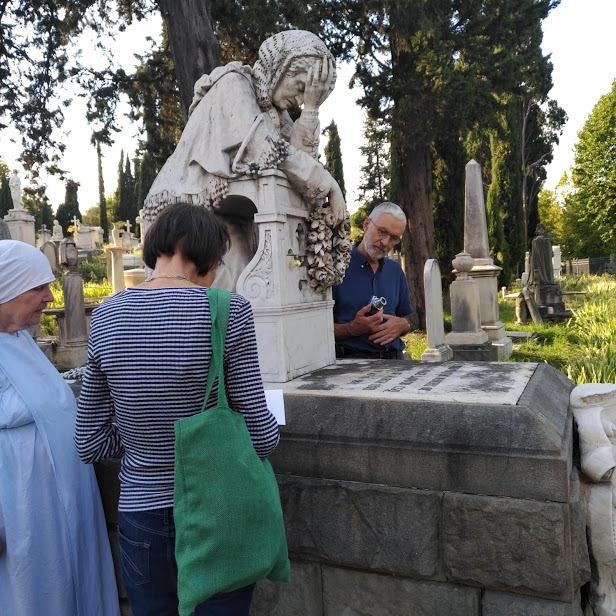
Landor’s wife, Julia, clearly felt badly let down by her husband, displaying herself on her tombstone with her despairing head held in her hands. Although she already had a younger lover herself, when Landor appeared to have been getting close to her German au-pair, their battles over the matter finished with complete separation.
Landor bought the Villa Gherardesca at Fiesole helped by a generous loan from Joseph Ablett of Llanbedr Hall, Denbighshire. Here, he had a dispute with a neighbour about water rights, which led to another lawsuit and a challenge, although the English Consul Kirkup succeeded in arranging the point of honour satisfactorily.
In 1858, with yet another libel act pending Landor returned to Florence in poverty, neither his wife nor his daughter Julia, were on speaking terms with him – his best companion in London had been a beautiful pomeranian dog, Pomero, that had been brought to him in London in 1848 as a gift from Julia in happier times. Landor had been overjoyed with this gift and encouraged the dog to sit on his head. It is believed that Charles Dickens based the character of Laurence Boythorne in ‘Bleak House’ on Landor – but he transformed the head-balancing animal into a canary.
Initially, he stayed with his son Walter at the family villa in Fiesole but not having money to pay for his “lodging” more rows and increasing financial difficulties ensued – In 1859 he left his own home without even taking clothing with him. Robert Browning wrote to explain his friend’s dire straits to his brothers who together arranged an annuity which enabled him to live independently for the rest of his life.
Robert and Elizabeth Barrett Browning moved to Rome in November 1860 but before leaving they made arrangements for Elizabeth’s own maid Wilson, to stay in Florence with her Italian husband and look after their elderly friend in a house they found for him in via della Chiesa. Sadly, all did not go well between the housekeeper and the poet and neighbours told tales of “plates and dinners flying out of the window“. The Brownings also bought Landor another pomeranian – called Giallo and Landor walked regularly with him in the street of the Oltrarno.
Landor had many friends gathered around him in Florence but in 1861 he lost several good friends including Elizabeth Barrett Browning. After the funeral, Robert Browning left Florence for good on 1st August 1861. Landor never saw him again, but Browning continued to manage his finances, again with help from the English Consul Kirkup, even his funeral and the cost of his headstone.
After Landor’s death Browning wrote “I have been more than rewarded for my poor pains by being of use for five years to the grand old ruin of a genius, such as I don’t expect to see again.”
