

Family Stuart connections with the Medici Family
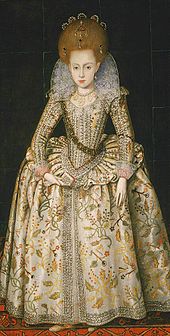
Elizabeth Stuart painted by English court painter Robert Peake in 1603
I have recently been reading a book by Nadine Akkerman about the life of Elizabeth Stuart (1596-1662)- the only daughter of James 1 King of the United Kingdoms of England, Scotland and Ireland – and was struck by the fact that her life plan was changed after the murder of King Henri IV of France.
Initially, a Protestant, Henri of Navarre gave up his religion and stated that “Paris is worth a Mass” in order to become the King of France. François Ravaillac, a Catholic fanatic, who still considered Henri a Protestant because he had introduced circumscribed toleration of the Huguenots through The Edict of Nantes, stabbed him to death in May 1610, the very day after the Coronation of his second wife Marie de’ Medici. A small link between the Medici and Stuart family but enough to pique my interest in the connections between the two families.
The curious connection was that the dreadful murder of a French King made British King James Stuart reconsider his plan to marry his child Elizabeth, then approaching 13 years old, to any of the many Catholic applicants for the Hand of his daughter. A healthy daughter of the King of the three newly-linked countries, Scotland, England and Ireland, made Elizabeth irresistible marriage material. She was already well educated, she generally corresponded with her father and brother in French, but also spoke several other languages, although she had been barred from learning Latin and Greek, as her father believed that “Latin had the unfortunate effect of making women more cunning” – perhaps due to the high jinx of his mother – Mary Queen of Scots.
Suggested partners for Elizabeth Stuart included a son of French King Henry IV and his wife Marie de Medici, but that connection was never made. Other contenders were the Duke of Savoy’s heir, The Prince of Piedmont Filippo Emmanuel. and in 1614 after the death of his 5th wife Margherita, even Spanish King Philip III asked for her hand in marriage. Two English noblemen also threw their hats into the ring but, back in 1608, Henri de la Tour d’Auvergne, Duke of Bouillion, and the Palatine Council had suggested the future Elector Palatine. Frederick. He had been one of the first proposals to the King and, ultimately, his fervent Protestant background made him the selected suitor.
A second reason for promoting Protestants, as opposed to Catholics, was that quite soon after their arrival in England King James and his family had already faced the challenge of the Gunpowder Plot of 1605. The Catholic plotter’s objective was to assassinate Elizabeth’s father and the Protestant aristocracy in the Houses of Parliament, then kidnap the nine-year-old Elizabeth from her base in Coombe Abbey, and place her as a Catholic monarch on the throne of England.
King James I, although the son of the very Catholic Mary Queen of Scots, had been brought up, far from his mother, under the formidable domination of the founder of the Presbyterian Church, John Knox, and once he became King of the three united territories he planned to maintain his influence in the Protestant world by forming an inseverable Protestant alliance.
Naturally, this didn’t please the Catholics.

The new King had already experienced a challenge to his crown from his first cousin, the English-born Lady Arbella Stuart, who was encouraged to marry Thomas Grey, 15th Baron Grey of Hilton, and together overthrow, and kill, the Scottish Stuart King and his family and thus secure religious toleration for Catholics in England.

Lady Arbella Stuart
Fortunately, for King James and his children, the conspirators were incompetent and Lady Arbella Stuart decided she had more chance of keeping her head on her shoulders if she passed a letter containing all the details of the plot to the Secretary of State Sir Robert Cecil ..…the infamous letter was written by Cecil’s brother-in-law and his wife, Lady Kildare, who was Princess Elizabeth’s governess. It was so fatuous Sir Robert Cecil laughed out loud when he read it – nonetheless they were imprisoned in the Tower of London to discourage others from plotting against the King.
Lady Kildare–Frances Howard in 1601
Having refused the offers of so many others, in 1611, after the unexpected death of 36-year-old Frederich IV,- Elector Palatine, King James I finally announced the arrangement of the marriage of his 13-year-old daughter to 14-year-old Frederich, Elector Palatine-in-waiting. Frederich and Elizabeth shared a common ancestor in Henry II of England and as a staunch defender of the Protestant faith, Henry would help James I to build his Protestant Alliance. Their extravagant wedding took place on 14th February 1613 at the royal chapel at the Palace of Whitehall and many members of foreign royal families came to the court of England to celebrate the union. The couple genuinely liked one another from the onset of their relationship and this love match also pleased the Protestant British public.

Elizabeth gave birth to three children in their first home in Heidelberg: Frederick Henry, Hereditary Prince of the Palatinate was born in 1614, Charles in 1617, and Elisabeth in 1619. In total, she had 13 children, of which only 6 outlived their mother.
 Frederick Henry, Hereditary Prince of the Palatinate
In 1619 Frederick was invited to become the King of Bohemia, after the Habsburg heir, Archduke Ferdinand, crowned King of Bohemia in 1617, was deposed as he was a fervent Catholic who persecuted Protestants in his Duchy of Styria.
Frederick accepted the job and another Stuart religious tragedy was set in motion when the heir Holy Roman Emperor Ferdinand II, would not accept his deposition. Frederick’s reign ended in November 1620 when the Bohemians lost the Battle of White Mountain. The Bohemian army proved to be no match for Emperor Ferdinand’s troops. The battle only lasted an hour and left the Bohemian army in tatters. an estimated 4,000 Protestants were killed or captured, while Imperial losses amounted to only about 700. The Catholic Emperor removed the religious right hitherto enjoyed by the Protestants in Bohemia and the protestant couple were dethroned
Elizabeth is remembered as the “Winter Queen“, and Frederick as the “Winter King”, in reference to the brevity of their reign, and to the season of the battle.
The best-known of Elizabeth’s children was Prince Rupert of the Rhine, the dashing Cavalier who supported King Charles I during the Civil War, but the child who made the biggest connection to the United Kingdom as it is today was her daughter Sophia. Elizabeth’s grandson by her daughter Sophia of Hanover succeeded to the British throne as George I, initiating the House of Hanover, which still leads down to our new King Charles III.

So, having missed the opportunity of being married to one of the sons of Marie de Medici, what became the initial connection between Elizabeth Stuart and the Medici? Very little, except changing the mind of the King with regard to the choice of Religion of the possible Husband for his only daughter, but, if we skip back a generation to James VI of Scotland. his mother made a much stronger connection when she became the daughter-in-law of Catherine de Medici – Queen of France,.
Elizabeth’s Grandmother, Mary Queen of Scots, born on 8th December 1542, turned out to be much less fortunate than Elizabeth in her personal selection of husbands.
Her father, King James V of Scotland. died when she was only 6 days old – so she became nominally Mary Queen of Scots from that moment.
In July 1543 Henry VIII of England became determined to marry his 5-year-old son and heir, Prince Edward, to the Scottish Queen and set up a union between the two countries. He signed a treaty on 1st July 1543, for Mary Stuart to come to England when she reached the age of 10 and marry Edward Tudor the following year. However, Cardinal David Beaton encouraged Mary’s mother Mary of Guise to repudiate the treaty and on 9th September 1543 the pair took the baby girl to Stirling Castle to be crowned in the Chapel Royal. In December 1543 the Catholic-dominated Scottish parliament repudiated Henry VIII’s treaty and thus negated the marriage between Elizabeth and Tudor Prince. as they renewed the “Auld Alliance” between France and Scotland, against their enemy, England.
Thus, on August 7th 1548 five-year-old Mary Queen of Scots was sent by her Catholic mother Mary of Guise to live safely away from the Scottish Protestant fanatics and maintain her Catholic family belief in France – King Henry II of France was delighted by the beauty of the child and placed her, and her 4 companions, also named Mary, into the household of his Florentine Queen Catherine de’ Medici where she lived in the warmth and luxury of many beautiful French Castles. As a clever child, she easily learnt French and other languages, including Latin and Greek, but, although she relearned her native language when she returned to Scotland she was never able to write well in English. One of the biggest changes wrought by her new life was the change of the spelling of her surname from Stewart to the French version of Stuart. She also adopted the spelling of her name to Marie whilst living in France.

Her first husband, Francis, the Dauphin was the firstborn son of Catherine de Medici. Aged 15, Francis was already weak but Mary was always tenderly fond of him and happy to be potentially blessed as Queen of both Scotland and France, although at the time of her marriage, there was no suggestion of her return to Scotland to pick up her other crown.

Mary had been happy in France and although she sometimes, encouraged by her rival Diane de Poitiers, looked down on Catherine de Medici as a mere banker’s daughter she had much to be thankful for. Catherine gave her daughter-in-law a gift of half of the jewels given to Catherine herself from the Medici Pope Clement VII as a dowry. Pope Clement VII had successfully arranged Catherine’s wedding to the second son in line to the French throne, who, unexpectedly, when his elder brother died from drinking cold water immediately after a strenuous tennis match, and then his father’s death after losing an eye in a jousting match, became the Valois King Henry II of France.
It is believed that Mary’s face was used as the model of Diana in the painting below by Francis Cluet, called The Bath of Diana – although it is unlikely that any of the 3 female nude images shown below were modelled directly by the protagonists, notwithstanding the rumour that the French court was famous during that period for what could be described as loose morals. A link to this painting suggests that Catherine de Medici and her rival for the love of Henry II, Diane de Poitiers, were the other female images in this allegorical painting.

After the early death of King Francis II in 1560 Mary Stuart was dispatched back to her own Kingdom of Scotland, where she soon met with the wrath of John Knox – already furious with the English Queen Elizabeth I, albeit that she too was a Protestant. He published his thesis in 1558 – His protest – famously known as “The First Blast of the Trumpet Against the Monstruous Regiment of Women” (SIC) was blazing against any of the Women who dared to rule over men.
Mary’s history is well known, with another two bad choices of Husband, first her cousin Henry Stuart, Lord Darnley, who sired their son Charles James who became King James I. On the 22nd July 1565 Lord Darnley was made Duke of Albany in Holyrood Abbey,- (please note this when we get through to the Young Pretender, AKA Bonnie Prince Charlie.)
Their son was baptised as Charles James Stuart on 17 December 1566 in a Catholic ceremony held at Stirling Castle. One of his godparents was Charles IX of France, the second son of Catherine de’ Medici so the families were still keeping in touch with one another!
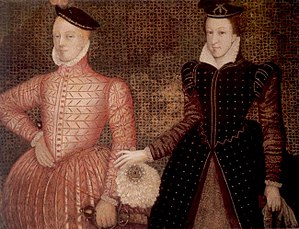
Darnley was desperately keen to become King of Scotland and thus, as a male, take precedence over his wife, but Mary had already begun to find his constant complaints intolerable, and the rougher wooing of James Hepburn, 4th Earl of Bothwell had begun to take her fancy.
Bothwell, was keen to improve his own status and offered to help her out of her predicament. He arranged an “accidental” explosion in the Palace Darnley was staying in – with suggestions that he was with his male lover. Her husband survived the explosion but was later found dead outside the building. Unfazed by this, Mary promptly married Bothwell, resulting in much bad feeling from her subjects and a scathing letter from Queen Elizabeth I writing to Mary: – “How could a worse choice be made for your honour than in such haste to marry such a subject, who besides other and notorious lacks, public fame has charged with the murder of your late husband, besides the touching of yourself also in some part, though we trust in that behalf false”
 Lord Bothwell
After many adventures, including imprisonment and escape from a Castle built atop a rock in Lochleven, Mary felt she might be safer in England and asked her cousin, Queen Elizabeth I to protect her – from her arrival in England she went from light imprisonment to total lock-up as her Catholic supporter’s efforts to help her to take over the throne of Elizabeth increased.
Sir Francis Walsingham, Elizabeth’s spymaster, uncovered several plots against her life, some of which were proven to have been agreed to by the desperately unhappy Mary, left wasting her life away in a variety of ever more dismal prisons.
Mary’s final tragedy was in Fotheringhay Castle after Queen Elizabeth had “mistakenly” signed her death warrant together with another large pile of papers. she later blamed her secretary, William Davison, for implementing it without her knowledge, but the decapitation had been completed before Elizabeth had time to change her mind.
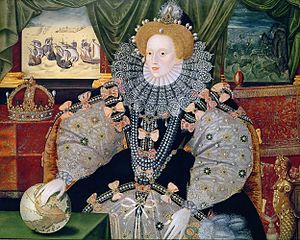 Queen Elizabeth 1
Just before Queen Elizabeth died in 1603 she acknowledged Mary’s son, James VI of Scotland, as her rightful heir to the English Throne. Beginning the Stuart Dynasty across the newly United Kingdom

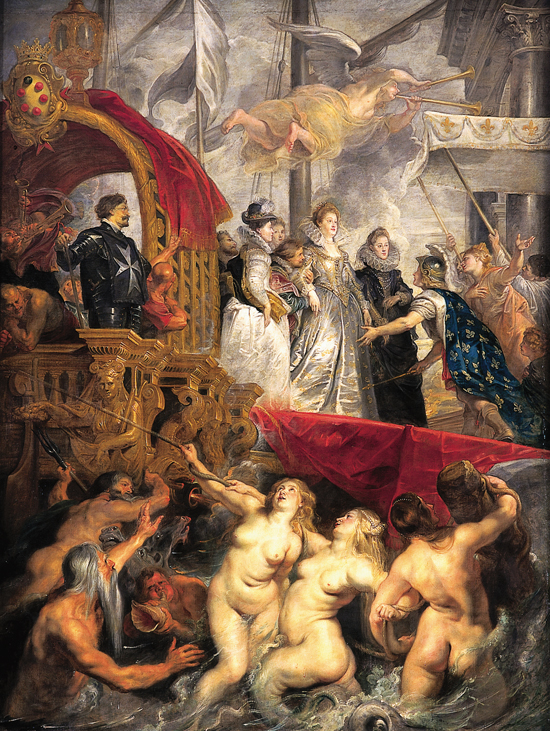
1610 – Looking into Medici life in France Queen Marie de Medici had troubles of her own – after the murder of her husband she became the Queen Regent until her son, still only 8 years old when his father died, came of age, but their relationship also became troublesome. After Louis XIII came of age at thirteen (1614), his mother refused to give up her position as Regent until 1617, when he was 16. Because of her Italian preference for Italian supporters her son Louis XIII of France didn’t approve of her choices as his Regent.
In retaliation, as soon as he became recognised as an adult he deposed his mother from the Court and sent her into exile in Blois…Although herself an exile she helped to organise homes for her children and her grandchildren until Charles II came back to England and the Stuart dynasty was restored.
The Duke of Mantua and his wife Eleanor de Medici
Friendly links from English Kings to the Medici family were maintained – in 1622 James’ eldest son, Charles, travelled across Europe in search of a suitable wife, he went with his friend the Duke of Buckingham and they had a very enjoyable trip. Amongst the families that they met with en route was the Duke of Mantua, Vincenzo Gonzaga (September 1562 – February 1612) and his wife Eleonora de Medici, who might well have mentioned that her sister French Queen Marie de Medici, had a pretty daughter of marriageable age called Henrietta Maria.
Prince Charles certainly paid attention to the Duke of Mantua and greatly envied the Duke’s magnificent collection of artworks bought from all over the world and others specially commissioned for his collection. In the long term, this visit proved expensive when the spendthrift Gongagas ran out of money and offered to sell their collection to King Charles I. Charles was able to buy the entire package to decorate his palaces across England and maybe even provide some art for his mother-in-law Marie de’ Medici.
Charles I and Henrietta-Marias marriage began with some difficulty, mainly because Henriette Maria spoke most of the time in French, and in order to improve her English King Charles, somewhat callously, dismissed all her French attendants. However, he did fall in love with her when she came to comfort him after the murder of his close friend the Duke of Buckingham.

The couple had nine children – three of whom became part of British Royalty, Princess Mary, (later Princess of Orange and mother of William III); James, Duke of York, (later James II); Prince Charles, (later Charles II); The baby in the painting below is Princess Anne. who died in childhood. The surviving youngest children were Princess Elizabeth and Henry, duke of Gloucester, who, after the Civil War were ultimately constrained to Carisbrooke Castle on the Isle of Wight, where Elizabeth died, Their final child was Henrietta Anne (aka Minette) who eventually married the French heir, Philippe of Anjou, in March 1661. The marriage made her the 2nd Lady of France but sadly, it was not a happy relationship.

The first five children of Charles Stuart 1 & Henrietta-Maria – daughter of Marie de Medici & Henry IV of France
Henrietta Maria commissioned portraits of her children to send to both her mother and her aunt to keep in touch with her family.
Little did she know in those good times, before Oliver Cromwell and his parliament had ordered the decapitation of another troublesome Stuart, her husband Charles, she would have to escape from England leaving her last baby, Henrietta Anne,(aka Minette) hidden in England until she was old enough to escape with her nurse, dressed as a boy!

Oliver Cromwell, as Lord Protector of the Commonwealth, raised funds for his work by selling the entire collection acquired from Mantua as part of what was known as the Commonwealth Sale. It raised money to maintain his Protectorate.

smart
There were certainly some bargains to be had-as an example-Rembrandt’s portrait of his mother above was bought for only £5.

Richard Cromwell
After Cromwell’s son, Richard, resigned from his unpopular Commonwealth role Parliament decided that they would like to bring the Stuart dynasty back into power – beginning again with Charles II and then his brother James, neither of whom had any legitimate issue. Hernietta-Maria her older children escaped back to Paris and were included as part of the French Court under the wing of their grandmother Marie de Medici.
Charles Stuart II was crowned King in 1661 with a retrospective right to the throne from 1649 when his father was executed. He was rather popular with the people, especially after he came out into the streets to help prevent any further spread of the Great Fire of London.
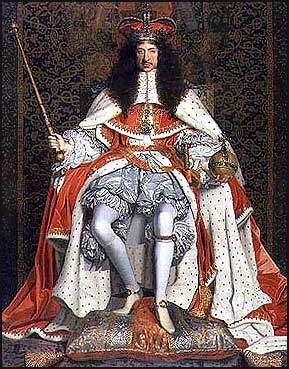
From his accession in 1660 Charles II recognised the need to develop good relationships with his nearby European neighbours and in 1682 he decided to pay tribute to the Medici ruler of Tuscany Ferdinand II. His plan was to give him a wood panel designed and sculpted by his protege Grinling Gibbons but progress was slow and by the time the gift was completed Ferdinand II had died. The gift was nonetheless given after 1685 by James II to Cosimo III Grand Duke of Tuscany. The Cosimo Panel is an allegory of art triumphing over hatred and turmoil – with doves of peace, crowns, feathers, olive branches and a four-leaf clover, plus an image of Cosimo himself.

Charles II had many mistresses and had sired many children but, because non of them were legitimate, after his death in February 1685 the throne was ceded to his younger brother James II.
James II
James II had two children with his first wife, an initially Protestant Anne Hyde, who turned to Catholicism in her later years. Both children were healthy girls but unfortunately, despite many pregnancies, neither of them was able to provide an heir who survived beyond 12 years old. Also, neither of them agreed with their father’s religion and In rebellion against his increasing Catholicism they and Mary’s Husband, William ultimately went into battle with him in Ireland, where he lost the Battle of the Boyne. Deposed from his throne he once again returned to France to join his mother and her youngest daughter Minette. After the unsuccessful invasion of 1715, as a strong Catholic James lived in Papal territory, first at Avignon (1715), then Pesaro (1717) and Urbino (1718)
Pope Clement XI initially offered the Ex-KIng James Francis Edward Stuart the Palazzo del Re in Rome as his residence and he also paid the cost of another residence the Palazzo Muti and donated a summerhouse near the shores of Lake Albano. He also performed the baptism of James’s son Charles Edward Stuart.
Pope Innocent XIII, like his predecessor, showed much support and allowed James to remain in Rome.

As a result of James’s deposition, the monarchy moved to Mary, the daughter of James II who had married William,(also the grandson of Charles I) who was the son of William II, Prince of Orange and Mary Stuart, daughter of King Charles I. Being rich as a King didn’t seem to improve the chances of a long life in the Stuart family – the second William of Orange never knew his father as he died of smallpox eight days before his child was born. When William was ten his mother also caught this disease, while visiting her brother (King Charles II) in London, and she too died young.
Anne succeeded her sister and was a popular Monarch but as she too died without an Heir the British throne moved back to the House of Hanover
The next unsuccessful attempt to regain the throne to the Stuart family was made by James Francis Stuart aka The Old Pretender -who was the son of King James II and VII of England, Scotland and Ireland, and his second wife, Mary of Modena.
He was Prince of Wales from July 1688 until months after his birth when he lost his birthright after his Catholic father was deposed and exiled after the Glorious Revolution of 1688. The Jacobites’ name comes from James – the Scots in particular supported the return of the Stuarts to the British monarchy. Despite some Scottish financial support, he was unsuccessful.

His son the Young Pretender Charles Edward Stuart made a famous attempt in 1745 to win back the Monarchy – initially successful, he fought his way south as far as Chester, but without the financial support he had been promised from France and Scotland he made a surprising volte-face and returned to Scotland, where he was finally defeated in April 1746 on the fields of Culloden.
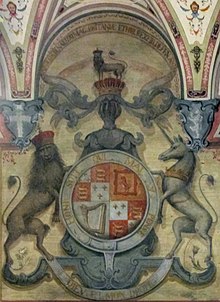
He escaped, with the romantic aid of Flora MacDonald, and returned to France initially, but after a brief unhappy time in Paris in 1777 he was encouraged to move to Italy, first Pisa then to Florence, where he purchased the Palazzo di San Clemente and lived with a new bride, Princess Louise of Stolberg-Gedern. They gave themselves the title of Count & Countess of Albany. He also had a fresco painted of own his coat of arms – in the name of Carlo Rex III – the same title as our new King of Great Britain!
Unfortunately, the Young Pretender, was no longer a bonnie prince when aged 55, he was a lot less pretty and had developed a problem with alcohol. As a result, his young bride, after a few relatively happy years, left him for poet and dramatist Vittorio Alfieri – regarded as the Italian equivalent of Lord Byron. She was able to get an official separation from her husband and after Charles died in January 1788 she was able to regularise their relationship.
Summary
So, let’s get back to my starting point, Elizabeth Stuart,
Under the English Act of Settlement 1701, the succession to the English and Scottish crowns (later British crown) was settled on Elizabeth’s youngest daughter Sophia of Hanover and her issue.
After the Coronation of her Grandson King George 1. Elizabeth arrived back in England in May 1661. she died of pneumonia in February 1662.
Prince Rupert was the only one of her sons to follow her funeral procession to Westminster Abbey to the chapel of Henry VII, created by Florentine Sculptor Pietro Torrigiani She was laid to rest amongst her ancestors and close to her beloved elder brother, Henry, Prince of Wales.
Sadly, the Medici connection to British Royalty derived from Henrietta-Maria died out in 1714 with the death of Queen Anne.
In August 1714, Sophia’s son (Elizabeth’s grandson) George I had ascended to the British throne, making the current Royal family all his descendants and hence, also descendants of the Winter Queen Elizabeth Stuart.
Gerrit van Honthorst – Triumph of the Winter Queen painted 1636
It seems that the Stuarts have won! 

Unsure about this Blog? Just a Scotswoman looking for a new angle!
Thank you for your message,
I already have a manager for my much loved but rarely used website -I have no legal right to have customers now as Brexit made my Italian
business illegal – therefore I have closed my company and only use Yalladog as a Blog page.
Thank you for your message,
I already have a manager for my much loved but rarely used website – I have no legal right to have customers now as Brexit made my Italian
business illegal – therefore I have closed my company and only use Yalladog as a Blog page.
Thank you for your message,
I already have a manager for my much loved but rarely used website – I have no legal right to have customers now as Brexit made my Italian
business illegal – therefore I have closed my company and only use Yalladog as a Blog page.
Hello,
I’m Neil, an English content translator. I excel in translating content from other languages to English language. I can translate blogs, articles, e-commerce product descriptions, website content, business listings, newsletters, brochures, social media captions, LinkedIn content, E-books, marketing materials and many different types of content with accuracy. With thorough editing & proofreading, I ensure fluency, and linguistic integrity in the translated content.
My rate is USD 40 for every 1000 words of Translation.
Feel free to email me at Outsourcingprojects112@outlook.com with any current requirements.
Thanks for the thought but I do not need to have any of my Bogs translated but best of luck with your work
I noticed an issue on your website, I’d like to help fix it for you here: https://alexholme.com/
Thank you for the Heads UP – my media support designer usually picks up issues on my website – I will ask her to take a look at it