
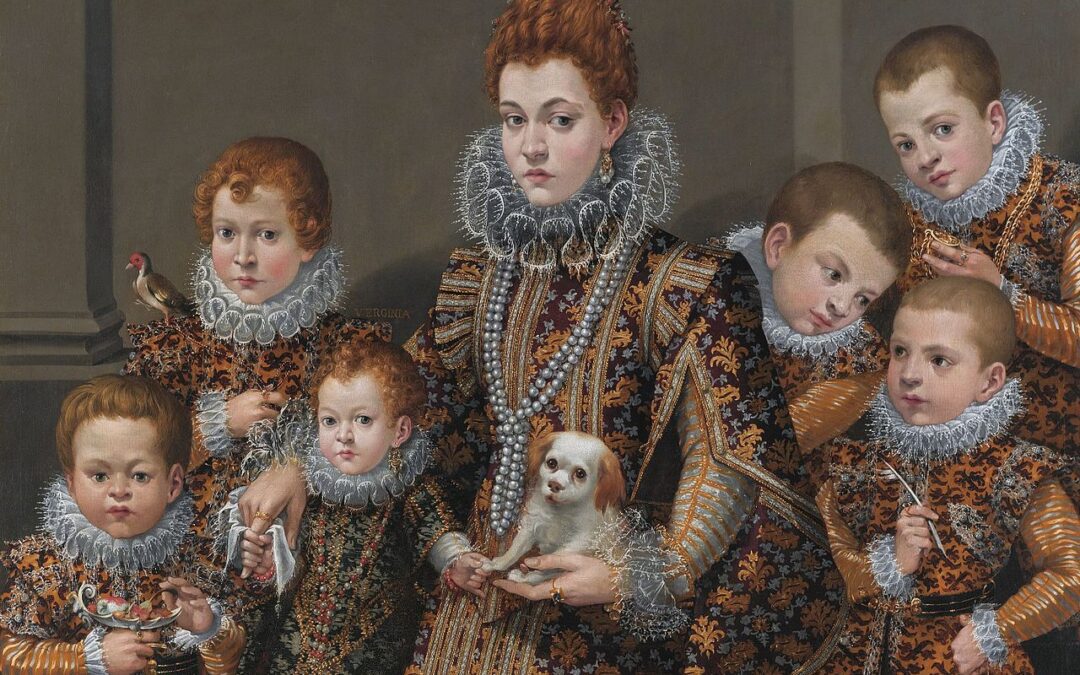
Lavinia Fontana painting of the Maselli family
Lavinia Fontana (born 24/81552 – died 11/8/1614) appears to me to have been the ideal artist to undertake this complicated family portrait.
In the first place her father, Prospero Fontana, (1517-1521) was already a well-known painter in Bologna. In the 1550s, Propero Fontana painted Pope Julius III‘s portrait whilst he spent some time in Rome. He encouraged his firstborn child to learn to paint with him and even allowed her to attend art classes at the University of Bologna. She was listed as one of Bologna’s ‘Donne addtrinatte’ (women with doctorates) in 1580.
Prospero initially needed Lavinia to support his own work, but he quickly recognised her skill as a portrait painter as well as her ability to earn her own income! Prospero valued his daughter’s work so much that before they got married her husband, artist Gian Paulo Zappi was obliged to sign a contract confirming that the couple would continue to live in her parental home as the family breadwinner. To do so she would be allowed to accept commissions and paint whatever and wherever she wished to. I feel sure that this freedom to paint was fortunate for the talented Lavinia – but, I suspect, was also advantageous financially to Prospero himself. Her husband Zappi might not have been so happy to be seen as an also-ran artist, but he kept to his contract and Lavinia didn’t disappoint her husband as she gave birth to no less than 11 children, although sadly only three of her children, Flaminia, Orazio and Prospero, outlived her,
Her Family Portrait (1585- 1590), shown below maybe comes from a collection of earlier sketches because at least two of those portrayed were already deceased by the date of the painting. Surrounded by the darkness of a Crypt her deceased grandfather is fondling his faithful dog, her father Prospero, fashionably dressed in the centre is stretching out a willing hand to help the family. On the right side of the painting, her mother, Antonia de Bondaris, is also fashionably dressed and wearing coral for protection, with a gesture of peace, or salvation, beside her grandmother. The old lady is clasping a handkerchief, as many fine ladies did but which was also sometimes shown in portraits to indicate death and mourning.
Lavinia potrays herself as the innocent child, dressed in white and holding open her Bible, or Book of Hours, to show her spirituality. She is also wearing coral for safely and perhaps displaying her trustworthiness by laying her hand on her heart as she keeps her promise to look after her family and provide for them all in the future?

a Painting of Lavinia Fontana as a child surrounded by her family
When Lavinia became famous in her home town and commissions flourished, it became the turn of her husband to work on articles of drapery and ornamental details on Lavinia’s work. Both her father and her husband helped to promote her works and enhance her reputation as a skilled painter.
As her fame grew beyond Bologna, and the demands for her work increased, she gained the patronage of the Buoncompagni, of which Pope Gregorius XIII; 7 January 1502 – 10 April 1585 was a member. Her work included this fine portrait of Pope Gregory XIII shown below.
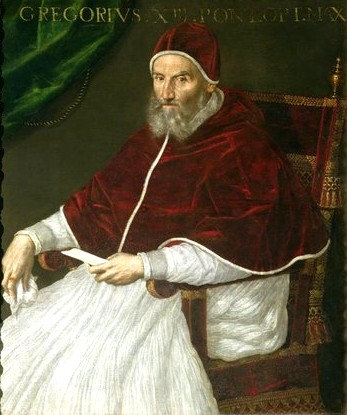 Portrait of Pope Gregory XIII by Lavinia Fontana
In 1603, after the death of both her parents Lavinia accepted the invitation of the new Pope Clement VIII for her family to come and live and work in Rome. In total, she worked for 5 Popes throughout her career.
One of Lavinia Fontana’s most original commissions was undertaken soon after she arrived in Rome with her husband and surviving children in 1603. It is a tribute to her attention to detail and speed of working that she was able to complete the work. Having given birth to 11 children and lost 8 she might have felt sympathy with her sitter, Bianca degli Utili Maselli, who had already given birth to 18 children, and she, like Lavinia, had lost most of them, The final one was born in September 1605, when Bianca was only 37, but both mother and child died during the delivery of the unfortunate child number 19.

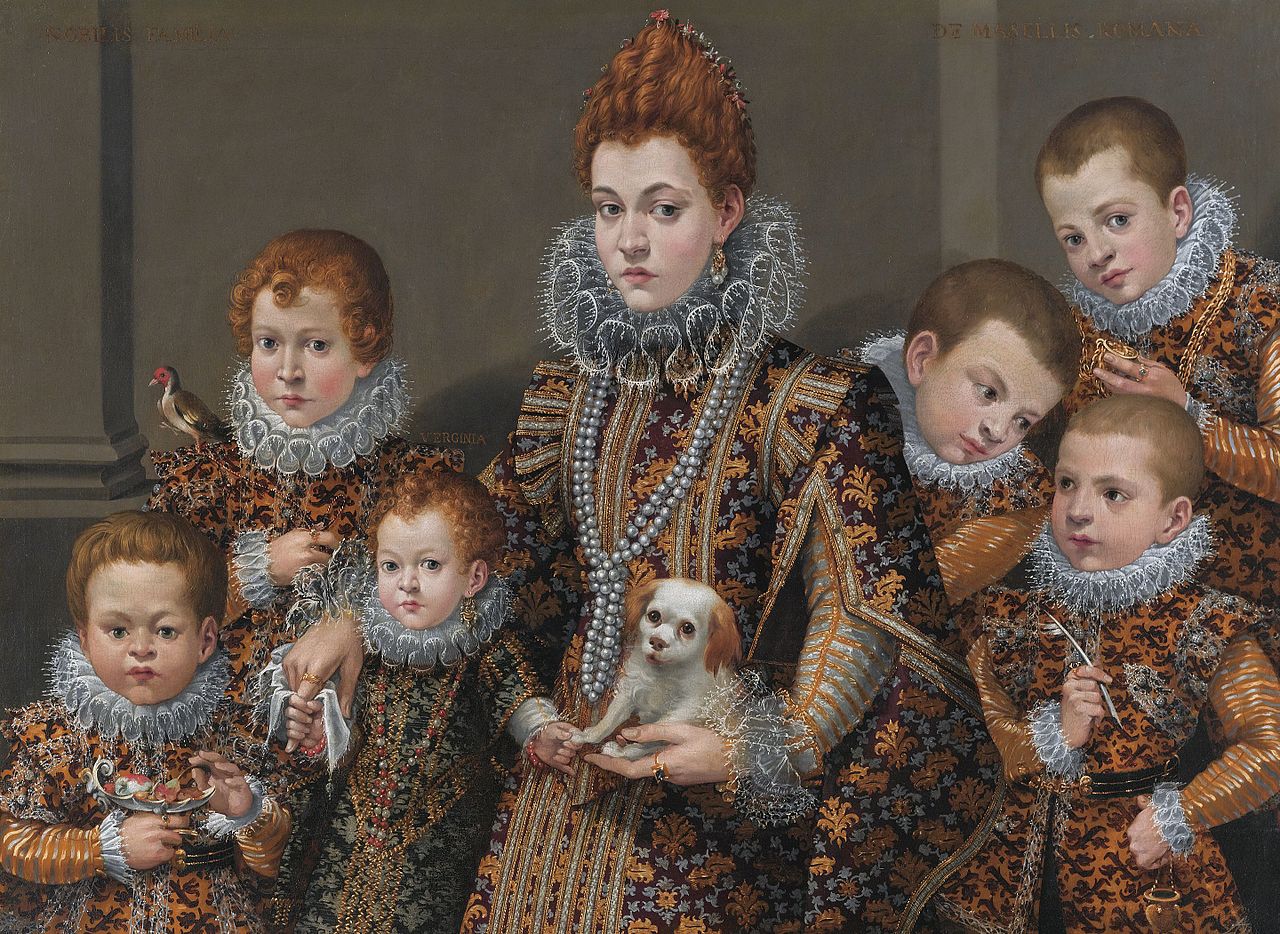
This complex image, also shown above, displays the six surviving children of Bianca degli Utili Maselli.with their mother and her faithful dog. These portraits were defined in the sale of the work by Sotheby’s as Bianca with her five sons and her daughter Verginia, whose name is written above the shoulder of the older child standing beside her. This taller child has long curly red hair like her mother and sister so my initial perception was of her as a young girl but Sotherbys decided that all the children except Verginia were boys because their suits were all made of the same brocade pattern. This child, with a Goldfinch perched on their shoulder, is probably destined for the church, the Goldfinch being a bird that was regularly used as a symbol of Salvation through the Blood of Christ. In many Renaissance paintings, these red-headed birds are shown in the hands of baby Jesus, John the Baptist or Noble Children to symbolise either The Passion or the second child’s destiny as a Priest or a Nun. The other taller boys all have their hair almost shaven but based on height the child on the left could be defined as the second oldest, and therefore destined for the church. The Goldfinch is also tethered by a golden thread to the ring on the index finger so neither party can escape their destiny.
Mother Bianca is also holding a handkerchief in her right hand so it is possible that this painting was completed after her death in September 1605?
 Giovanni di Medici with a Goldfinch – 1543 – by Bronzino
The other children also have some description of their future. The tallest boy at the back seems to be holding a small golden purse on a golden chain, perhaps a sign that he is due to inherit the family fortune? The child below him has a quill pen and an inkpot, maybe to be a writer or simply a scribe, and the shortest one on the left seems to be filling his face with sweetmeats – he certainly seems well fed!
We know the provenance of this painting thanks to the Sotheby sale. Verginia, may have been the key subject of the painting as she is the only one whose name is written on the painting. She is also the one whom her mother is holding protectively close and who, like Lavinia herself in her own family portrait, is wearing coral, which was used as an amulet, a preservative against the “evil eye” and ill health. Sotheby’s maintain details of important old master painting and sculptures that they sell, including where they have come from. In this case, their records show that Verginia married Fausto Bartoli and as she was believed to be the key subject, she inherited the painting and it was kept in her family home in Rome. Their daughter, Maria Felice who married into the Marchetti family, (quite a lot of choices here!) inherited the painting and it was kept within the family until the sale through Sothebys, New York on 26th January 2012.
The painting was sold for US$602,500. which was three times the initial estimate of US$200,000
There is an epigraph on Bianca’s tomb which suggests that she was born in Florence. She was married in 1603 to a Roman Knight called Pierino Maselli, This was a noble family name hailing from Piedmont. It is a patronymic surname, ie. similar to Johnson meaning son of John, MacDonald being the son of Donald and O’Brien being the son of Brian. The surname Masselli was derived from the first-name Maso, which is the short form of the personal name Tommaso.
To Art Historians probably the best-known member of the Masselli clan would be Tommaso Guidi Masaccio, born 1401, in Florence, his short career ended in Rome aged only 26 when he was rumoured to have been poisoned by a jealous competitor. Working in Florence before he left to die in Rome he completed famous works in Santa Maria Novella and the Brancacci Chapel. His companion in the Brancacci Chapel was also a Thomas known as little Tom – Masolino.

Self-portrait of Masaccio in Brancacci Chapel
In summary, these two Renaissance women had a tough life when it came to childbirth and bringing up children but Lavinia Fontana at least had her work, which she enjoyed and was recognised for. It is clear from the price paid for her painting of the Masselli family that her work is increasingly acknowledged and well valued.
I would like to pay tribute to these two strong and brave ladies. and to The British Institute in Florence for their wonderful Art History series of lectures, and in particular to Caterina Romei who introduced me to this painting.

Hi Penny
A beautiful, deeply researched essay. Thank you,
Best wishes, Stephen
THANK YOU STEPHEN, I wrote a reply to this before but it seems to have disappeared – good to know that you are out there!
Penny, your knowledge, and ability to express it, knows no bounds! Non vedo l’ora per la primavera 2022 a Firenze!!
Always great to hear from you Barbara – I cant wait to see you back in Florence too. I must get round to writing some more Blogs!