
26.7.2011
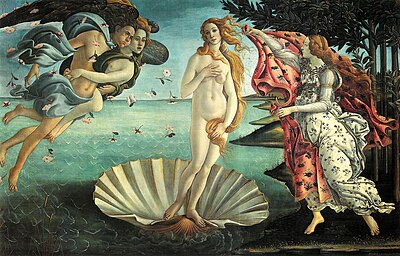
One of the most popular paintings in the Uffizi in Florence – this enigmatic image of Venus (or Aphrodite as she was known in Greece) – painted by Sandro Botticelli in 1483 is almost impossible to stand back from and study from a distance.
It is always surrounded by tourists and by tour guides explaining it to groups – a pity, as it is worthy of study.
The basis of this painting is reputed to be part of a poem – Stanze per la giostra –by the Renaissance scholar Angelo Poliziano – a friend of Lorenzo (il Magnifico) di Medici and the professor who taught his children – he is shown below in the fresco by Ghirlandio in the Sassetti Chapel in Chiesa Santa Trinita with Lorenzo’s son Piero di Medici – latterly suspected of killing both his former tutor and his friend and possible lover Pico della Miradola by arsenic poisoning! (Yes – a bit extreme as a reaction to too much philosophy and poetry – there was more to it than that – but nothing to do with the Birth of Venus!)

The model for Venus in this painting has traditionally been associated with Simonetta Vespucci – who had been a muse for Botticelli, and was seen as the model for female beauty throughout Florence – especially for the Medici family for whom this painting had been created. There is added credence to this suggestion from the fact that she was born in the Ligurian fishing village of PortoVenere – called Port of Venus because there was a little Temple to Venus there from 1st Century BC.
The other model for the pose of Venus in the painting was possibly the Medici Venus – a first century BC statue depicting Aphrodite in a Venus pudica pose. It is actually a marble copy of an original bronze Greek sculpture, that Botticelli would have has an opportunity to study whilst visiting the sculpture school or the Platonic Academy which flourished at the family home of the Medici in Florence.

The unusual feature of Botticelli’s early paintings is that they are based on mythologies, not religious paintings – which at the time must have itself been something of a shock to people outside the Neoplatonic, Humanist circle of friends of the Medici.
The Renaissance marked a huge sea change in ideals and the Philosophy changed from living to please God to gain a future life in Heaven towards Humanism where man had one life and would best please God by living it well. Plato argued that contemplation of physical beauty allowed the mind to better understand spiritual beauty. So the Neoplatonic reading was that looking at Venus, the most beautiful of goddesses, might create a physical response in viewers which then raised their minds towards God and his divine love!! (I am sure that happens to readers of the Sun too!)
Botticelli’s early style was to create visual poetry, unlike Ghirlandaio and even his own teacher Fra Filippo Lippi, he was not trying to construct space within the picture frame and he made no attempt to model solid three dimensional people; instead his figures float flatly on the front of the picture against a decorative landscape backdrop with their form defined by a thin outline.
The story of the Birth of Venus is well described below by a Homeric hymn but it’s relevance to the painting is disputed as the poem was only published, by the Greek refugee Demetrios Chalcondyles, in Florence in 1488 – five years after the painting was completed as a wedding gift for Lorenzo di Pierfrancesco de’ Medici in 1483.
Of august gold-wreathed and beautiful
Aphrodite I shall sing to whose domain
belong the battlements of all sea-loved
Cyprus where, blown by the moist breath
of Zephyros, she was carried over the waves
of the resounding sea on soft foam.
The gold-filleted Horae happily welcomed her
and clothed her with heavenly raiment.
Portrait of Demetrios Chalcondyles by Ghirlandiao

Much much later, another lover of Tuscany – Percy Bysshe Shelley
also wrote of the birth of Aphrodite – maybe based on the Botticelli painting?
THE BIRTH OF APHRODITE
Look, look why shine
Those floating bubbles with such light divine?
They break, and from their mist a lily form
Rises from out the wave, in beauty warm.
The wave is by the blue-veined feet scarce press’d,
Her silky ringlets float about her breast,
Veiling its fairy loveliness, while her eye
Is soft and deep as the heaven is high.
The Beautiful is born; sea and earth
May well revere the hour of that mysterious birth.
Percy Bysshe Shelley
By some quirk of fate Shelley himself suffered a mysterious death connected with water. On 8 July 1822, less than a month before his 30th birthday, Shelley drowned in a sudden storm while sailing back from Livorno to Lerici.
There has been a lot of dispute about the cause of his death – suggestions of incompetency, foul play, piracy and even in a 2002 novel by Julian Rathbone‘s A Very English Agent, a 19th century government spy Charles Boylan, tampers with Shelley’s schooner Don Juan on orders from the British government, thus causing his death.
What is certain is that his early death – and passion for Italy – made him a very Romantic poet indeed!

Shelley’s Tomb in Poets Corner in Westminster Abbey
But doth suffer a sea- change
into something rich and strange.

So finally – we get to the book – if you are visiting Florence and want some well researched background reading on Renaissance life – money, cloth, childhood, marriage, prostitution, sodomy, Savonarola and his whining children, nuns and painting – all human life is featured in Sarah Dunant‘s marvellous “The Birth of Venus” – I cannot recommend it highly enough – and you can buy it through the Amazon link “Recommended Reading” on my site
Her other books are good as well!



“The Beauty comes, and had I tongues of fire,
So many songs did Beauty e’er inspire,
Who sees her, of his wits is dispossessed,
And who possessed her was too highly blessed…”
Interesting, however Shelley is not buried in Westminster Abbey— he’s buried in the Protestant cemetery in Rome, which is where the photo is from.
Thank you – Yes, of course, you are correct, most of his ashes were buried in the “Non-Catholic” Cemetery in Rome whilst his heart was buried in St Peter’s Churchyard, Bournemouth, Dorset, England. It often bothers me how people decide what part of a cremated – or in Dante’s case seriously corrupted – body is the heart when they decide to bring it “home”?