
31.711
Symbolism in art was an important movement in the 19th Century – but it certainly wasn’t invented then!
Symbolism was very big in the Renaissance – in Religious Art, (lilies, pomegranates, goldfinches,etc) – and in the reincarnation of 2nd Century BC Greek and Roman mythology by Botticelli , (apples, arrows and zephyrs) Also with the Astrological signs – including the goat of Capricorn, which was one of the 48 constellations listed by the 2nd century astronomer Ptolemy – and still used today.
A Capricorn was a mythical animal with the forepart of a goat and the tail of a fish that has been found on Greek and Roman coins dating back to 7c BC . Capricorn literally translates from Latin as “goat horn.” – which could also refer to the cornucopia or horn of plenty – another symbol of abundance and munificence Grand Duke Cosimo 1 chose to demonstrate as symbols of Florence during his reign.


These coins above were dedicated to Neptune, protector of the Roman Emperor.” As we know Neptune was the God of the sea – and he was also the God of horses, and the first coin shown above is a hippocamp, with a horse’s forepart and a fishy tail, and the second coin shows a capricorn, with a goat’s forepart and a more stubby fishtail with a trident-shaped tail fin.
Bearing in mind that our old friend Cosimo – Grand Duke 1 of Tuscany was born under the sign of Capricorn -and he was also keen to depict himself as Neptune, he was particularly keen to invoke this Imperial Goat Godfish symbol as an insignia for himself – so there are plenty of examples of goats with fish tails dating from his rule in Florence!
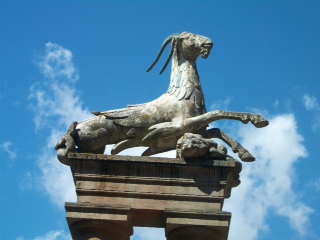
Capricorn the Sea God
This handsome chap is one of pair guarding the gates entry to the water feature where the precious lemons were kept in the Boboli Gardens .
Also known as Capricornus – this sea goat God is one of the 88 modern constellations. This constellation is located in an area of sky called the Sea or Water, consisting of many water-related constellations such as Aquarius, Pisces and Eridanus. The planet Neptune was discovered in this constellation by German astronomer Johann Galle, in 1846, – how excited Cosimo 1 would have been if he had known that this astral link between his symbol and the Sea God was also possible!
Another interesting astrological connections is that In Chinese astronomy, constellation Capricornus lies in The Black Tortoise of the North
Grand Duke Cosimo’s other favourite symbol was that of the tortoise – which appealed to him because it supported his motto Festina Lente ( “Hurry up – slowly” ) The Duke chose a depiction of a tortoise with a sail on its carapace as his ‘seal‘ and it is reproduced more than six thousand times all over the Palazzo Vecchio. There is even a free childrens expedition to the Old Palace where they are encouraged to go on a “tortoise hunt”around the building. It must be booked in advance
Info: Children’s Museum
Ph.: +39 055 2768224 – 055 2768558
Email: info.museoragazzi@comune.fi.it
Web: www.museiragazzifirenze.it
Personally I am off to seek for more Goats with fishy tails to photograph – and plan to leave Cosimo in peace next week … His second son Ferdinand – the Cardinal turned Duke – after the unfortunate death of his brother Francesco – will be my quarry!

Trackbacks/Pingbacks