
Andrea Palladio – (30 November 1508 – 19 August 1580) and five villas in the Veneto

I am not planning to write a treatise on Palladio as I am only just beginning to get to know the man and his works – and there is plenty of such material already out there. Suffice it to say that he influenced many great architects not only through the beauty and symetry of the villa’s he created but even more through the books he wrote describing the principles of his creations. I Quattro Libri dell’Architettura -the four books of architecture.
Our personal voyage of discovery began this Easter weekend when , taking advice plus a very, very large book with all sorts of notations and recommendations from our friend Kath, we progressed from Mantua into the Veneto and managed to visit five of the many Villa’s that Palladio worked on in his career.
We started in another pretty walled town, which is called Montagnana searching for the house of the Pisani.
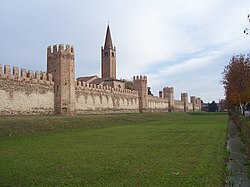
Montagnana from outside the walls
Having walked under the loggias all the way through the walled city we found the house situated outside the walls on the other side!
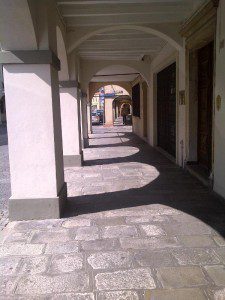
Montagnana-under a loggia
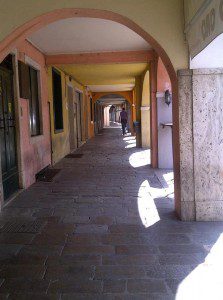
under a loggia
However we had tried their local speciality cheeses, sweet prosciutto and delicious warm bread on our way through- so well worth the detour!
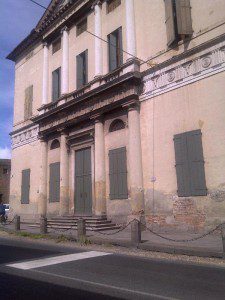
The house of the Pisani evidently had seen better days, it is now based on a road junction and a significant part of the original design seems to have been lopped off – but it’s charm was maintained and the symmetrical design can be seen better from the rear!
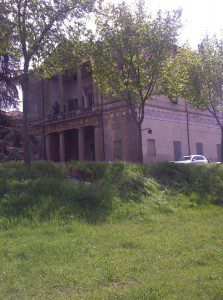
Our next quest was the Villa Poiana in Poiana Maggiore, near Vicenza – the home of the Knight and soldier Bonifacio Poiana who after the war against the League of Cambrai gave up his arms and devoted himself to agriculture. His home therefore, like so many of the period, has a long narrow interior with windows on either side of the central rooms facing the road = commerce – and the fields = agriculture!
We were able to visit the interior of this house – and see some models of other Palladio residences inside. Having been allowed to decay Villa Poiana has been restored over the past ten years and is now open to the public.

Pojana Maggiore- front
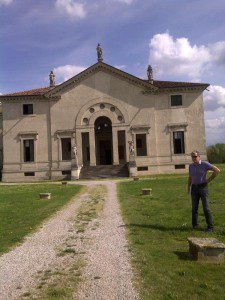
Moving quickly on we found our second Villa Pisani in Bagnolo – in rather better condition and probably a better example of Palladio than our first villa!


As with most of these Villas one can see from side to side across the villa and the entrance hall stretching between was very beautiful.
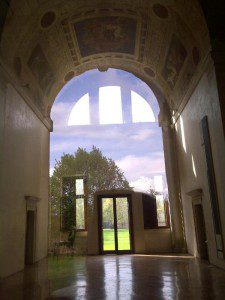
Villa Pisani in Bagnolo
Next villa was Villa Saraceno in Finale – another agricultural building that had fallen into decay until someone realised that all the visitors in search of Palladio must have a value and now the property can be rented or visited. The Villa was built c.1550 for Biagio Saraceno, a minor nobleman from Vicenza, to be both a country home and a working farm – the original plan appears to have been to have a similar farming wing on both sides of the house but there is no evidence that this was ever completed.

The back of the house shows the simple symmetry of Palladio’s design
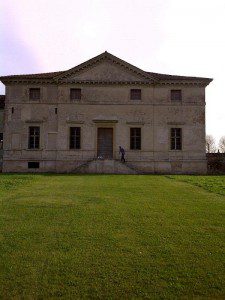
Campiglia dei Berici- villa Saraceno
Finally it was beginning to get dark when we got back to Fratta Polesine – to find a village stuffed full of 16 century villas – including Villa Badoer – our last – and one of the prettiest of the villas seen on this trip.

This villa is unusual in having curved collonades on the side wings –

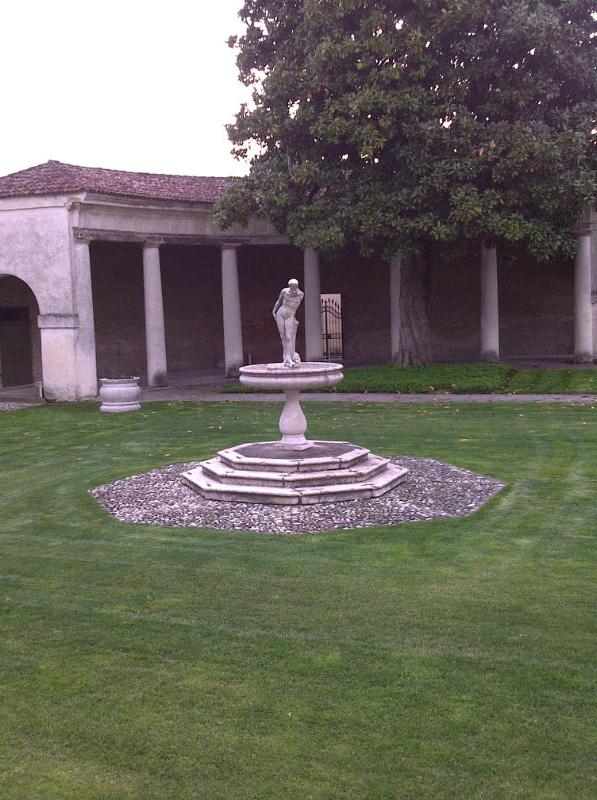
and, at last, we have a complete design with both wings in place – and – bringing deep joy to my husband’s heart a large luscious lawn!
Fratta Polesine- Villa Badoer

Trackbacks/Pingbacks