
26.05.12
The name Dominican originates from the order of Saint Dominic , a Roman Catholic religious order which was approved as a Mendicant order by Pope Honorius III (1216–27) on 22 December 1216 in France.

The name is also used to describe the order as the Hounds of God – translating the Domini canes, or Cani di Dio into what could have been seen as a pejorative term indicating that they were fighting dogs – but remember that one of their most famous members, Savonarola, was certainly always game for a battle and not even afraid to take on the mighty Medici.
So, searching for Last Suppers in the cloisters of Santa Maria Novella I was surprised to see the Dominicans graphically rejoicing in their title of God’s Dogs and attacking most ferociously some milder looking brown dogs – or wolves – in their territory.
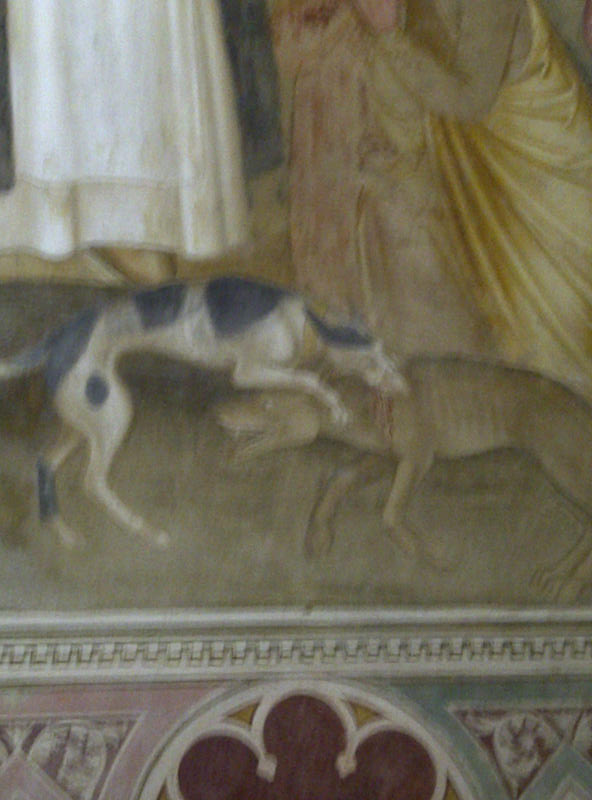
The black and white Cani di Dio attack the brown Franscicans
So who are the underdogs in this battle? Well, it seems that there were religious wars even within the City because the Dominicans didn’t like the other Mendicant religious order of the Franciscans infiltrating their territory – even although both orders were allowed out of their Monasteries to heal the sick and spread the word of Christ – they were none the less competing for rich converts – who would give the Order all their money , which was desperately needed to cover expenses, before taking to the road with the simple friars! Roberto Rossellini’s 1950 film franscesco giullare di Dio shows what happens to the group when the money runs out!
The Franciscans were known for their simple brown habits and even more severe vows of poverty – so it looks as if this milder, less provocative order, is literally getting it in the neck in the fresco above St Francis.
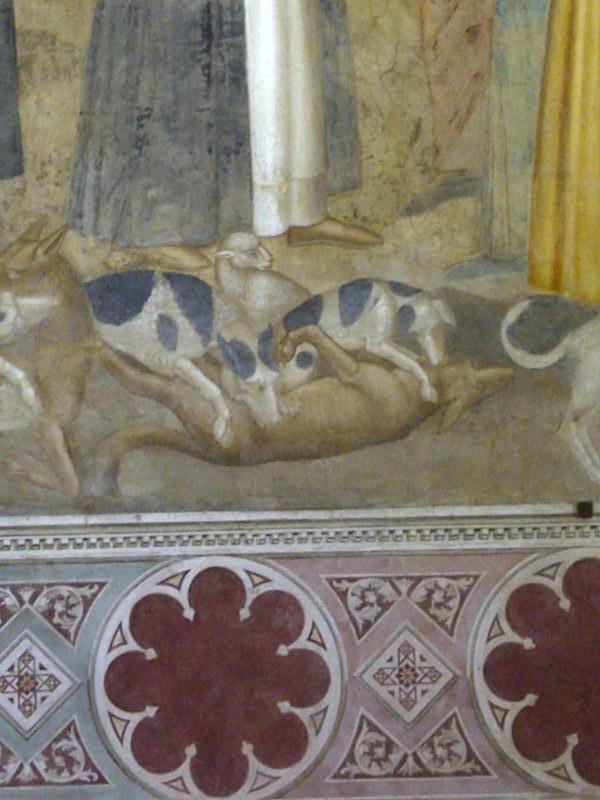
The black and white Cani di Dio attack the brown Franscicans
And the poor creatures aren’t doing much better in this picture above either – definitely a warning off for the poorer boys on the block!
This fresco was done between 1367 and 1369 by Andrea di Bonaiuto in the convent’s chapter room, now erroneously known as the ‘Spanish Chapel’:
It is a masterwork without doubt, with the scenes of the Passion, Crucifixion and Descent of Christ into Limbo on the altar wall, whilst on the entrance wall are Scenes from the life and miracles of St Peter Martyr and the right-hand wall there is an Allegory of the Church Militant and Triumphant, and the left-hand wall the Triumph of St Thomas Aquinas.
The segments of the vault show the Resurrection, Ascension, St Peter’s boat and the Pentecost – NB Michelangelo – the whole massive chapel seems to have been completed in only 2 years!

If you are ever trying to spot St Dominic in a painting he is tonsored, dressed like a penguin, and often has a dog with him as an attribute – not to be confused with St Peter Martyr who will also be dressed in white with a black cloak – but he usually has a knife in his head!

St Francis is much easier – often surrounded by birds and animals, also tonsored but he has the stigmata as well, he wears the simple brown habit with a belt with three knots representing the trinity.



Trackbacks/Pingbacks