
Mass at The Florentine Badia can be one of the most moving and wonderful experiences in Florence – but it is not all about the music – there is art in the old church too
The Apparition of the Virgin by Filippino Lippi is one of his most admired works. Initially looking like a fairly normal day out in the Tuscan countryside if you look closely you can see – hidden in the rocks behind St Bernard a couple of ghostly devils that had hitherto been troubling St Bernard – but the visit of the Virgin to the Saint dispels the demons.

Bernard of Clairvaux, (1090 –1153) was a French abbot and initiated the reforming Cistercian order – he can be recognised in paintings through his attributes – usually wearing a white Cisterican habit he is accompanied by a devil on a chain and sometimes a white dog
A scroll on a rock contains a verse by the 3rd century AD stoic writer Epictetus: Sustine et abstine (“Carry on and abstain”), a hint to Bernard’s teachings
The painting is found in the Francesco del Pugliese Chapel of the Badia Fiorentina and the praying man in black and red is the donor Francesco del Pugliese’s son Piero.
Other important painting of this saint is the Madonna and Child enthroned with Saints by Raffaellino del Garbo, in the Corbinelli Chapel, Church of Santo Spirito in Florence – He is on the right hand side with his chained devil at his feet – accompanied by patron saint of Florence, San Lorenzo, with the grid on which he was martyred, St John the Apostle with his eagle and his book to show him as the writer of the Gospel of St John, and St Stephen with the stone of his martyrdom hitting his head.
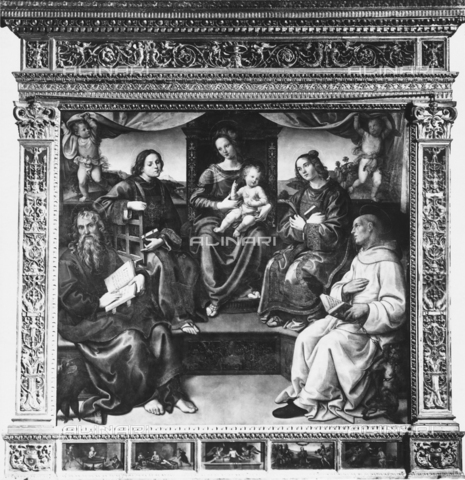
Raphaelino Del Garbo was one of the nicknames of Raffaello Capponi; aparently given too him for the graceful nicety (garbo) of his earlier works. He has also been called Raffaello de Florentia, andRaffaello de Carolis or Karli. Little known these days, he had great training from Filippino Lippi, and was himself the master who taught Bronzino. This is one of my favourite paintings in Santa Spirito and Raffaelino seemed to like the subject – painting a variety of them – presumably with different saints to suit the needs of the donors!!
I started working on this post because I was recommending someone to visit the Badia and hear the nuns sing – it is a spine-tingling experience. The origins of one of the chief buildings of medieval Florence are that it was founded as a Benedictine institution in 978 by Willa, Countess of Tuscany, in commemoration of her late husband Hubert. They sing Mass at 6pm but also have some sessions at 8.30pm on Thursdays of unaccompanied chants, which begin after the nuns have sat on the floor of the church in silent prayer until they feel “ready” to give voice – there is no charge but a donation is always welcome.

Trackbacks/Pingbacks