
27.9.12
Thirties Art, Bronze and well lit sculpture
I have been to two excellent exhibitions in two countries this week – using totally different materials and – within the Bronze Exhibition – crossing vast periods in time (14c BCE to the 1960’s) but the distinguishing feature in both of them to me was the lighting – getting the right light on a piece of sculpture – however large or small makes such a difference to how you see it – and what you see in it.

I intend to write a detailed post on both Art in the Thirties at the Strozzi Palace in Florence and on the Bronze Exhibition at the Royal Academy but for now my point is mainly that seeing a well lit sculpture enables it to be seen, literally, in an entirely new light – and the Sculpture in the 30’s exhibition are lit in such a way to explain the inevitable development of Cubism
From Adolfo Wilte massive chiselled head of the aviator Arturo Ferrarin –shown above – to Mario Radice ‘s bather – which I can’t find a photo of – the chunky shapes can only foretell Cubism – checking on Google what do I find as the majority of Radice’s work? Well , see below – even his self-portrait has a chiselled hair-cut!
Self -portrait of Mario Radice
The painting that they use to show Italian art work in the 30’s is used on the poster – this beautiful but hard face painted by Antonio Donghi looks wryly amused, but appears to stare accusingly from walls, buses and shop windows all across Florence!
And the Florentine fashion shops and markets are getting into the act – the windows are full of angular lines, boots, cloche hats and berets – and lots of black – I think the economy is taking it’s toll on our sense on humour!
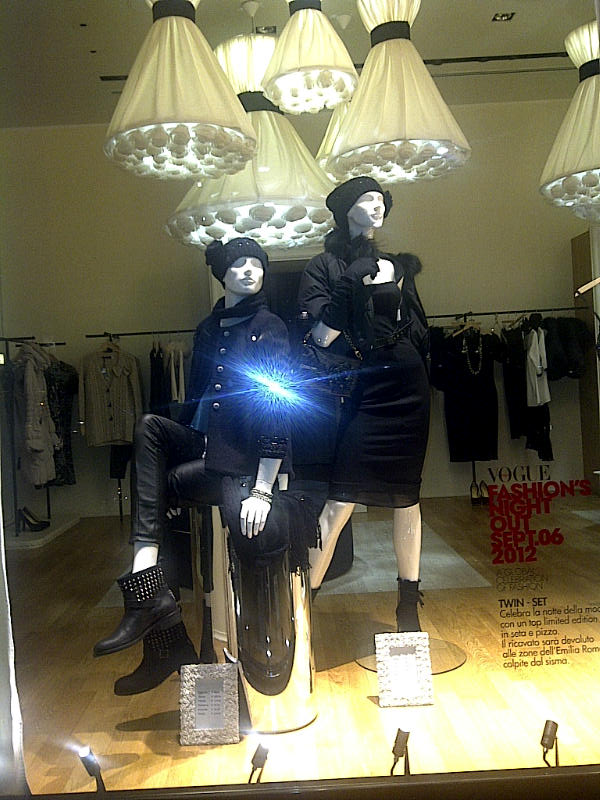
30s images in the shop windows of Florence – Sept 2012
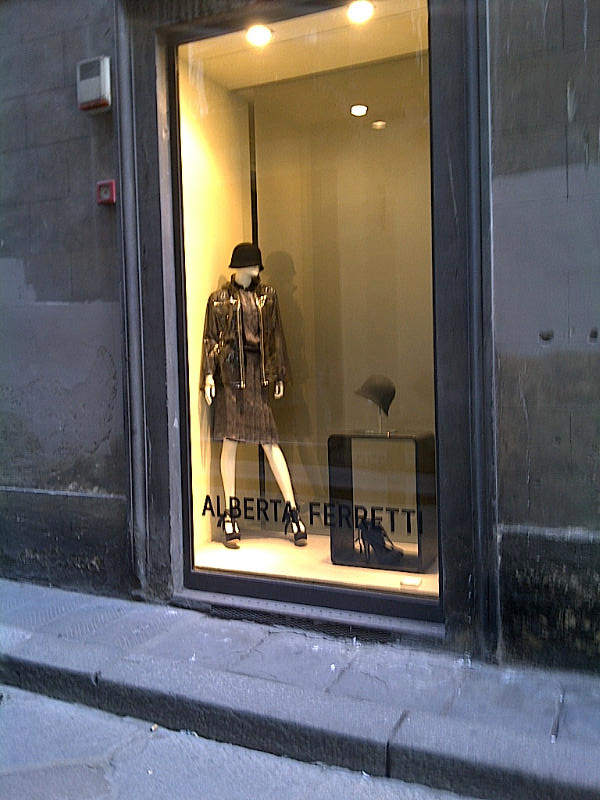
30s images in the shop windows of Florence – Sept 2012
Returning to bronze sculptures at the Royal Academy some of the impressive huge statues – like Cellini’s Perseus in the Royal Academy seem to be four times their original dimension solely through the impressive way they are lit. It richly deserves to get the full lighting treatment here as the original is always stunningly lit in the Loggia del Lanzi in the Piazza della Signoria in Florence.

Every image has back and front lighting casting massive shadows on the walls around the images – one of the most impressive being the Greek Dancing Satyr made in the 4th Century BCE which was dredged up in 1998 by local fishermen aboard the Capitan Ciccio (Captain Fatso) in the ordinary course of casting nets for octopus in the sea near Sicily!
This massive image with amazing yellow eyes greets you as you enter the exhibition and fully justifies a room all to itself.

Both these exhibitions are well worth seeing – more than once – there is so much information in the Bronze Exhibition – including videos and touchable models explaining how these sculptures are made – and in the 30’s Exhibition there is a very strong undercurrent of fascist activity as it develops across the 1930’s, which we can only hope is only returning in fashion – not in reality.

First class page ,Congratulations.”.doctora ” This secciones are great motivations for readers and have a touch of scholastic knowledge . Brava Penny.
Alfonso T via Facebook
Can’t wait for your Strozzi/30s summary (hope it’ll be more than 1!) — I always regret missing out on their fabulous fall exhibitions, but so grateful that I have been ableI to take in the equally incredible spring ones!! Thanks for the upcoming vicarious tour!! your avid reader–Barbara