
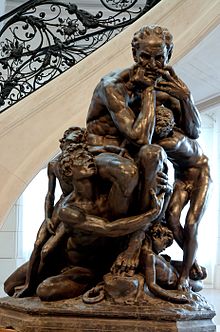
The grisly death of Count Ugolino della Gherardesca and his sons

Count Ugolino della Gherardesca is remembered in history largely thanks to Dante Aligheri , who featured him as someone he met in the Inferno of his famous Divine Comedy , and reminds readers of his infamous and horrendous death, abandoned with his sons and grandsons to starve in a prison not far from where visitors now queue to go up the Leaning Tower.

The story reawakened my interest when I saw the bronze relief of this horrible story made by Pierino da Vinci in 1550 -1553 at the Bronze Exhibition in the Royal Academy this week.

The bronze has it’s own story as it was lost and only rediscovered in Chatsworth House in 2010
The ill fated Ugolino was born in Pisa into the della Gherardesca family, who were a noble family of Germanic origins. They had sufficient alliance with the Emperors of Hohenstaufen to get political influence in Tuscany and became the leader of the Ghibellines in Pisa, by political definition they were therefore in opposition to the Guelfs and thus to the Papacy.
Ugolino was condemned to his punishment for his political ambitions which led to his agreeing, as podestra (mayor) to sell some Castles in prime defensive positions to the ever opposing forces of Florence. He was locked into the tower of Cavalieri Square, together with his children and grandchildren, and the keys thrown in the Arno – with no sustenance and no hope of rescue they finally all starved to death.
The Dante story – and local history – suggests that the surviving family members were compelled by their hunger to feed upon the bodies of those of them who had died – in fact it is told that the children offered their bodies to their father to keep him alive, but notwithstanding this struggle for survival nobody came out of the tower alive. Dante – as an exiled Florentine showed some sympathy for the family and used the story as another example of the perfidy of the Pisans.
Although evidence has recently been found to suggest that the bodies were in fact, eaten, there is also a point of view that a 79 year old medieval man probably wouldn’t have had the strength in his teeth – if indeed he had any – to tear into the flesh of his progeny, and it is therefore more likely that all the bodies were actually devoured by rats.

Yes, this, briefly is the correct story of my ancestor.
A few years ago, Pisa totally rehabilitated Count Ugolino and declared him a great politician, although not understood by his enemies, including some members of his own family.
The full, long, history of our family, arguably the oldest aristocratic family in Europe, unfortunately only in Italian, is here, composed from the works of many historians by my father, himself named Ugolino:
Download: “I DELLA GHERARDESCA DAI LONGOBARDI ALLE SOGLIE DEL 2000”
http://www.dellagherardesca.org/gherardesca_opere.html
Thanks so much for writing this response – I was aware of how many twists and turns in this story I had omitted because , frankly , of it’s complexity and the risk therefore, of my getting it wrong .
The good news is that, obviously, they didn’t succeed in extinguishing the family line completely – I will give your family history my best shot although I doubt that my Italian will be up to it.
Thanks again for your comments and the link.
Honestly Penny your web site is getting super with this little details that makes your stories educational without going into trivia bits and pieces.
You are Superb.
Un abbraccio con affetto
Alfonso T – via Facebook