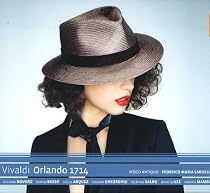
Orlando furioso
I first learnt about the poem Orlando Furiosoin Caroline P. Murphy’s excellent book Death of a Medici Princess. Wherein the unfortunate Medici Princess Isabella, daughter of Cosimo First Grand Duke of Tuscany – who remained in Florence after her arranged marriage to Paulo Giordano Orsini, became after the death of her mother, the First Lady of the Florentine Court – and as such – a frequent organiser of events.
This was the dawn of the age of grand theatrical productions and elaborate stage sets so there were many performances of the poem – also extemporised versions under the direction of Isabella herself – performed in the Pitti Palace for the benefit of family and visitors.

Isabella identified with this complex story of Orlando Innamorato (“Orlando in Love”) written by an Italian writer, Matteo Maria Boiardo and the theme further developed by Ludovico Ariosto (pictured above by Titian better known under the title The Man with the Quilted Sleeve ) and dedicated on publication to his erstwhile friend Cardinal Ippolito di Medici, ( also painted by Titian below). Ippolito was rumoured to have been murdered by his dissolute cousin Alessandro Medici (The Moor)– before Alessandro himself was killed by his cousin Lorenzino de Medici!
Isabella herself was later murdered by her husband with the full approval of her own brother Francesco .
Nice family!
The poem begins in medias res (in the middle of things), picking up from Orlando Innamorato (“Orlando in Love”).
The background of the action of Orlando Furioso is a war between Emperor Charlemagne, a Christian, and the “Saracen” king of Africa, Agramante (often referred to as “the Moor” or “the African” in the poem). Agramante invaded Europe in revenge for his father Traiano’s death. Agramante has various Saracen allies, including prince Ruggiero; Rodomonte, King of Sarza and Algiers; and King Marsilio of Spain. Together, Agramante and his allies lay siege to Paris. Orlando, one of Charlemagne’s knights, is distracted from his duties as a warrior by his love for the pagan princess Angelica (daughter of the Great Khan of Cathay [an old name for China]).
At the beginning of the poem Angelica is put up as a prize by Charlemagne to stop Orlando and his cousin Rinaldo from fighting over her. Charlemagne says that whoever kills more Saracens will win Angelica. But Angelica escapes from Duke Namo of Bavaria, pursued by various would-be lovers: Orlando and Rinaldo, as well as Ferraù (nephew of King Marsilio of Spain), and Sacripante (King of Circassia). Another plot involves the female Christian warrior Bradamante (Rinaldo’s sister), who is in love with the Saracen Ruggerio. There are many other subplots!
Various adventures in the forest ensue. In brief:
Bradamante rescues Ruggiero from the enchantments of his guardian, the sorceror Atlante, who owns a flying horse, the hippogriff.

The Hippogriff in an illustration by Gustav Dore for Orlando furioso
Rescued from Atlante, Ruggerio flies off on the hippogriff to have various adventures. Later, he is seduced by the sorceress Alcina but freed from her magic by the enchantress Melissa, who gives him Bradamante’s magic ring that kills enchantments. In the end, Ruggiero converts to Christianity and marries Bradamante.
Eventually, Angelica falls in love with Medoro, a wounded Saracen knight, and runs away with him to Cathay. Orlando can’t handle this and goes mad (hence “Furioso”). Witless, he runs riot through Europe and Africa until another cousin, Astolfo (son of King Otto of England), rescues Orlando by finding his lost wits and returning them. Astolfo had been turned into a tree by the sorceress Alcina but is later rescued by Melissa. He finds a cure for Orlando’s madness by flying up to the moon on the hippogriff where whatever is lost on earth can be found (including Orlando’s lost “wits”). Eventually, the Christians defeat Agramante, whom Orlando kills.
I am sure you followed all that! I have to admit it has been more or less copied from the “chivalric romance” site on the subject of Orlando furioso !

Anyway my interest in this sad tale is through my friend in Florence Federico Maria Sardelli -who is passionate about Vivaldi and all things Baroque. He has recently reconstructed and recorded Orlando furioso 1714 – a musical drama written by Vivaldi for the choir of the Teatro Sant’Angolo in Venice in 1714 – If you like Baroque music this is a real treat! Available through amazon by clicking on this Orlando furioso 1714 link !