
From Florence to The National Gallery – a Raphael dismissed and left to languish unloved in a corridor now freely available to view at The National Gallery

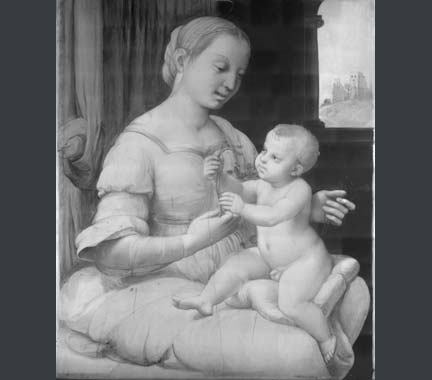
The Madonna of the Pinks (‘La Madonna dei Garofani’)
Controversy continues to rage over this beautiful little painting of Mary and her baby tenderly exchanging carnations – or as the smaller version are known as – Pinks. The botanical name of these flowers is dianthus (Greek for ‘flower of God’), and – like so many of the things the baby Jesus is given to play with , like goldfinchs , they are a symbol of Christ’s Passion.

Christian legend has it that the red carnation first appeared when the Virgin wept at the Crucifixion , hence the symbolism, but it is also exchanged at marriage ceremonies, so this painting also suggests that Jesus is not only the son of Mary but that she is also his bride – and this would have been appropriate for the lady for whom it was reputedly first commissioned , Maddalena degli Oddi, a member of a prominent Perugian family, for her to take to the nunnery after she had taken holy orders.
The painting is now owned by the Nation and hung in Room 8 of the National Gallery of London , a room dedicated to paintings from Florence and Rome 1500-1560
Previously owned by the Duke of Northumberland – it was seen as merely a good copy of a lost original that was known to have been painted in Florence in 1506/7 and hung in a small corridor in his home, Alnwick Castle!
As a result it wasn’t much in the public eye until 1991, when the painting was spotted by a visiting curator from the national Gallery, brought to London and re-examined using modern technology and ultimately confirmed as a genuine Raphael by the Renaissance scholar Nicholas Penny.

Raphael scholars were aware of the painting, as it was first presented as a genuine Raphael in 1829 whilst in the collection of Pietro and Vincenzo Camuccini in Rome. The two brothers being copyists , as well as collectors and art dealers, raised some doubts as to its provenance , especially as there are many good copies of the painting in oils and also a number of French etchings of the image.
It was bought by the 4th Duke of Northumberland in 1855 as a relatively insignificant part of the entire Camuccini collection.
Director Nicholas Penny and the National Gallery team undertook a complex process of research into the authenticity of this work – not only checking the style and technique of the Renaissance master in this stage of his career but also undertaking scientific analysis that would not have been possible even 20 years ago. Microscopic examinations using infrared reflectography,identified the wood panel support as yew, which would set it in the right period, it was prepared with gesso – as used by Raphael at the time , and the detailed underdrawing was made using a stylus made from an alloy of lead and tin identical to that used by Raphael in a slightly later painting – the Garvagh Madonna.
Having convinced the public that this was a painting too important to lose , Penny set up a huge public appeal in 2004, which together with contributions from the Heritage Lottery Fund and the National Art Collections Fund, enabled the National Gallery to buy the work from the Duke of Northumberland for £34.88 million – not a bad return for a painting once deemed to have been of little value!
In the summer of 2006 Desiderio Z Caruzzi published online research which alleged that Nicholas Penny‘s attribution and the associated defence of it that was published by the National Gallery. he claimed that the attribution was based on “incomplete analysis, untenable arguments and misinterpretations”.
In 2007 the posthumous publication of James Beck, From Duccio to Raphael: Connoisseurship in Crisis also disputed the attribution of the National Gallery’s painting Madonna of the Pinks to Raphael.
And so the battle continues ….. but I like to think that the National Gallery have made a wise purchase on our behalf!
