
The Iris , the Giglio and the Fleur de Lys
What a complicated flower is the Iris? Not only in its multiple leaves and colours – it also has multiple names, with multiple historic references and this has resulted , naturally enough , in it also having multiple meanings and being used as an emblem in various different ways in a variety of different places.
Just for interest I thought I would try to annotate some of them – but be aware that this is by no way an exhaustive list!

Let’s start with the name – What ‘s in a name after all? An Iris by another name would look pretty much like a Lily – and this has led to confusion between the genus since French King Louis VI (r 1108 to 1137) or VII (r 1137-1180) won a battle on a swampy field blooming with Iris and decided to choose this flower as his emblem – the graphic design created was initially known as a Fleur di Louis but was soon truncated to Fleur-di-Lys – French for Lily! Confused? We all are!

So let’s talk about Iris – a name usually tells us something about the person it refers to and in the case of Iris it tells as something about the function of Iris – The Greek God Juno’s handmaiden.
She had a big job – she was the Messenger of the Olympian Gods – their female intermediary between heaven and earth – and interestingly in Greek the word Iris means eiris, “messenger” and also “rainbow” –

just as the God of the Old Testament made his promise to Noah by sending a rainbow!

So whichever God , or set of Gods you choose, Iris was a pretty important messenger – so it was natural that artists should select a variant of this image to reflect the Annunciation from the Angel Gabriel to the Virgin Mary – which also came to her as a bolt from the blue – and so in Italian Renaissance paintings he usually brought with him a bunch of Virgin White Lilies to protect her reputation!

Whilst in Dutch paintings of the Annunciation there are definitely also Iris in the bowl – blue ones, which represent fidelity.
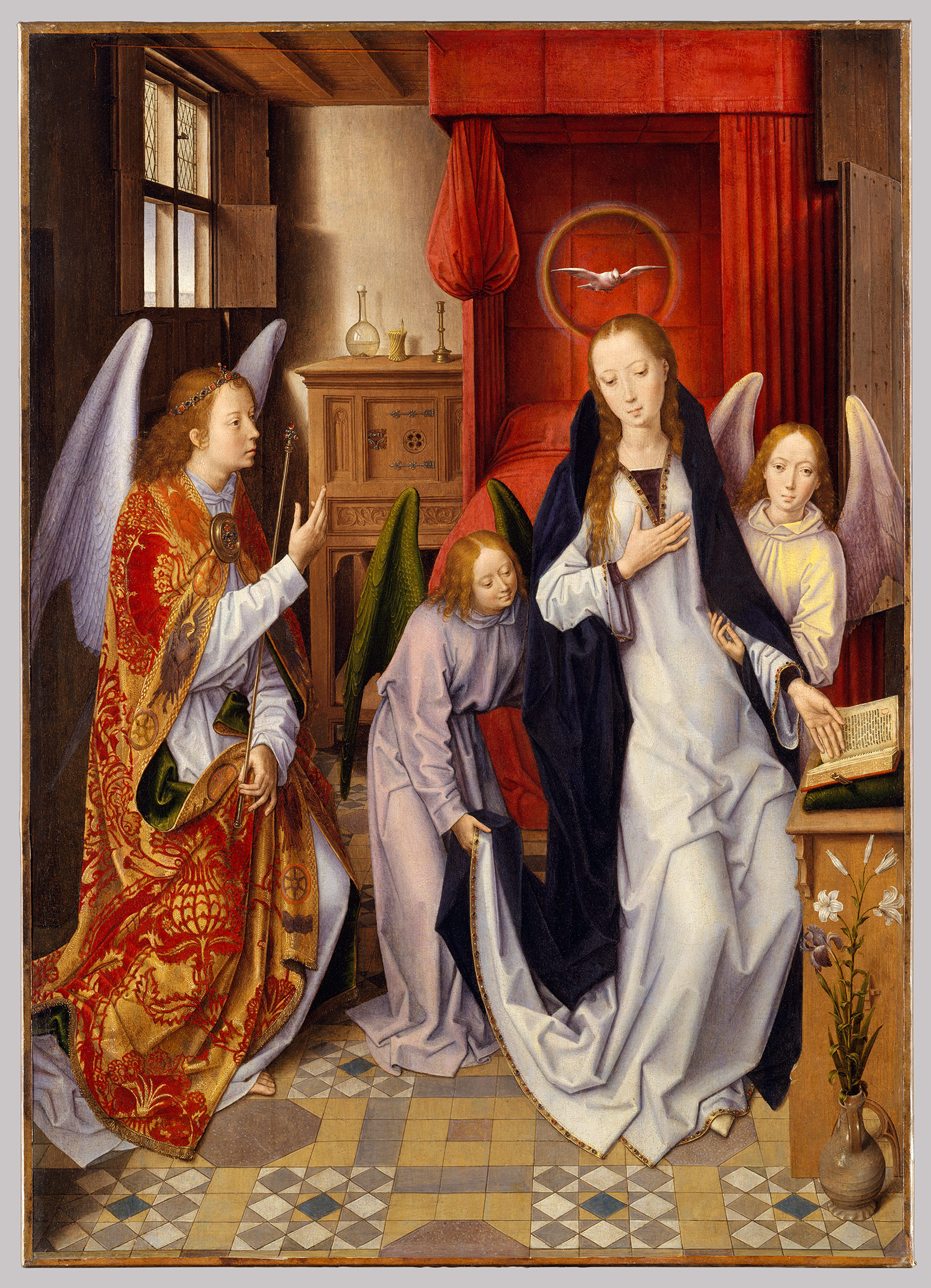
White lilies are not only shown to represent Mary’s purity at the time of The Annunciation but they also – due to the German name for Iris being Schwertlilie (Sword Lily) – refer back to Simeon’s message to Mary when the baby Jesus was presented at the Temple, that “a sword shall pierce through thy own soul” (Luke 2.35) so the Lily image was found on the “bleeding heart” images so beloved of the Victorians.

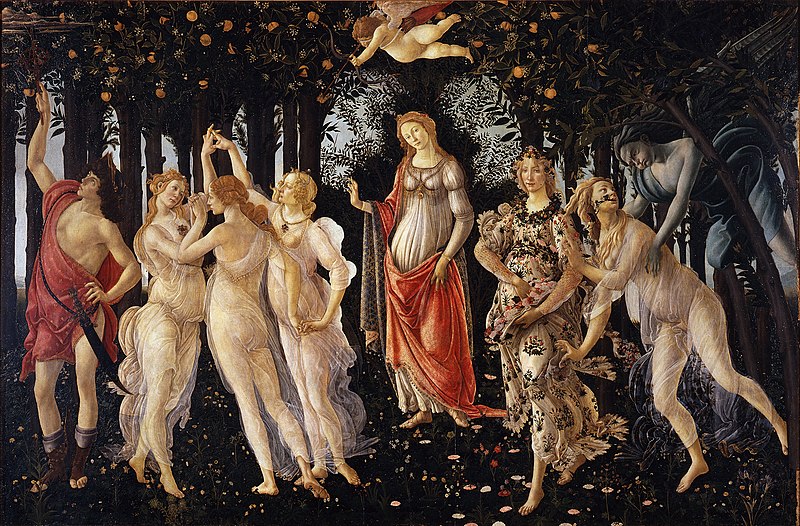
In Greek mythology Iris was reputed to be the wife of Zephyros – the West Wind so exciting to Botticelli that he featured in both Primavera and the Birth of Venus – unfortunately in both paintings he is shown intertwined with his other wife , called Chloris (or Kloris) – but then he was known to be generous in his attentions to other ladies as well!

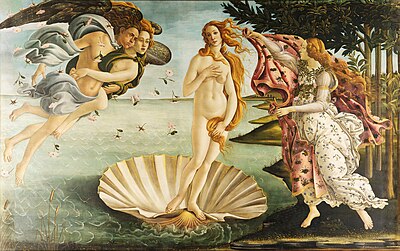
We know that Zephros had forsaken Iris for Kloris through the poetry of Angelo Poliziano, friend of Lorenzo the Magnificent and tutor to his children, and also from the works of Pliny the Elder. In Botticelli’s Primavera the West Wind was losing his lover as she transformed herself into Flora – probably a reference to Florence – the City of Flowers itself.
None of these messages sound too propitious to me as a wedding gift , although the painting is believed to have been commissioned by Il Magnifico to celebrate marriage of Lorenzo di Pierfrancesco de’ Medici in 1482.

We also hear from Alcaeus , that Iris was the mother of Eros , aka Cupid/Amor another character featured in Primavera – so she would have been livid to find both her husband and son off to Botticelli’s party with the new love!!
However Cupid is also reputed to be the son of Venus ( the lady in the centre of the picture) or alternatively a primordial God – so round in confused circles we go again!
It seems that Iris , perhaps to the disappointment of all those advocates of the Bobbitt trim for straying partners , took her dismissal with equanimity, contented herself with being Juno’s Handmaiden and Goddess of sea and sky. In line with her identification with the rainbow, in ancient Greek imagery the single Iris is also represented as supplying the clouds with the water needed to deluge the world!
As I said before Iris had a big job – and there are few things as joy-giving as a rainbow!

The Giglio – the Florentine Giglio ( Lily) was established as the emblem of the City in 1250 – so well after the French Emblem had gone into bloom . In 1266 the colour was inverted on the City Logo from a Ghibellines white lily on a red background to a Guelph red lily on a white cloth.
It is also confusing because it looks so similar to the French Fleur du Lys, particularly as the Fleur du Lys is itself an emblem which also appears on the “augmented coat of arms of the Medici that was granted byLouis XI in 1465 !

The Giglio however is more flamboyant in design and always displays stamens as well as petals ! It is seen all over Florence to this day and is even the logo for the Florentine Football team!

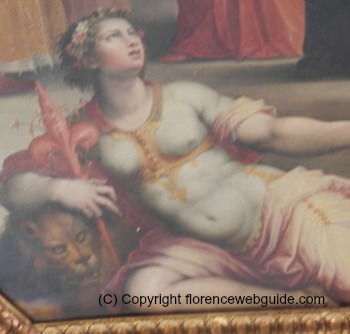
Finally an image from the ceiling of the Palazzo Vecchio wherin a rather raunchy lady of Florence holds a red Giglio in her arms as she lies on the head of another symbol of the City of Florence – a lion – but more of him later…!

WOW!! You have me hooked; can’t wait for the next part!!!
Nearly done now – Barbara – although I am sure there is more to be learned!