
David Herbert Lawrence -(1885- 1930)

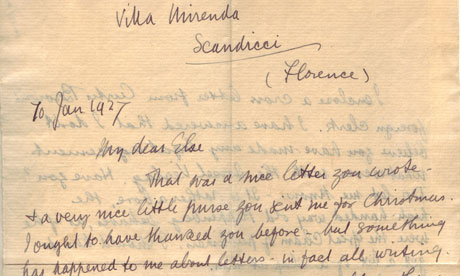
On 15th May 1926 D H Lawrence wrote to his friend, the aristocratic socialite and painter Dorothy Brett, from Villa Mirenda in Scandicci to advise her that he and his wife Frieda von Richthofen had taken the top half of the Villa for a year at a cost of 3.000 lire.
Even at the time Lawrence knew he had a bargain and he wrote to explain that he would be able to keep a pied-a-terre near Florence and still afford to go travelling. The exchange rate at that time enabled 12 months luxury living for only 25 pounds sterling- would that it were so today!

For this sum he gained a view over the Arno valley, “real country with pine woods“, plus time to “sit still and spend little” and even to study the Etruscans and visit their works in Volterra and Perugia.
Although he tried not to acknowledge his tuberculosis as more than severe bronchitis, his illness by this time in his short life was already a considerable problem, but he was determined to continue an active life and ensured that he was able to make time to write.
His work flourished in Italy and his various stays between 1912 and 1929 Lawrence finished Sons and Lovers, (1913) and started The Rainbow (1915) in Lake Garda.

In Taomina, Sicily he wrote Women in Love, (1920) Twilight in Italy, Sea and Sardinia, Etruscan Places, The Lost Girl, Revelation, and a book of poems including Snake (1923) -see bottom of page.
Moving on to Genoa in 1924 Lawrence started the plot of Lady’s Chatterley’s Lover, wrote Sun, and the Virgin and the Gypsy.
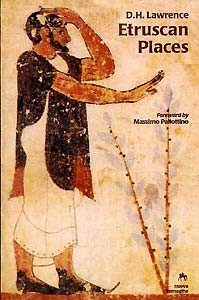
Etruscan Places, was written during his sojourn in Florence and published posthumously in 1932
Finally, one of his most famous books, written in Florence in 1927, was a hymn portraying his credo that his own personal “great religion” was a “belief in the blood, the flesh, as being wiser than the intellect”
This was no ordinary book, but one that even now remains one of the most controversial books of all time – This was Lady Chatterley’s Lover,
Lawrence had already made three draft copies of his book, John Thomas and Lady Jane, and the first and second Lady Chatterley, before he completed the final version of the ground breaking Lady Chatterley’s Lover, which was written, and first published, in Florence.
The publisher who enabled the books private publication of 1000 copies in Florence in 1928 was Pino Orioli. An image of the first edition is shown below.

As most people know an unexpurgated edition of Lady Chatterley could not be published openly in the United Kingdom until 1960, that is, after the media frenzy of the trial of Penguin books under the Obscene Publications Act 1959.
The 1959 obscenity law act was introduced by Labour politician Roy Jenkins. It enabled publishers to escape conviction for using anglo-saxon four letter words in books provided they could show that the work was of literary merit. Thus writers and academics including E. M. Forster, Helen Gardner, Richard Hoggart, Raymond Williams and Norman St John-Stevas, were called to the witness stand to defend the literary merit of the novel. In addition part of the defence was famously conducted by Barrister, wit and writer Sir John Mortimer.
A “Not Guilty” verdict was delivered on 2 November 1960.
In 1961 Penguin promptly printed a second edition, which probably remains one of those books that just falls open, always at certain -well thumbed- pages!

Foyles in Charing Cross Road was besieged with would-be readers as soon as they announced that they had the book in stock – and shortly afterwards they had to re-stock!

The book maintains its cult status even now – in the third Mad Men episode in season 1, “The Marriage of Figaro” (2007), Joan Holloway is shown furtively returning her borrowed copy of the book to one of the other administrative pool members.
The sexual revolution was born – Don Draper was no longer in pursuit of women – they were out of their cage and going to pursue him!
The reason for my checking on DH Lawrence in Italy was the new book by Alex Preston – In Love and War – set in Florence 1939 -43 ( more of this next week.)
Preston makes quite a lot of references to the scandalous lifestyle of Norman Douglas and his colourful friend Pino Orioli, including a passing remembrance of DH Lawrence’s description of Douglas as “a man with a face like a fallen angel” in Aarons Rod so I wanted to check out their friendship in Florence even although it was well before the period of the book.

Norman Douglas and Pino Orioli on holiday in Austria
Lawrence worked with Douglas on an essay called D.H. Lawrence and Maurice Magnus: A Plea for Better Manners (1 924) – also printed privately by Orioli in Florence in 1924.
Also whilst in Florence, Lawrence wrote an introduction to his translation of one of the most tortuous titles ever – The Story of Doctor Manente. Being the Tenth and Last Story. from the Suppers of A.F.Grazzini, called IL Lasca.
The book shown below was also published by G.(Pino) Orioli in Florence in 1929.

So Lawrence was not exactly sitting still and spending little in Florence – but he was clearly loving his life in Italy – and who can blame him!
Snake poem for reference
Snake
A snake came to my water-trough
On a hot, hot day, and I in pyjamas for the heat,
To drink there.
In the deep, strange-scented shade of the great dark carob-tree
I came down the steps with my pitcher
And must wait, must stand and wait, for there he was at the trough before
me.
He reached down from a fissure in the earth-wall in the gloom
And trailed his yellow-brown slackness soft-bellied down, over the edge of
the stone trough
And rested his throat upon the stone bottom,
And where the water had dripped from the tap, in a small clearness,
He sipped with his straight mouth,
Softly drank through his straight gums, into his slack long body,
Silently.
Someone was before me at my water-trough,
And I, like a second comer, waiting.
He lifted his head from his drinking, as cattle do,
And looked at me vaguely, as drinking cattle do,
And flickered his two-forked tongue from his lips, and mused a moment,
And stooped and drank a little more,
Being earth-brown, earth-golden from the burning bowels of the earth
On the day of Sicilian July, with Etna smoking.
The voice of my education said to me
He must be killed,
For in Sicily the black, black snakes are innocent, the gold are venomous.
And voices in me said, If you were a man
You would take a stick and break him now, and finish him off.
But must I confess how I liked him,
How glad I was he had come like a guest in quiet, to drink at my water-trough
And depart peaceful, pacified, and thankless,
Into the burning bowels of this earth?
Was it cowardice, that I dared not kill him? Was it perversity, that I longed to talk to him? Was it humility, to feel so honoured?
I felt so honoured.
And yet those voices:
If you were not afraid, you would kill him!
And truly I was afraid, I was most afraid, But even so, honoured still more
That he should seek my hospitality
From out the dark door of the secret earth.
He drank enough
And lifted his head, dreamily, as one who has drunken,
And flickered his tongue like a forked night on the air, so black,
Seeming to lick his lips,
And looked around like a god, unseeing, into the air,
And slowly turned his head,
And slowly, very slowly, as if thrice adream,
Proceeded to draw his slow length curving round
And climb again the broken bank of my wall-face.
And as he put his head into that dreadful hole,
And as he slowly drew up, snake-easing his shoulders, and entered farther,
A sort of horror, a sort of protest against his withdrawing into that horrid black hole,
Deliberately going into the blackness, and slowly drawing himself after,
Overcame me now his back was turned.
I looked round, I put down my pitcher,
I picked up a clumsy log
And threw it at the water-trough with a clatter.
I think it did not hit him,
But suddenly that part of him that was left behind convulsed in undignified haste.
Writhed like lightning, and was gone
Into the black hole, the earth-lipped fissure in the wall-front,
At which, in the intense still noon, I stared with fascination.
And immediately I regretted it.
I thought how paltry, how vulgar, what a mean act!
I despised myself and the voices of my accursed human education.
And I thought of the albatross
And I wished he would come back, my snake.
For he seemed to me again like a king,
Like a king in exile, uncrowned in the underworld,
Now due to be crowned again.
And so, I missed my chance with one of the lords
Of life.
And I have something to expiate:
A pettiness.
Taormina, 1923

My thanks to Sarah for letting me know that her ex-husbands grandmother was also a witness for the defence in one of the most exciting trials in the 20th Century!
My thanks to Sarah Holliday for letting me know that her ex-husbands grandmother Joan Bennett (ne Frankau) was also a witness for the defence in one of the most exciting trials in the 20th Century!