

30.6.12
Chronology of Last Suppers
Talking to a friend this week I realised that I was possibly becoming a little obsessed with the Last Supper, however he raised some interesting questions, which I hope means that he wasn’t totally bored to sobs by my enthusiasm and one of them was where Leonardo fitted in the history of Last Suppers? Our discussion mused on whether Leonardo raised a challenge that no-one wanted to take on after seeing his masterpiece in Milan – I thought not – but that he raised the bar a lot higher in terms of movement – so here goes – the chronology of my favourite Last Suppers.
This is not intended to be the last word on the subject as I am still searching for more, and there are lots more to be found – not only in Florence but across Europe – wherever there was a Monastery there was a Refectory – or in Italian a Cenacolo – and wherever Monks gathered to eat who better to invite to the meal – even in a Silent Monastery – than Jesus and his disciples, – even if one of them had turned to the Dark Side?
One of the earliest in the style you will see below was painted in the Cenacola of the Monastery that used to be attached to Chiesa Santo Spirito sometime between 1343- 1355 by Andrea Orcagna, unfortunately as this refectory was used for the storage of “trams” at the end of the 19th Century the fresco has been damaged irretrievably but it is still possible to make out two early Renaissance figures at a table looking dumbfounded and clutching themselves -saying “How could you say such a thing?”


Another fresco begun in or around 1340 is in rather better condition> It was completed by Taddeo Gaddi in Santa Croce. Originally attributed to Giotto, this painting has also been damaged – in this case by the 1966 flood. Tantalisingly for lovers of Dan Brown (which I am not!) it shows St John sound asleep, not just on the shoulder, but practically in the lap of Jesus – and what beautiful tapered fingers he has! – almost like someone who takes care of their hands with luxury oils?

1445-1450 – Andrea de Castagno – in some ways I think this looks the most modern of them all – Freud would have enjoyed interpreting the disturbance going on behind the heads of Judas and Jesus!
As they say, you learn something everyday and today I learned from a Nun at another Florentine Church that these painted marbles have always had contemplative significance – the little red spots on the blue marble should raise profound thoughts about the pain Jesus felt on the cross as they represent the blood of Christ, and the cloud of white spots on the porphyry colour between the blue on the left panel and the brimstone above Judas represent the miracle of the mothers milk of the Virgin Mary.
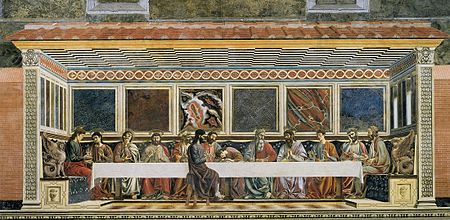
This fresco is to be found in the Cenacolo of the Church of Sant’Apollonia in Florence. It depicts Jesus and the Apostles during the Last Supper, each in a characteristic pose, which would have told latter day churchgoers immediately who was who in the group – not so easy for today’s audience – which. without the benefit of compulsory education on all religions. can on average, only pick out Jesus, Judas and Peter – and perhaps with prompting, Andrew, young John and the doubtful expression of Thomas.
However, according the legend underneath their feet, they are – in left to right order – St Matthew, St Phillip, St Thomas -looking skyward in wonder, St Jacobus (James the Greater) St Peter, Judas (wrong side of the table) Jesus, St John (sleeping) St Andrew, St Bartholomew, St Thadeus, (AKA St Jude, patron saint of lost causes)St Simon and St James minor.
1480 – Domenico Ghirlandaio – a recently renovated masterpiece to be found in the Cenacola of Ognissanti – one of the fascinating things about visiting this version is that as part of the renovation they also removed the sinopia of the original painting which allows us to see how much it has been adapted by renovators over the years!

1482- 1484 – also by Domenico Ghirlandaio in Chiesa di San Marco – The Monks there liked the one in Ognissanti so much they asked him to paint another similar. A new symbol has arrived on Judas’s side of the table – the treacherous cat – and Peter is looking even more threatening with his knife – in this one Ghirlandaio has helpfully put everyone’s names on the back of the bench behind them!
They are left to right – James Minor, Philip, James Senior, Andrew (brother of Simon called Peter) Peter, Jesus, John (sleeping) Bartholomew, Thomas ( looking doubtful!), Matthew, Simon , Jude (aka Thaddeus to avoid confusion with Judas).
1493-1496 – the turn of Perugino whose work has been preserved in the Convent of Foligno in Florence Behind the supper he shows the next step when the Disciples sleep in the garden of Gethsemane, whilst Christ thinks about asking for a reprieve. Once again we have Judas on our side of the table with his money bag but he is the only one looking out at us – normally this would mean a self -portrait of the artist but would you want to put yourself in Judas’s place?
The likeness I do see prompted another debate with a friend – Perugino has also put the names in the panel below everyone’s feet – and shows James the brother of Jesus, in the left corner, as a virtual twin! My Catholic friends tell me this can’t be, – because Mary was thrice blessed, a virgin on conception of Jesus, a virgin whilst giving birth to Jesus and remaining a pure virgin throughout her married life – therefore James the brother of Jesus has to be Joseph’s son by a previous marriage and genetically would bear no physical resemblance to him at all – but okay it is probable that they would use the same tailor!

self portrait of Perugino

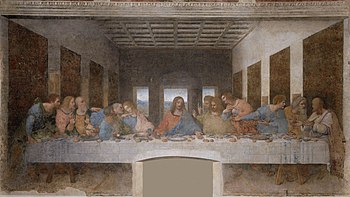
1495–1498- Leonardo da Vinci – now we have the one everyone talks about – and many believe is the only one ever painted. This painting began the challenge to catch the disciples in movement – a snapshot taken at the moment of accusation and subsequent denial from all the Disciples – including Judas – that nothing would tempt them to betray him!
Question asked in the Da Vinci Code was “Is John really Mary Magdalene? – It seems unlikely but this is the most female looking version in a painting – but interestingly the most female “John” in a drawing is in the Ghirlandaio sinopia at Ognissanti painted in 1480, which has a sketch of a young female wearing a low cut top.
1512 – 1514 – Franciabigio – at Cenacolo della Calsa, at the end of Via di Serragli – recently restored and re-opened to the public in the form of a Conference centre. Franciabigio shared a bottega with Andrea del Sarto and they clearly had some influence on one another. This group has more food , including three plates of sacrificial lamb, but less cutlery – nobody has a knife and St Peter isn’t found to Christ right hand side or even wearing his signature cloak of yellow ochre – he seems to have already moved to Papal purple!
Looking at these characters it is almost Ghirlandaio’s order in reverse ie reading left to right young Thaddeus, Simon, young Matthew, doubtful Thomas saying “What! Really?” Bartholomew, young sleepy John, Judas on wrong side of the table, angry Peter, brother Andrew alongside as always, James senior looking a bit like Jesus, elder statesman Phillip and another young one in James minor. One might almost suspect that he had hung his “cartoon” up the wrong way round and pounced in his red sinopia into the arriccio layer of plaster – and decided he was committed to putting them up the other way around! Stranger things have happened?


1519-1527 – Andrea del Sarto – Take a short bus-ride out of the city centre to visit the Cenacola di San Salvi. Andrea del Sarto must have seen the work of Leonardo da Vinci before embarking on his own masterwork on the subject – here everyone is saying “What ME? How could you possibly think such a thing!”

In this painting – as in Leonardo’s painting – Judas is not separated from the group by the table – and is not even shown in yellow to differentiate him from the rest of the group – he is actually sitting on Christ’s left looking just as incredulously injured as everyone else, as Jesus offers him bread – the symbol of his body – to show that he knows what he knows.
Another quirk of this painting is the artist’s increasing sense of self-worth – Andrea del Sarto and his wife, Lucrezia are portrayed on the balcony overlooking the whole scene.
Next in my count for today is Alessandro Allori, who painted the Cenecola in Santa Maria del Carmine in 1582 – so nearly 90 years after Leonardo they were putting Judas back as part of the group – as first suggested by Leonardo – and keeping the group surprised and lively – except perhaps Peter who looks totally perplexed!
Interesting opportunity to play spot the copy of characters taken directly from Andrea del Sarto’s painting of the subject.

So finally we move to oils and this rather curious example also by Alessandro Allori begun in 1584- lively it certainly is – and whoever knows who is who is doing very well amongst this jumble!

A late fresco entry was painted in 1642 by an artist born in Fiesole called Nicodemo Ferruci . It is to be found in the Cenacolo of the Five star Hotel Villa San Michele in Fiesole – it goes back to the traditional format of nearly everyone crowded at the back of the table except Judas who sits at the far left of Jesus on other side of the table accompanied only by his equally treaturous cat!

So my next challenge is to find one later than this – or is it the final response to the challenge of Leonardo?
I think Leonardo – as usual – takes the crown – but personally I still love the Ognissanti Ghirlandaio best!
Last but not least – albeit completely difference – there is this scene below from 1970 Robert Altman film MASH
The Last Supper sequence in the the Suicide is Painless scene – with groupings based on Leonardo’s Last Supper in Milan gathered around the despairing army dentist Dr Waldowski (John Schuck) – after he has taken what he believes is his suicide pill.

2013 – we have a late entry in the form of a photograph of Britain’s finest lovies by Alistair Morrison – this one has a Blog all to itself!

The actors shown above echo the images in Leonardo’s painting so I dont think they will help to confirm the images in Suore Plautilla Nelli’s Last Supper now being restored to it’s orginal beauty thanks to the Fundraising Efforts of The Advancing Women Artists Foundation – but Ghirlandiao’s might?
 For Ghirlandaio – The disciples are from left to right – James Minor, Philip, James Major, Andrew (brother of Simon called Peter) Judas on the wrong side of the table, Peter, Jesus, John (sleeping) Bartholomew, Thomas (looking doubtful!), Matthew, (leaping up) , Simon the Zealot, Jude the patron Saint of Lost Causes.(aka Thaddeus to avoid confusion with Judas Iscariot)


Loved the chronology on a theme!! As you know our friend Leslie shares your Last Supper “obsession” and has expertly taken me around to several of the works in Florence, but then I mix them all up in my mind — so a printable version will be a great reinforcer! If you want to take on another chronology obsessively, an idea came to mind during the British Institute’s John the Baptist Day talk series — the “hidden meanings” of Mary’s gestures with baby Jesus and baby John and the babies’ prophetic gesturing to each other and John’s growing up from babe in animal skin to teen to man in same furry garments that keep playing out in the Madonna and other paintings of the masters.
Barbara – yes must follow -up on these gestures whilst you are over here!
Yes – it is on the post !