
10.6.12
Today we went Beyond the Yalla Dog with a Fresco Class with two American Educationalists from Oklahoma who have been funded for their trip due to their successful grant application, which goes under the lovely title of “In Their Footsteps!” They are following a line of great masters across Europe – Paris, London, Manchester and today was the turn of Florence to study Giotto, and Ghirlandaio whose work was introduced to us by Alan Pascuzzi.
First step – the ladies had to take a photo of Alan and his shoes ( mine too! – had to be on the weekend that I haven’t had a pedicure!!) as the starting point for every new adventure.
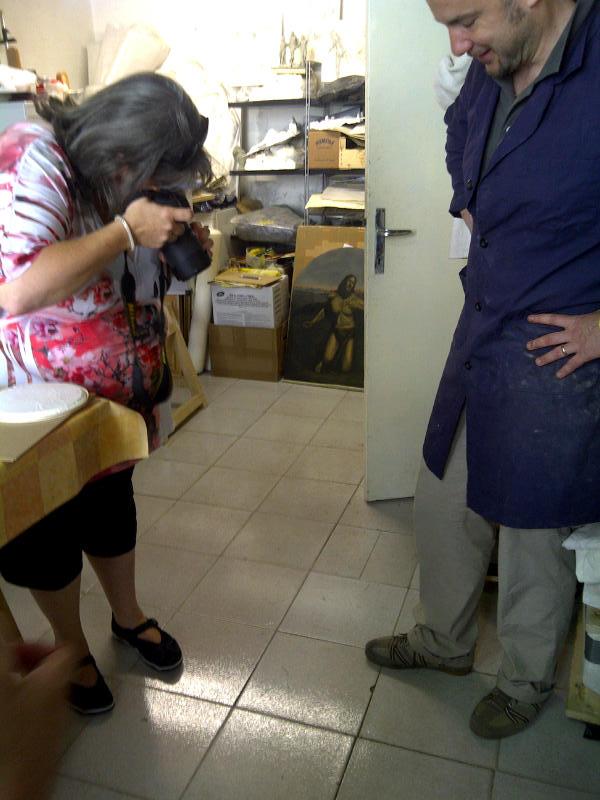
The teacher's shoes!
Alan introduced the chemistry of fresco painting and how it would have been done by French cave painters over 17,000 years ago – when you might have thought they would have more to worry about in relation to their survival than home decoration!

But here they are – and these cave dwellers clearly had an eye for design and colour as well as for simple drawing – just fabulous!
So Alan explained the chemical process of how the paint eventually becomes part of the wall – and how the liquid marble paste will dry with our freshly applied colour held fast within it.
The chemical formula , which I am sure you are all agog to know is:-
CaC03 Calcium carbonate = marble
Ca0 Calcium Oxide
Ca0 + H20 = Ca(0H2) Calcum Hydroxide (+ sand= mortar)
Ca(0H2) loses H20 gains C02
CaC03 Dried fresco (lime crust)
Who would have thought the cavemen would have been so clever to work out all that? – I certainly couldn’t – but I can assure you that it works – at least when Alan does it!
And here he is below squeezing the water out of the marble paste (calcium carbonate + H20) in order to make our lime paste to make our arriccio base on which we will make our sinopia drawing!
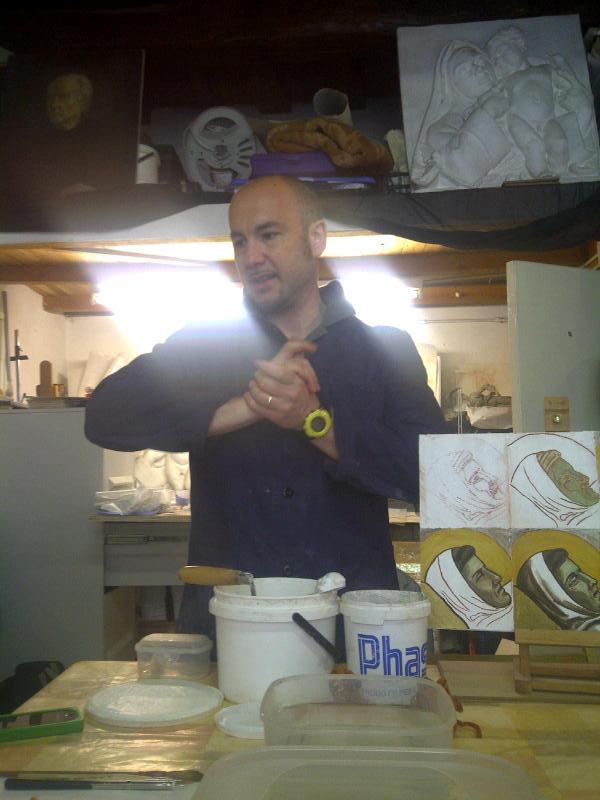
Squeezing the water out of the marble paste
Then we had a demonstration of the step by step process we were going to follow. To me it looks a lot simpler now we have lost the maths!
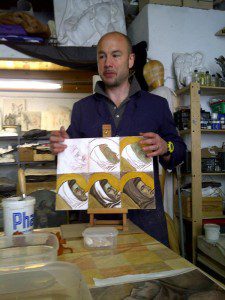
Step by step Giotto painting
We used natural earth based pigments and hogs hair brushes that take the paint so well – just the same materials and tools as the great masters would have used, so we really were following in their footsteps.
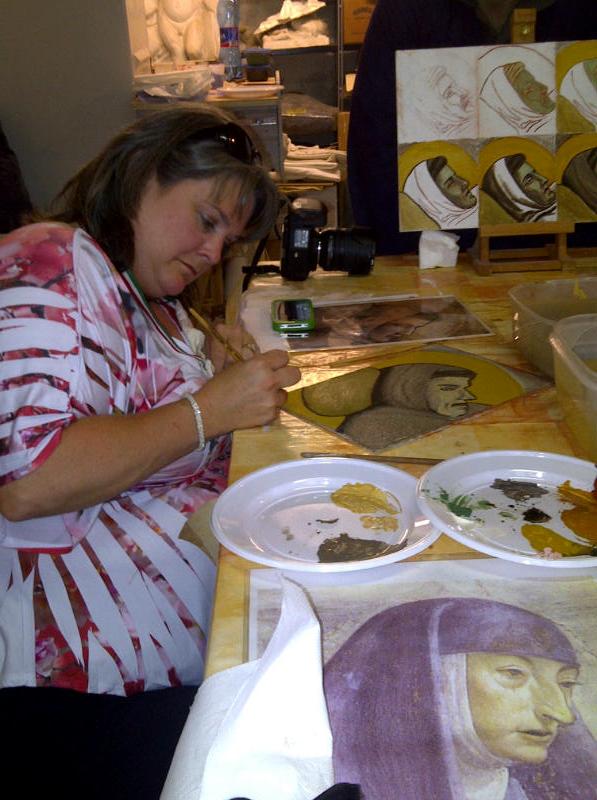
Painting with concentration
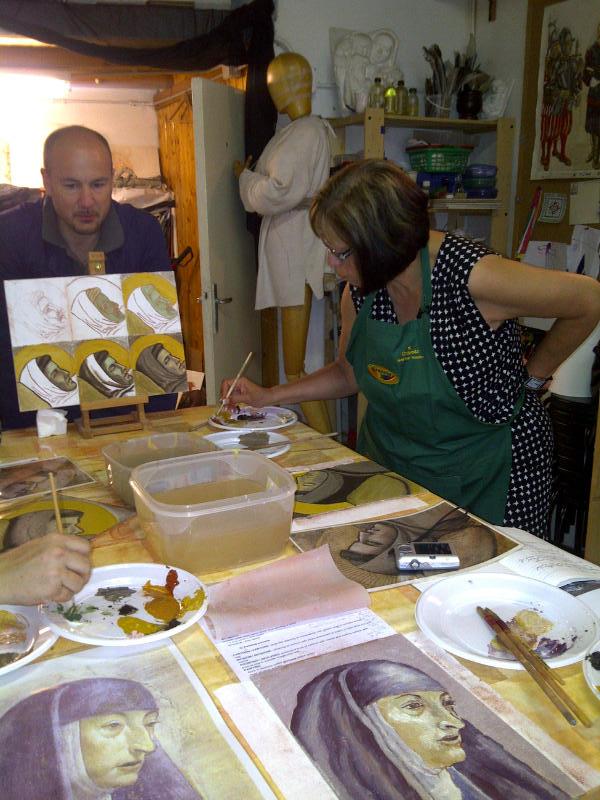
I was very excited because I was being allowed to work on part of a painting we had only seen that morning in Chiesa Santa Trinita in the Sassetti Chapel by Domenico Ghirlandaio – who is currently my favourite fresco painter – because of his style and also because of all the symbolic details he managed to incorporate in every painting.

The original painting is traced onto a sheet of thin paper ( maybe Giotto wouldn’t have actually had an sheet of baking paper!)and becomes the basis for the sinopia. The painting below was the one I had to copy with the tracing paper – punched full of holes along the lines – ready to form the basis of the cartoon/cartone that enables us to transfer the details of the image onto our board.
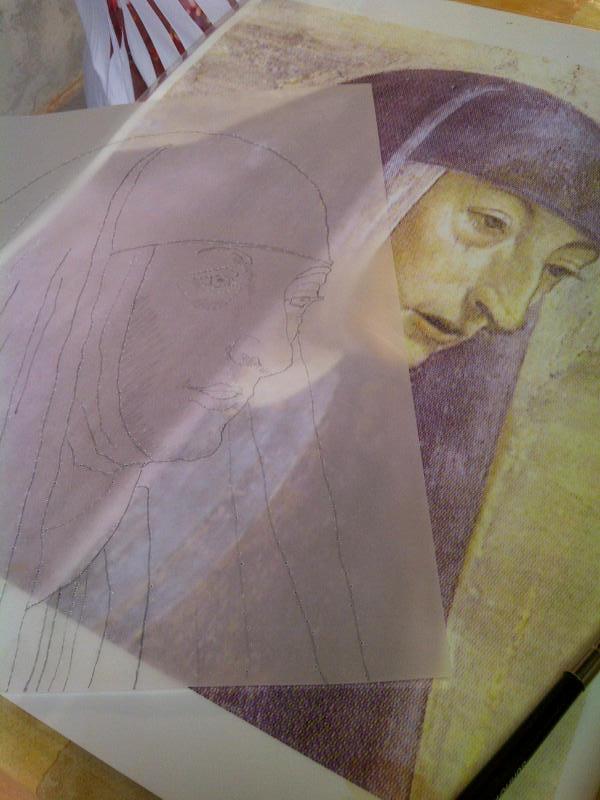
with cartoon
The next part is quite fun – if slightly messy – using a cheesecloth”pounce” bag full of red ochre powder to transfer the image onto the board through the holes in the paper.

The opened cheesecloth pounce bag contains a cotton wool pad and lots of raw Siena powde
Then the really hard part where our own painting skills come into play – getting the colours and modelling right for our giornata ( day’s work).
The famous expulsion from Eden by Masaccio in the Brancacci Chapel shows very clear evidence of using different pigments on fresh plaster for a second giornata of work – look closely at the darker blue around the top half of Adam’s body!

Finally we show off our work to you all – thank you so much Alan for being a great teacher and Kim and Johnnie for such enthusiastic participation!
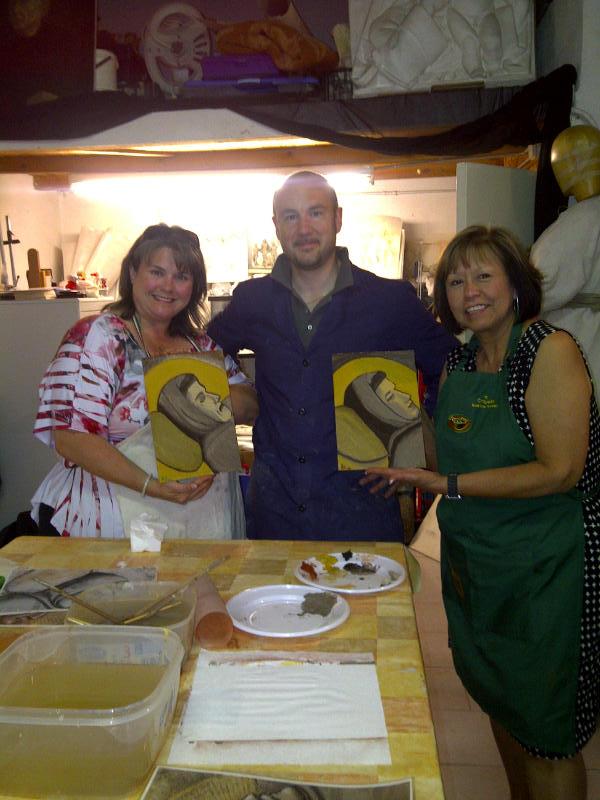

Link looks great. I hope they liked the lesson. AP