
Elisa Bonaparte and her part in Tuscan history
3 January 1777 – 7 August 1820
A woman of many titles , Maria Anna (Marie Anne) Elisa Bonaparte Baciocchi Levoy, was a Princesse Française, Duchess of Lucca , Princess of Piombino, Grand Duchess of Tuscany, and finally demoted after the fall of Napoleon to Countess of Compignano – goodness knows how the public were supposed to address her?
Dr Katie Campbell and I have recently taken quite a few groups around the gardens of the Villa Marlia (aka Reale) just outside Lucca – a huge country mansion that Elisa, saw, acquired and set about “restoring” to her own taste.

Her brother, the rather better known Napoleon Bonaparte – was a scion of a large family and his plan, implemented at the height of his power, was to control Europe by placing his many relatives in strategic positions – in the expectation that they would gratefully do as he told them to do! Not a chance with this little sister! Elisa who had been given the job of Grand Duchess of Tuscany in 1808, was a strong character – and Elisa did what Elisa thought best! This resulted in frequent filial squabbles and many Imperial summons’ back to France to be read the riot act!
As an example of this on 17 March 1810, Élisa returned to Paris to witness Napoleon’s marriage to Marie-Louise of Austria, but her brother took advantage of her visit and wanted her to return some grants he had made to the poorer regions of Tuscany , those of Massa and Carrara. Élisa refused , Napoleon insisted, and even when pressed by Napoleon’s Envoys Élisa still refused to pay, – claiming that the territories hadn’t sufficient resources to pay the fee of 200,000 lira that Napoleon demanded. Her punishment was that Napoleon threatened to take back Carrara, which he had given to her in March 1806 , and which she had increased the value of by establishing an Académie des Beaux-Arts, designed to host the greatest sculptors and had made Carrara an exporter of marble statues, which had a significantly greater value than the raw marble.

She also set up the Banque Élisienne to give financial aid to sculptors and workers on marble taxes, so perhaps there was more income being raised from the area than she wanted to admit to?
In May 1811 Napoleon demanded that the City of Lucca , also under Elisa’s control should raise men at arms by conscription, which it had not previously been required to do. Complying with Napoleon’s demands eroded Élisa support in Lucca.
In 1813, Napoleon faced an allied coalition against him after his disasterous Russian campaign, and another sister, Caroline Bonaparte‘s husband Joachim Murat, King of Naples, deserted his brother-in-law and aided the Austrians to successfully fight for restoration of the House of Habsburg-Lorraine in Tuscany . On 30 May 1814 Elisa was thus forced to abdicate as Grand Duchess of Tuscany in favour of Grand Duke Ferdinand III’s restoration and leave Florence for Lucca. When Élisa returned to Lucca from Florence as mentioned above, she became increasingly unpopular as she tried to “restore” the Villa Reale di Marlia.
Élisa hadn’t got a great track record with the Tuscans when it came to her restoration projects -although Élisa set up city improvement works in her territories, including building new hospitals and financing schools in Lucca, most of her demolitions took place to expand her princely palaces. One such project in 1807 necessitated the demolition of the Church of San Pietro. She also razed an entire block in Lucca to build a piazza in the French style in front of her city residence. The block included the Church of San Paolo with a venerated image of the Madonna dei miracoli and its demolition seriously affected the city’s medieval architecture which almost sparked a revolt.
Worse news was to come for Elisa when, in 1815, the Duchy of Lucca was itself carved out of Tuscany and the Neapolitans captured Massa and Carrara in March so she was losing her income.
Finally an Anglo-Austrian force under Lord William Bentinck captured Lucca and forced a pregnant Élisa to flee the city.
Trying to maintain at least part of her lifestyle Élisa made several short stays in Italy and France whilst she was trying to return to Italy as a private individual. The former duchess’ requests were denied, but she was able to stay in Austria for a time thanks to the efforts of her brother, Jérôme Bonaparte, before moving to the Villa Caprara in Trieste.
Napoleon was exiled to Elba on 1 March 1815, and Élisa was arrested on 25 March and interned in the Austrian fortress of Brünn. When she was freed at the end of August she was authorized to stay in Trieste with her latest title of Countess of Compignano.
After her release Elisa acquired a country house at Villa Vicentina near Cervignano ( which was not part of Italy until after WW1) and financed several archaeological digs in the region.
She contracted a fatal illness in June 1820, probably at an excavation site, and died on 7 August at the age of 43.
Élisa was the only adult sibling of Napoleon Bonaparte not to survive the emperor.
She was finally allowed to take her place back in Italy when she buried in the San Petronio Basilica of Bologna.
The Villa Reale at Marlia remains a wonderful place to visit on a Tuscan garden tour – the next one being planned with Dr Katie Campbell in Spring 2013.
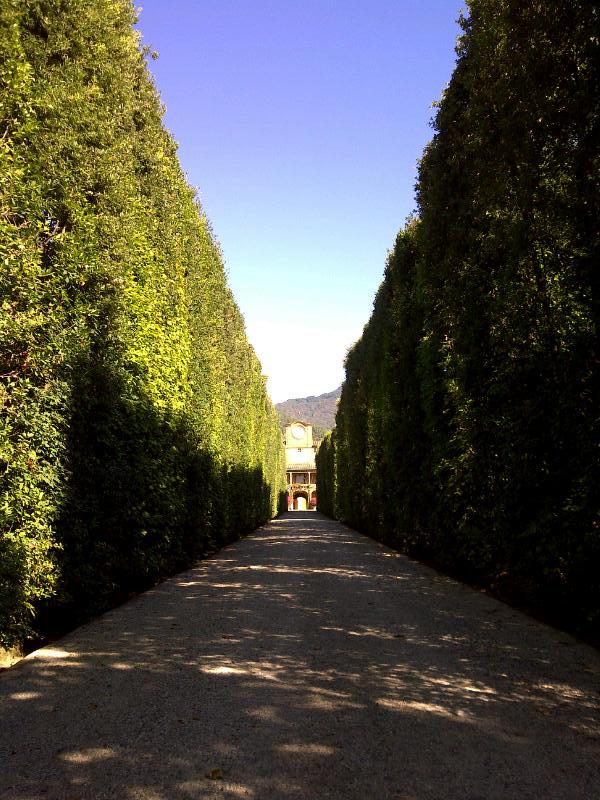
The stables at the end of the drive – Villa Reale di Marlia
