
One of the many fabulous things about Florence is the number of paintings and sculptures classified as “mai visti” (never seen before) , which for the past four years the Uffizi Gallery team have uncovered for an exhibition of treasures usually hidden from the public eye simply due to the lack of space in the main galleries!
This exhibition is being held opposite the Uffizi in the Sala delle Reali Poste – used as the main Post Office building from 1866 to 1917, this space was first established whilst Florence was the Capital of the new Kingdom of Italy.
There is some suggestion that nearly 47% of the treasures of Florence are stored away – many in cellars well below the water-line of this flood prone city… Just imagine that!
This year’s exhibition contains a selection of treasures that are doubly “mai visti” – Why? Because they show both sides of various paintings and artefacts that are painted or written on two sides – one of which is usually tucked inside the other – or only uncovered when the backing paper is taken off the frame.

The poster of the exhibition shows this image – possibly of his lover as the artist Palma il Vecchio painted this lady with a possible self portrait of himself on the back of the wood panel.
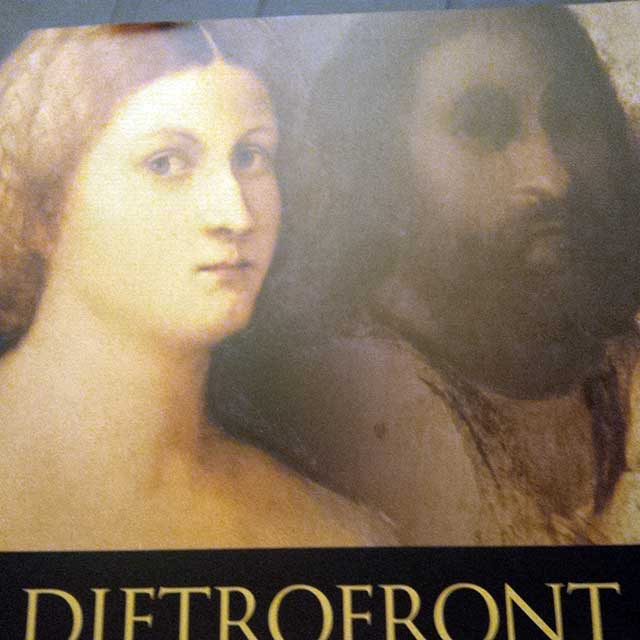
Whoever this lady was she certainly seems to have been Palma Il Vecchio’s muse as many of his paintings, such as the one below, feature a woman with similar colouring and features – and the self-portrait on the back (taken from the book cover as unavailable on the web) shows a man who looks a lot like Christ in this painting!

Many of the double-sided images were created for travellers who wanted, or needed, to carry their religious artefacts with them across Europe. Certainly the largest example was this portable altar believed to have belonged to a Medici Cardinal on tour – it has messages hidden on the backs of the drawers.

My favourite example is this image painted by an unknown artist of the early 15thcentury of the Florentine Representive of the Pazzi bank in Bruges, Pierantonio Bandini Baroncelli with his wife Maria Bonciani – perhaps painted for their marriage.
The case opens up to show an older painting (c1489) of the Annunciation hidden on the back of the painted panels.
I love these portraits and I was especially struck by the beautiful books they are carrying – a classic Renaissance display of learning and knowledge – and a new openness to the beauty of nature through the window – as well as a display of wealth.


Antonio Cioci (working 1750-1792) was a master of trompe l’oeil, and the image attached is a bad photo that I took from the exhibition catalogue but the original is truly amazing – on the back of another painting – it really feels as if you could reach out and unpin some of these pieces of paper.
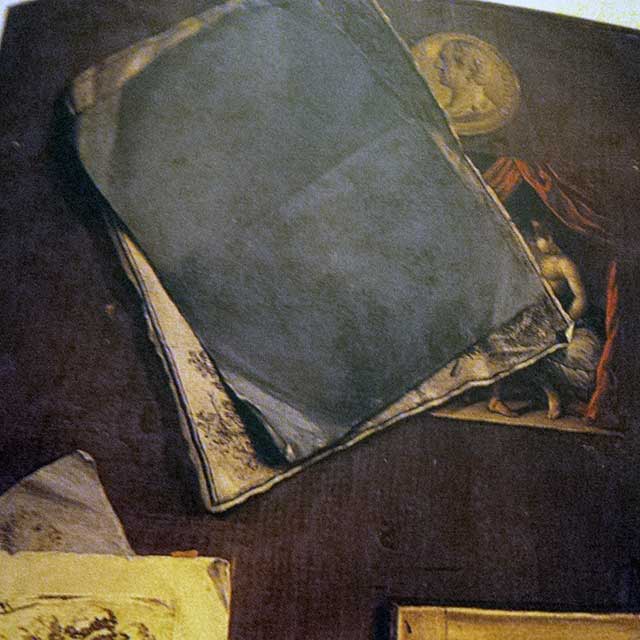
There are many other paintings across the centuries with other paintings on the back – for reasons of economy it seems many artists reused canvases and seemed to prefer to paint on the canvas reprimed the other way up – so you have to twist your head a bit to get a good look at the paintings at the rear.
Other artists left messages on the back of their work and on the back of a painting by Francois-Xavir Fabre there is a loving poem written by Vittorio Alfieri about the virtues of his mistress Louise of Stolberg -Gedern – the lady who “bolted” before the custom was even thought of – from her unfortunate husband, the not so “bonnie” Prince Charlie, last pretender to the throne of Scotland.

The exhibition is on until the end of January and has free admission – so if there are queues at the Uffizi it is well worth popping in for a look.

Thanks so much ! Well done. ” Merry ” Christmas to you x
Leslie M
Enjoyed it all until I got to the part about it ending in January!! 🙁 Thanks for the glimpse!!
This looks fascinating!