
24.7.11
Glorious Baroque with il Prete Rosso (“The Red Priest”)
aka Antonio Lucio Vivaldi (4 March 1678 – 28 July 1741),
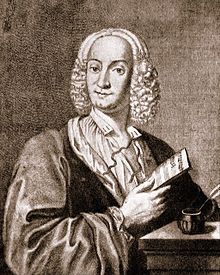
In September 1703, Vivaldi became maestro di violino (master of violin) at an orphanage called the Pio Ospedale della Pietà (Devout Hospital of Mercy) in Venice. it seems that the orphans in this facility came from a similar source to those in at the Ospidale gli Innocenti in Florence but by this time the orphans were more likely to be supported – and even acknowledged by their fathers – and many lived a quite well to do lifestyle.
In my leaflets and on my website I promise to go “Beyond the Four Seasons” with my musical activities in the city of Florence, often in collaboration with my friend Federico Maria Sardelli, who is passionate about all music from the Baroque period and conducts and plays all over Europe. Federico has even presented his story of the Life of Vivaldi to some of my guests in the small church of SS Annunziata in Florence
Federico is always on the look out for lost works of Vivaldi to authenticate and catalogue – Vivaldi himself claimed to have written 94 operas and so far just over 50 have been found so there is plenty of research work to do.
Whilst Federico is naturally working finding the obscure pieces and making some glorious CD’s and concerts it sometimes it doesn’t hurt for us to revisit the popular music – to be fair – it is usually popular for a reason – and usually that reason is that it is simply wonderful.
The Four Seasons is like that – it tells a very simple tale – that almost everyone can relate to – with musical eloquence. The four violin concertos, (available to listen to through the Four Seasons link above) each depict scenes appropriate for each season, They were written in 1725, the year Vivaldi returned to Venice from his four year sojourn in Rome – it says much for his massive output that he also wrote four operas in the same year.
The Four Seasons are based on four sonnets reputedly written by Vivaldi himself – which invoke country life in each season.
The translations below were provided by the The City of Oxford Orchestra for their performance at the Sheldonian Theatre last night.
Spring
Primavera is not exactly as seem below by Sandro Botticelli – no graces or cupids – but it does have zephyrs, dancers and a flower strewn meadow – and the bird’s singing – once identified as bird song – can be heard as nothing else.

Allegro
Spring has come , and joyfully the birds welcome it with cheerful song,
and the streams, at the breath of zephyrs,
flow swiftly with sweet murmurings.
But now the sky is cloaked in black and thunder and lightning announce
themselves, when they die away, the little birds
turn afresh to their sweet song
Largo
Then on the pleasant flower strewn meadow
to the gentle rustle of the leaves and branches the goatherd resta,
his faithful dog at his side
Danza pastorale: Allegro
To the rustic bagpipe’s gay sound, nymph and shepherd dance beneath the fair spring sky in all its glory
Summer
To me this image below captures the fierce unrelenting Tuscan heat which often turns to thrashing thunderstorms, which flatten the crops

Allegro non molto
In the torrid heat of the blazing sun, man and beast alike languish,
and even the pine trees scorch, the cuckoo raises his voice,
and soon after the turtledove and finch join in song
Sweet zephers blow, but then the firece north wind intervenes;
the shepherd weeps. anxious for his fate from the harsh menacing gusts.
Adagio/Presto
He rouses his weary limbs from rest in fear of the lightning,
the fierce thunder and the angry swarms of gnats and flies
Presto
Alas! his fears are justified , for furious thunder irradiated the heavens, bowing down the trees and flattening the crops.
Autumn
This party starts with a dance, pauses for a drunken nap but ends with a fearful pursuit and the death of the prey – and the huntsmen’s tramping feet as they carry him off to eat at the next feast.

Allegro
The peasant celebrates with song and dance his joy in a fine harvest and
with generous draughts of Bacchus’s cup
his efforts end in sleep
Adagio
Song and dance are done; the gentle pleasant air and the season
invite one and all to the delights of sweetest sleep.
Allegro: La Caccia
At first the nuntsman sets out with horns, guns and dogs,
putting his prey to flight and following its tracks,
Terrified and exhausted by the great clamour and guns and dogs,
wounded and afraid the prey tries to flee but is caught and dies.
Winter
Okay this painting isn’t Italy!- but it is evocative of the poem – and I can imagine these guys stamping their feet whilst their teeth chatter – and I can hear the melting ice dropping from those roof tops!
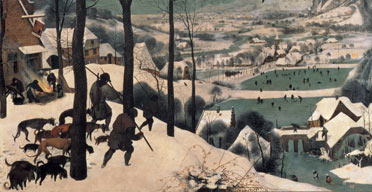
Allegro non molto
To shiver icily in the freezing show in the teeth of a cruel wind,
To stamp your feet all the time
so chilled that your teeth chatter.
Largo
To remain in quiet contentment by the fireside
while outside the rain pours in torrents. To walk on ice,
with slow steps in fear of falling, advance with care.
Allegro
Then to step forth strongly, fall on the ground and again run boldly
on the ice until it cracks and breaks,
To listen as from the iron portals rush winds from the south and north
and all the winds in contest,
Such is winter, such the joy it brings
attributed

