
21.11.11
Marie de Medici (26 April 1575 – 4 July 1642)
Statue of Marie de Medici in the Luxembourg Gardens in Paris
Statue of Marie de Medici in the Luxembourg Gardens in Paris
Marie de Medici, was considered a great beauty when she, like most females born into wealthy families of her time, was offered in marriage as good breeding stock and, most importantly, to her husband Henry IV of France, she was also a provider of a substantial dowry (600,000 crowns)

She kept her breeding part of the bargain promptly as her eldest son, the future King Louis XIII, was born at Fontainebleau the following year.
Her other children were later well married off into Royal families across Europe, – into lineages that would have seemed incredible to the original members of the Medici Family – particulary Cosimo the Elder who always made great pretension to not having political ambition.
Marie and King Henry’s other children include Elizabeth, Queen Consort of Spain, Christine Marie, Duchess of Savoy, Gaston Duke of Orleans, and the luckless Henrietta Maria, Queen of England and Scotland whose husband Charles 1st came to an unfortunate end partly due to her Catholic religion and also her intransigence – particularly in respect of her husband’s divine right as a King!
Marie herself was born in Florence on April 26 1573, the youngest daughter of Francesco I, Grand Duke of Tuscany and his unhappy wife Johanna, Archduchess of Austria.

Above – from the famous cycle of paintings by the French court painter Rubens we see the bride to be descending from a ship proudly displaying the Grand Ducal Medici Coat of Arms and being welcomed to her new home in France by a personified France, wearing a helmet and a blue cloak with golden fleur-de-lis.
But this idealised welcome was far from the truth, as in reality Marie’s marriage to Henry IV in 1600 began very badly as she – like her mother before her – found herself married to a man who was deeply in love with his mistress, in this case Catherine Henriette de Balzac, who only ever looked to his new wife to do her duty and produce suitable legitimate heirs.

Unlike her mother however Marie fought back – loudly – according to historians “His words may have been cutting, but she had a choice vocabulary of crude ones” but in common with her mother Marie did become more bitter and disenchanted with her lot.
Now we come to Marie’s adaptation to change – when her marriage was cut short- dramatically – on May 14, 1610, as the King was stabbed to death in the Rue de la Ferronerie in Paris by religious obsessive François Ravaillac ( shown in the image below displaying all the signs of the crazy man he was!)

Only two and a half hours after his assassination, showing some political prowess, Marie, who had only been crowed as Queen the day before her husband was murdered , was next recognized by the Parisian Parliament as the new Regent of France.

The Dauphin, Louis XIII was only nine-years-old at the time of his father’s death. So like her aunt, Catherine de Medici , Marie rapidly took charge and reigned as Regent from on behalf of her son – shown below at the time of his ascendency to the throne in 1610 – until 1617.
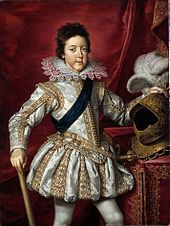
Even more extraordinarily in terms of adapting to a change in circumstance was that according to the unflattering historical notice at the gates of the garden the very next day after the death of her husband , when you might have thought she was going to be busy running the country, Marie commissioned the building of the new Palais de Luxembourg, basing the design on that of her home palazzo in Florence –

The Pitti Palace – calling her new home her Palais Médicis – and developing also a formal garden to rival that of the Boboli Gardens in which she had played as a child.

Sadly for Marie she never actually lived in her ideal palace as her Regency with Louis V111 turned out to be no more happy than her aunt Catherine’s had been with any of her sons, and in 1617 she was exiled to the castle at Blois having lost the battle for the heart and mind of her weak son against the formidable, soon to become Cardinal, Richelieu.
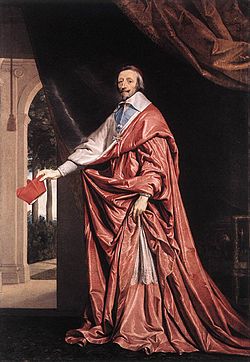
At the same time her favourite courtier Concino Concinia, a nobleman from Florence was assassinated, officially because he had “resisted arrest” and undoubtedly under the orders of her son.
Although Marie did escape from Blois in 1619 and became briefly reconciled with her son and Richelieu the French public never really liked her and her continuous unsuccessful attempts to displace Richelieu in her son’s favour ultimately led to her attempted coup.
One single day in November 1630, known as the “Day of the Dupes“, she seemed to have succeeded but Richelieu quickly found and used her correspondence in setting up this coup and in 1630 she was exiled a second time – further afield to to Compiègne.
Undaunted Marie was also clever enough to escape yet again and went in some triumph to Brussels in 1631 and Amsterdam in 1638 where her visit lent official recognition to the newly-formed Dutch Republic; and she was given a ceremonial royal entry, – the sort of welcome the Republic avoided for its own rulers!
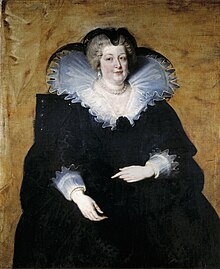
Marie de Medici was never again accepted by her beloved son and she finally died in exile in Cologne, still scheming against the hated Cardinal Richelieu.
