
Jeanne Modigliani (29 November 1918 – 27 July 1984)
I have updated this Blog as a result of the increased interest in Modigliani aroused by the splendid current exhibition at Tate Modern (23 Nov -2 April 2018)
Jeanne Modigliani was brought up in what is known as “the most modern Tuscan town” – the Port of Livorno – before going to Florence to laureate in History of Art.
She had been adopted by her paternal aunt, Margherita Modigliani after she was brought back from her Grandparents home in Paris, France by her paternal uncle, Socialist leader Giuseppe Modigliani – a man who was much better known than his younger brother, the artist, Amedeo at that point in time.
Her childhood was never discussed and until she reached adulthood so she was unaware of the lives and tragic deaths of her parents, who both died when she was only 14 months old.
Jeanne’s mother was Jeanne Hébuterne, who was herself an accomplished artist but is now better known as an artist’s muse and model.
She was born into a strict Roman Catholic family. Jeanne Hébuterne‘s father, Achille Casimir Hébuterne, worked at Le Bon Marché department store in Paris and liked neither artists or Jews, so was not impressed by her choice of lover- Amedeo Clemente Modigliani, who was both.
Worse – he was 14 years her senior and living “La Boheme” – the life of a penniless artist in Le Bateau-Lavoir, a bohemian commune in the Montmartre district of Paris.
Not yet recognised for his talent as an artist poor Amedeo Modigliani was certainly not deemed suitable for their precious, beautiful daughter.


Modigliani himself had been born into a family whose fortunes had oscillated between riches and poverty, so he was no stranger to living on the edge of ruin – in fact, his birth coincided with the ultimate disastrous financial collapse of his father’s business interests.
According to the tales Amedeo told around the Parisian bars, his timely birth saved the family from ruin. They took advantage of an ancient law under which creditors were prevented from seizing the bed of a pregnant woman or a mother with a newborn child. The Modigliani film starring Andy Garcia shows his mother, Eugénie Garsin, going into labour on a bed piled high with the family’s most precious assets even as the bailiffs arrived at the door!
In later years his loving mother more than repaid the favour through encouraging her sickly son to pursue his love of art and taking him to study the old masters in the Uffizi and the Pitti Palace.
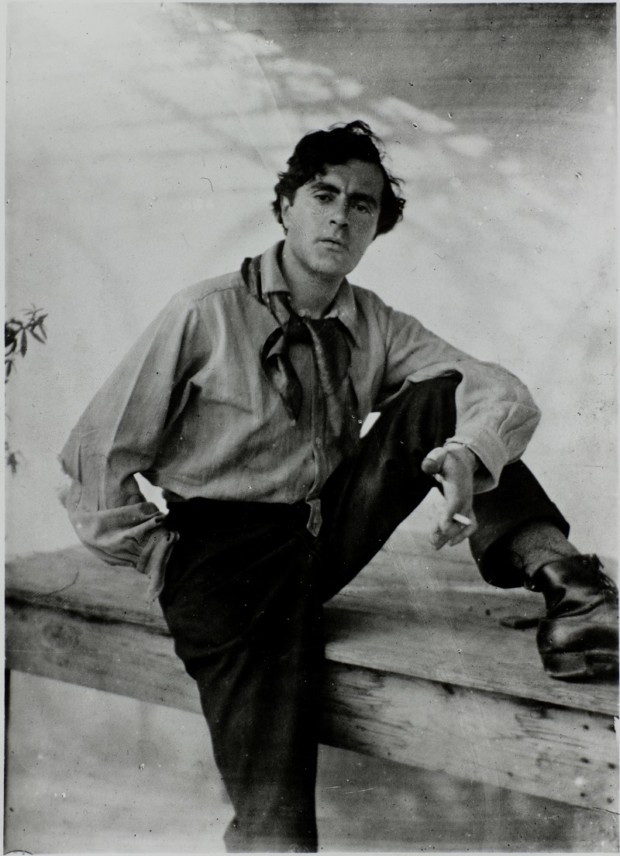
Modigliani’s debauched life in Paris quickly turned him from a dapper boy struggling to be an artist, into a dirty artist struggling for his life. From 1914 Modigliani’s use of drink and drugs intensified and after years of remission the symptoms of tuberculosis got worse. It is unlikely that when he was introduced by the Russian sculptor Chana Orloff to his model, the 19-year-old Jeanne Hébuterne, that he was still a pretty sight – but he had not lost his Italian charm and she fell devotedly in love and set out to save him!

To try and improve relations with his “out-laws” through distance – and also by gaining some wealthy clients to improve their living standards in 1918 the couple moved to Nice – where Jeanne Modigliani was born.

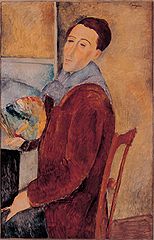
Although her father painted some of his most sought-after work during that period, including the portraits he and Jeanne made of each other, he only made a small amount of money, so the family moved back to Paris – where Modigliani’s health continued to deteriorate and he had increasingly frequent alcohol-induced blackouts. The portrait below is his final self-portrait.
Modigliani died on January 24, 1920, and despite the fact that the couple were so poor, Modigliani had a lavish funeral paid for by his loyal friends from the various Montparnasse cafes and bars frequented by the painter.
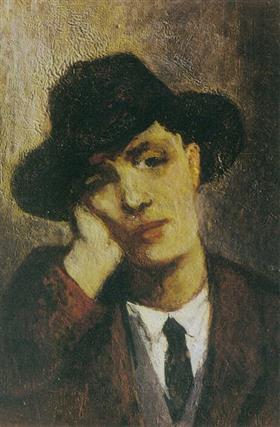
Portrait of Amedeo Modigliani by Jeanne Hébuterne
A large crowd of these fellow “Bohemians” followed his coffin across the district to where was buried in the famous cemetery of Père Lachaise.

Jeanne Hébuterne could not bear the thought of life without her lover and despite the fact she was nearly full term with their second child, the following morning at 3.am she threw herself to her death from the window of her parent’s house.
Blaming Modigliani for Jeanne’s death, her parents quietly buried her in Cimetière de Bagneux, somehow covering up the fact that she had committed suicide so she could be buried in holy ground. After ten years and the death of her father, the family finally allowed Jeanne’s remains to be buried with her beloved Amadeo in of Père Lachaise. .Her epitaph reads: “Devoted companion to the extreme sacrifice.”
Thus 14-month-old Jeanne Modigliani was left to be taken care of by her distraught grandparents – who evidently didn’t really want the child.
Enter the paternal uncle, Socialist Giuseppe Modigliani who arrived in Paris to whisk her back to a loving home, and by June 1920, Jeanne Modigliani was living with her aunt in Florence. Their aim was to bring her up far from the Bohemian life she had led in Paris. This they succeeded in doing so well she claimed to remember nothing of her former life. In March 1923, Jeanne was declared legitimate based on the statement signed by Modigliani in 1919 that he intended to marry her mother. This was hugely important as the value of Modigliani work soared after his death and the arrangement with his agent was that one-fifth of the proceeds of any sale of Modigliani’s work went to the artist or to his heirs..
However despite her inheritance life was not to be easy for the child of Modigliani either, and as Fascism deepened its hold on Italy poor young Jeanne was identified and persecuted as a Jew. Most of her Modigliani family were forced into exile in Paris in 1926, after Mussolini’s rise to power.
So, in 1939 she too left Italy and, like her father before her, took refuge in Paris!
Before the outbreak of WW2 Jeanne Modigliani married Italian economist and journalist Mario Cesare Silvio Levi. She also became an ardent Communist.
photo of Jeanne Modigliani standing beside a self-portrait by her mother
When France was occupied by the Nazis during World War II, she joined the rural Maquis, aka the French Resistance, and in 1943 she was imprisoned for political reasons’ but managed to get released through the help of some forged documents.
During this time she met another Resistance fighter, Valdemar “Valdi” Nechtschein, who was eight years older than her and also married, and they began a 30-year love affair. In May 1946, Jeanne gave birth to their daughter, Anne. After some years of only seeing one another at weekends, they divorced their spouses, married one another, and had a second daughter, Laure Nechtschein, in 1951.
Sadly the end of their romance led to Jeanne and Nechtschein divorcing in 1980.
Jeanne Modigliani, died Friday afternoon 7.9.1984 in Paris at ‘La Pitié Hospital, where she was hospitalized after a fall that had caused a brain haemorrhage.
She was sixty-six.
Probably her most lasting Heritage was the Biography of her father that she wrote in 1958 – the product of intensive research when she finally discovered who her real father was!
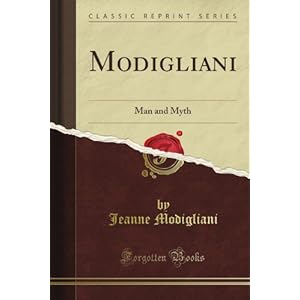
Modigliani, man and myth, was later translated into English from the Italian by Esther Rowland Clifford – and the book is now available through Amazon in the Classic rePrint series.

Besides a couple of spelling mistakes – interesting
Thanks – also for the tip about the spelling mistakes – I get a bit word blind with these late night blogs!
Thank you for the information!!! , I dont know why but in others website I read that she died of alcoholism???
Thanks for the message – actually I expect the two things – a fall causing a brain haemorrhage and alcoholism – are not mutually exclusive – possibly the information I read was being polite – and I certainly cant blame her for turning to alcohol!
Where is Jeanne Modigliani Nechtschein buried?
According to the newspaper reports of the time she was to be buried privately in the Pere Lachaise cemetery in Paris , where her father was buried. I have to confess that despite visiting the Cemetery in Feb this year I was unable to locate either tomb. Best of luck Penny
Thanks for the history. Do you know if his daughter ever benefited financially from his eventually priceless work?
Excellent question – I need to do a bit more research to find the answer to that – One would hope so! Have you seen the exhibition at Tate Modern yet?
Further research shoes that daughter Jeanne was legitimised on the basis of a letter from Modigliani confirming that he definitely intended to marry Jeanne Hebuterne. I have updated the post to show this and also how important it was as it entitled his Heirs to 1/5th of any money made on these painting and his fame and value shot up after his early death. Zborowski, who is featured in the Exhibition at Tate Modern, appears to have been an agent and he must have made an awful lot of money – but at least the ophan Jeanne had a goodly inheritance!
I’m going to the Tate Modern on Tuesday to see the exhibition as well as the reconstruction of Amedeo’s Studio from Rue de la Grande Chamiere.(?)
Will keep you all posted.
MDF
It is very clever – worth the queue because it is so unexpected – enjoy it!
Excellent exhibition at the Tate Modern. Worth queuing for the VR studio.
Wonderful Exihibtion at the Tate by the amazing modigiliani
Indeed – I have already seen it 5 times – amazing how he gives so much character to such simple shapes.
However, FYI I have updated this Blog in the light of new information. If you would like to check out http://www.beyondtheyalladog.com/2018/01/modiglianis-daughter-jeanne-2/
I have lived in Spain for 40 years and I was fortunate enough to visit
a wonderful exhibition of his work many years ago in Madrid. I am an
artist and much of my own style has come form my deep love of his paintings.
Where are Amadeo and Jeanne’ s grandchildren now? ( I mean , Anne and Laure). Do they also have children?
I regret to say that I don’t know the answer to this – I will do some more research. Thanks for the question.
Jeanne had two childeren, Anne who died, and Laure, still living in Paris
Thank you so much for this response Ingeborge – I hope that Mariam will pick up on this below – Thanks again
Please see the response above from another reader juanitadeblende.idb@gmail.com – thanks again for both question and the response. Now to find Laure in Paris?