
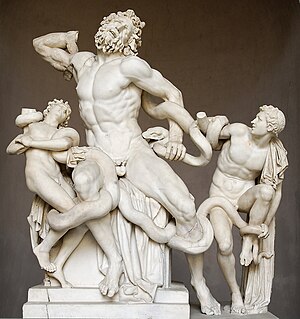
In 2005 Lynn Catterson, a summer lecturer in art history at Columbia University, presented an argument that this sculpture of Laocoon and his sons, shown above , was far from being an original ancient Roman statue and had in fact been sculpted by Michelangelo himself.
She presented this argument in a talk at the university’s Italian Academy for Advanced Studies in America on April 6 2005 and for a while had the Art World embroiled in frantic dispute.
She had done some thorough research through a wealth of material — including Michelangelo’s drawings, records of his banking activity and his acknowledged reputation as an avid seeker of fame and fortune to prove her contention and declared at her lecture that ” Michelangelo had the motives and the means.” Clearly Michelangelo was interested in sculpting and painting writhing tormented figures tormented by snakes and other demons.
Michelangelo also had “previous” in relation to falsifying the provenance of antique sculptures having buried his own sleeping Cupid earlier in his career in 1497 to “age it up a bit” . Sadly that bit of Michelangelos’s work was believed to have been destroyed in 1698, in the great fire in the Palace of Whitehall, London
After analyis however, Catterson’s suggestion was finally thoroughly discounted.
In fact this ancient sculpture is one of the most copied and influential pieces of art work – starting from it’s re-discovery on Jan. 14, 1506, on the Esquiline Hill. When it was found Pope Julius II immediately dispatched the Florentine architect Giuliano da Sangallo to view it; Sangallo took his Florentine colleague Michelangelo Buonarroti with him for his opinion. Michelangelo was undoubtedly influenced by the work.
This original sculpture shown above, which is still not firmly dated – has estimates of its date of origin ranging from about 160 to about 20 BC. It has always been stored in the Vatican Museums.
In 1520 the Florentine sculptor Baccio Bandinelli was commissioned to make a copy by Pope Leo X de’ Medici. The intention originally being to offer it as a gift to King Francis I of France, but unfortunately Pope Leo X died before the work was completed.
However when his cousin Guilio de Medici ascended the Papal Throne as Pope Clement VII he recommissioned the work from Bandinelli, but he decided to keep it in the family and sent it to Florence. And after all Francis I didn’t do too badly – he got Cellini’s Golden salt cellar and then a whole hoard of additional Medici Money came as a dowry with his Daughter in Law Catherine De Medici!

Bandinelli’s version, which was often copied and distributed in small bronzes, is held at the Uffizi Gallery in Florence, complete with plinth dedicated to Pope Clement XII. Bandinelli changed the position of Laocoon’s arm slightly and most of the subsequent copies copy his interpretation rather than the original, where the arm is bent back and the hand broken off.
The story of Laocoon, a Trojan priest of Poseidon, with his two sons Antiphantes and Thymbraeus, being punished by Neptune for striking the Trojan horse to warn his country men of the falsity of the gift that was to bring down the City of Troy, has fascinated many artists – including Titian – who depicted the family as somewhat cartoon monkeys
and later El Greco – shown below. An artist who took the school of Mannerism to a contorted extreme unknown even in Florence.

By 1812 this painting by Francesco Hayez, has the dying family dressed in Greek Togas and a rather more Greek environment
And this blog came into my mind having seen the current exhibition by Roy Litchenstein at Tate Modern this week -Here amongst this later works is Lichtenstein’s own nightmare vision of the family being strangled by sea serpents – complete with his trademark dots and the truncated bent back arm of the original.
The Lichtenstein exhibition continues at the Tate Modern until May 27 2013
For more information about Lichtenstein you might also like to visit Artsy an online magazine with information about Art, Artists and Exhibitions.

I love watching a motif evolve and replicate through the ages! Being art-viewing greedy, and even though I am soon to join you in Florence for adventures yet named, wish I could’ve also been in London with you for theTate exhibit — love that place!!
Hi Barbara – as you know you are more than welcome to come and visit London with me and devour as much Art as we have time to see!