
Saints Alive! Reincarnation in 2013 – by Michael Landy
The National Gallery in London must be very pleased that they chose Michael Landy as their Rootstein Hopkins Associate Artist in residence, allowing him the luxury of time to create some original new art – and thus to introduce a new audience to the many Italian Renaissance religious paintings featuring Saints that they have there.

Since coming to live semi-permanently in Florence I have also become fascinated by the tortured lives, and the frequently macabre methods by which the enemies of Christianity attempted to kill these religious fanatics. The interesting feature being that the more obscure the method used , the less successful a method of despatch it seems to have been, all their strange devices leaving the Saint with an interesting story – plus an unusual symbol to be recognised by – and their frustrated enemy with little choice but to resort to the more effective solution of de-capitation!
If you can make it out from the small images St Catherine of Alexandria’s story shown below it is a classic. Young Catherine, having defeated the arguments of Roman Emperor Maxentius, and many his followers, whilst trying to persuade him not to persecute those Christians who were not worshipping the Roman idols , had to stand by whilst he put all the converted followers to the sword. These included his own wife, who had been overwhelmed by Catherine’s convincing words – and Maxentius was not slow to try to fill the vacancy by proposing himself in marriage to this beautiful intelligent virgin princess! Catherine turned him down on the basis that she had already promised herself as spouse to Jesus Christ. To whom she had already consecrated her virginity.
The Roman Emperor was enraged by her rejection of his offer and condemned Catherine to death on a spiked breaking wheel, but, once she was tied to the wheel the instrument of torture was destroyed – according to local legend – by the intervention of an angel.
Catherine subsequently ignored the conditions of her reprieve and continued to preach the gospel of Christianity so finally Maxentius arranged to have her beheaded.
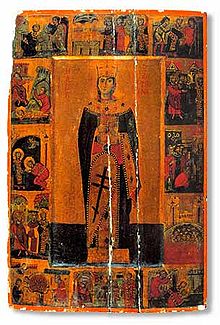
Catherine’s story has been updated fairly recently as in 1969 the Catholic Church declared her story and her miracles unproven and removed her feast day from the General Roman Calendar
Michael Landy was born in London in 1963, he studied at Goldsmiths alongside Damien Hirst and Sarah Lucas. His work varies from epic performances to meticulous drawings and collages both of which media are also shown in the exhibition.
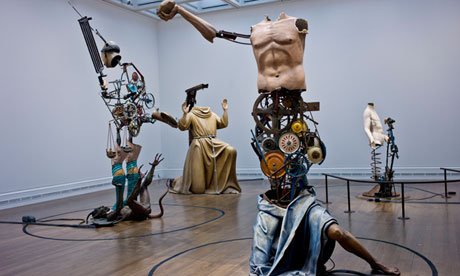
The Saints depicted include Apollonia, Catherine, Francis, Jerome, Thomas – and an multiple moving part sculpture that shows a number of parts of various saints – including Florence’s own St Lawrence with his gridiron – having pain inflicted upon them.
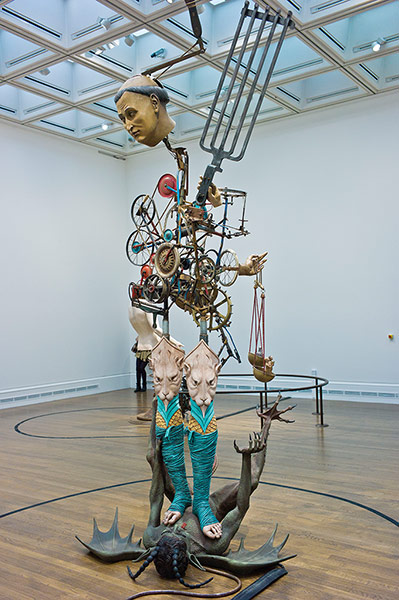
Taking his inspiration from Yves Tinguely, whose work is shown below, Landy also used spare parts to create his Saints. We are told in the exhibition catalogue that Landy scoured flea markets and car boot sales to accumulate all these pieces of old machinery, especially cogs and wheels that he needed to construct these kinetic works.
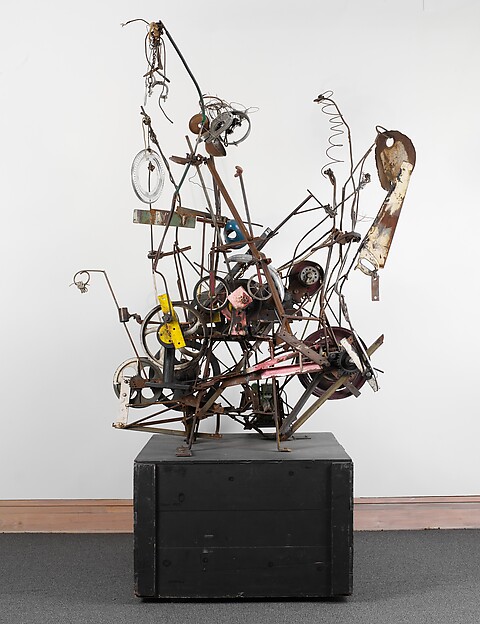
Jean Tinguely’s Narva, 1961, Metropolitan Museum of Art.
But the trick is that they have also been designed using images from various parts of the paintings he had been studying whilst in the gallery. The legs of St Michael killing the Devil are taken from the painting by Carlo Crivelli painted in 1476
 And the gruesome image of St Lucy holding out her eyes on a platter as usual , and St Peter Martyr with the axe still in his head also come from paintings by Crivelli

Visitors can – and have been cranking the works into life with a foot pedal mechanism – perhaps a little too vigorously because some of them have broken this week and whilst St Jerome was still vigorously punching his chest with his stone – the stigmata was no longer lasering down upon St Francis in his lucky dip and the doubting hand of St Thomas was no longer thrusting itself into the wound of Jesus.
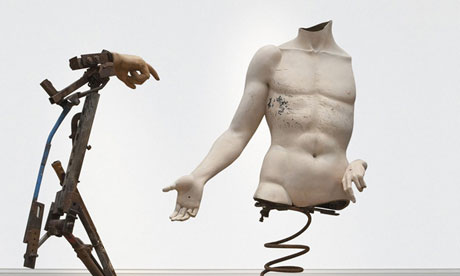
But this breakdown is not a tragedy – this – coupled with the size of the queues for entrance – only shows how successful this latest National Gallery show has been – and to be honest Landy’s drawings and collages showing his thinking process are almost as interesting as the moving parts.
That said, I do hope that they do get the parts moving again so the exhibition can continue to draw a more diverse audience into the National Gallery – and pop a little more money into St Francis’s special collecting box – even if that means still further battering for the poor saint’s head!

Wow, that looks like a fantastic exhibition, Penny, what a fantastic artist Michael Landy is! Wish we were stopping in London on our way home, we’d love to see it. Many thanks.
Wow, that looks like a fantastic exhibition, Penny, what a talented and thoughtful artist Michael Landy is! Wish we were stopping in London on our way home, we’d love to see it. Many thanks.