
The Baptism of Christ by Andrea del Verrocchio and Leonardo da Vinci
In 1472 one of the most busy workshops in Florence was that of Andrea di Michele di Francesco de’ Cioni, – better known as Andrea del Verrocchio. (true-eye)
At that time the 37 year old artist was at the height of his powers and had recently handled commissions as diverse as creating and installing the famous gilt-bronze ball on the top of the Duomo and designing the monument to Piero and Giovanni de’ Medici in the Old Sacristy of San Lorenzo .

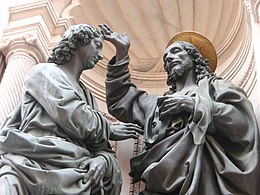
Another sculpture he had already completed was the ground breaking bronze of Christ and St. Thomas purpose built for the centre tabernacle of the Church of Orsanmichele.
This sculpture was replacing the single figure of St Louis of Toulouse so Verrocchio had been faced with the challenge of creating a sculpture of two people that would fit within a space originally designed for only one.
His elegant solution was to twist both bodies so they are facing one another and a large part of the body of Thomas is actually outside the alcove – generally believed to be the first Renaissance sculpture with a freestanding figure balanced on only one leg.

A busy workshop like Verrocchio’s was going to need some artistic support and who better to cooperate with the commission from the Church of San Salvi of The Baptism of Christ than Leonardo da Vinci who had been apprenticed to him, when aged 14 in 1466.
Now 20 the young artist was already making a name for himself in Florence with his skills in drafting, chemistry, metallurgy, metal working, plaster casting, leather working, mechanics and carpentry as well as the artistic skills of drawing, painting, sculpting and modelling – but he still needed some money and recognition through an important commission.

According to Giorgio Vasari in his Lives of the Artists , Verrocchio , who was first a foremost a sculptor , was so amazed by the skills of Leonardo displayed within this painting that he put down his own paintbrushes forever and vowed never to pick them up again.
In truth he might not have needed to if his preference was for sculpting and the painting commissions could be handled by Leonardo and other students within the workshop, which also included Pietro Perugino , Francesco Botticini, Lorenzo di Credi and Domenico Ghirlandaio.
The technique of painting artworks in oil paint, had only recently been introduced into Florence by Dutch and Flemish painters and this painting was also a bold step away from the usual fresco and egg-tempera.
The painting is famous in the Leonardo da Vinci room in the Uffizi for showing the early work of Leonardo, and it is undoubtedly a masterpiece, but a lot of the interest showed in this painting is guessing who painted which bits!
Best guess on the parts painted by Leonardo are :- the idealised sweet-faced angel on the left, parts of the body of Christ, the beautifully observed Tuscan background, and the scientifically observed detail in the water around Christ’s feet.
Some critics ascribe the second angel to another young Florentine artist, Sandro Botticelli but most attribute the one on the right to Verrocchio himself – as well as the portrait of Florence’s Patron Saint – St John the Baptist.
Maybe the bird on the right was done by Ghirlandaio – he liked to put them in all his Last Suppers after and there seems to be a formula behind these designs.

The palm tree is clumsy and a bit crude – probably the hand of yet another pupil – and the hands of God and the Holy Spirit seem completely different in style to anything else in the painting!
This generates the confusion with viewing the painting – what exactly is the importance – the subject matter of the Holy Spirit entering the body of Christ with the Holy Water of the river Jordan – or who painted which part?
