
There are some strange prizes on offer for being friends with the winning side in a battle – In the case of Diomede Leoni he won from Francesco I de’ Medici the permission to knock window holes in the City wall of San Quirico Del Orcia to let light into his castle – and was granted the privilege of building the first “public” Italian garden.
In fairness his open “windows on the world” were a sign that the wars between Siena and Florence were over because Siena was now subject to Francesco I de’ Medici the Grand Duke of Tuscany – and there was, in theory at least, less need for fortification.
The first formal garden outside the City wall – called Horti Leonini – was laid out by Diomede Leoni in 1581.

Horti Leonini is a classic formal Italian garden, the first of it’s kind to be opened to the public in the 16th century.

After coffee, some minimal shopping and a quick peek in a 12 century church we drove across the beautiful UNESCO protected valley of the River Orcia to Pienza to see Pope Pius Piccolomini’s concept of an ideal City centre shimmering on its rock face in the distance.

We went through the City Walls – rebuilt in 1955 after having been shelled and destroyed by Allied bombing in 1944 – and were greeted – as always – with a tantalising whiff of aged Pecorino. I could swear that they spray this aroma out of an aerosol can just within the gate to ensure we are salivating like Pavlov’s dogs by the time we get to any of the many cheese shops…!
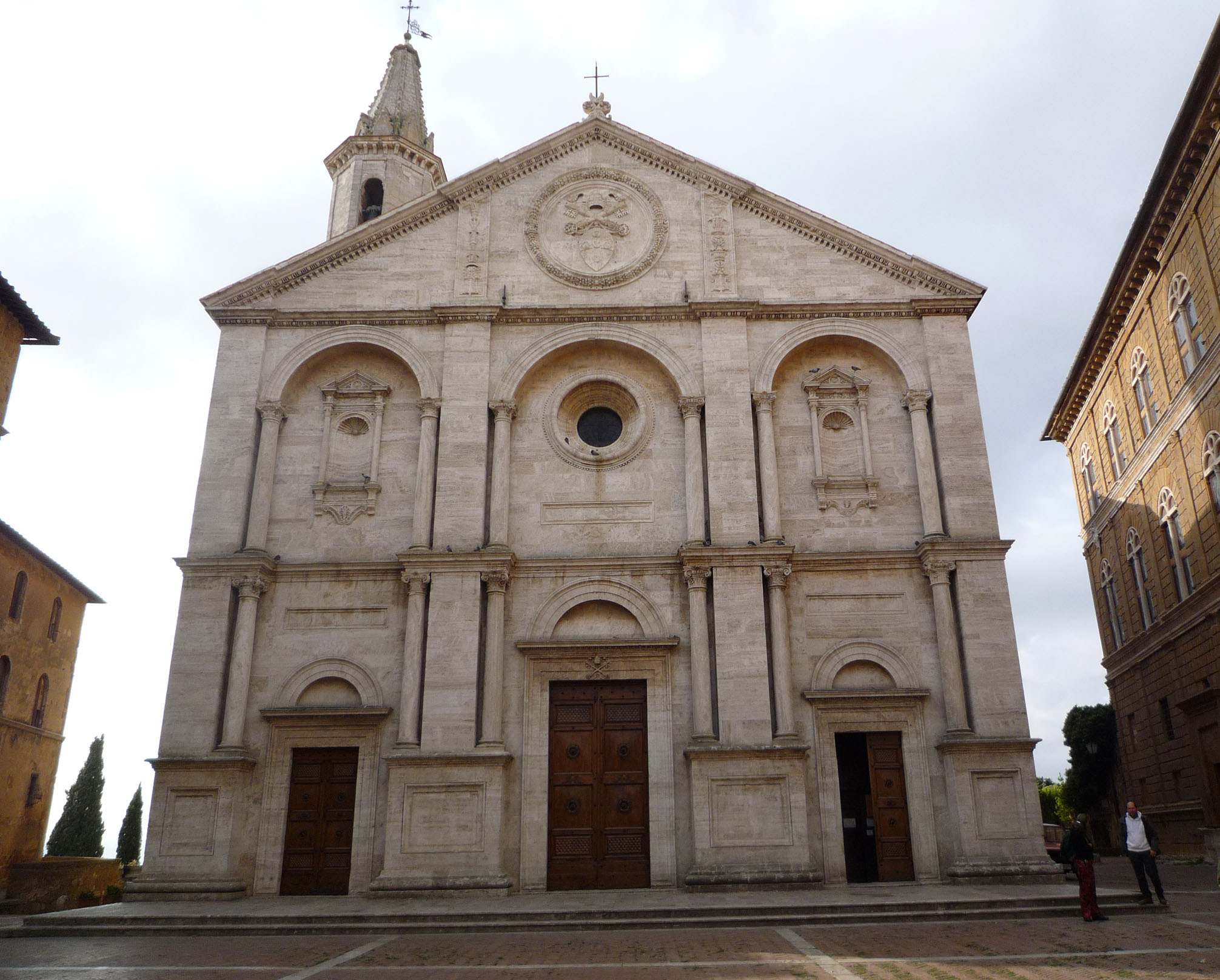 The Church, Papal Palace and Town Hall all surround the same square in the centre of the walled city and Pope Pius 1 encouraged urban development on the main street through the implication that Papal preference would be offered to Bishops and Cardinals who invested in building their own palaces along the High Street through the town – even the Borgia’s built an aspiring nephew a residence there!
Another quick shop and then back on the van to have lunch again in Dopo Lavoro La Foce where our usual fixed price menu was improved by a Dolce – Vin Santo and delicious Cantucci biscuits.

Our overall lunch experience was enhanced by one of us reading from War in Val D’Orcia Iris Origo’s account of what happened at La Foce on this day 70 years ago – 16th October in 1943 ( five weeks after Italy signed the Armistice) –

“Antonio goes down to Chianciano and returns with the news that at Magione a German Captain, as he was driving through a wood , was shot at and killed: he was buried yesterday at Chianciano.
In the evening a Moroccan soldier turns up here , an escaped prisoner from Laterina (prison camp). He can speak only a few words of English and Italian and is very completely lost – travelling north, although he wants to get to Rome. We give him food and shelter for the night and point out the road to the south. “Me ship”he says, “Me not swim” – very slight are his chances of getting home again.
An ominous short paragraph in Corriere della Sera (newspaper) refers to the treatment given to the Italian Soldiers who are imprisoned in Germany. They are not considered prisoners of war, but internati (ie directly under the control of Himmler)but the Fascist Government will “attempt to obtain a mitigation of fate of those who are willing to fight on the side of the German Army”.
I think this is a great snippet to show the risks the Origo’s took sheltering POW’s, escapees of every shape, colour and religion at the same time as the German Officers regularly visited their Farm demanding supplies of food, petrol and mattresses!
After lunch we arrived at La Foce again and Dr Katie Campbell was able to lead us on a private garden tour across this extensive estate.
Our weather certainly exceeded expectations – with a bright blue sky and not a raindrop in sight!

What’s not to like? A lovely group of people in a beautiful garden with some of the most famous views in the world.
After taking the road to Montepuliciano used by Antonio and Iris Origo to escape along the Front Line with 28 terrified children we stopped in that heroic city for a wine tasting and visit to Etruscan tomb at the family run vineyard GattaVeccia.

– and Yes! Some of us did sing along with the music in the mini-van on our way home through one of the most beautiful sunsets I have ever seen!

And what a day it was! An adventure even better than I’d imagined! A wonderful, wonderful garden; great lunch; lovely stop in Pienza; an incredibly good explanation of all by Katie Campbell; charming and handsome Giuliano driving; great small group if us; stop at an excellent winery in Montepulciano and all arranged by wonderful, wonderful Penny Howard! Beyond the Yalla Dog makes Tuscan dreams come true!
SMcC