

The Basilica of San Marco and the Monastery Museum attached are amongst the most popular places to visit in Florence.
This is largely due to the amazing frescos that decorate the Monk’s cells painted by a Dominican monk – generally known today as Fra Angelico. whose image is shown attached from a detail of Deeds of the Antichrist by Luca Signorelli (c. 1501) in Orvieto Cathedral, Italy
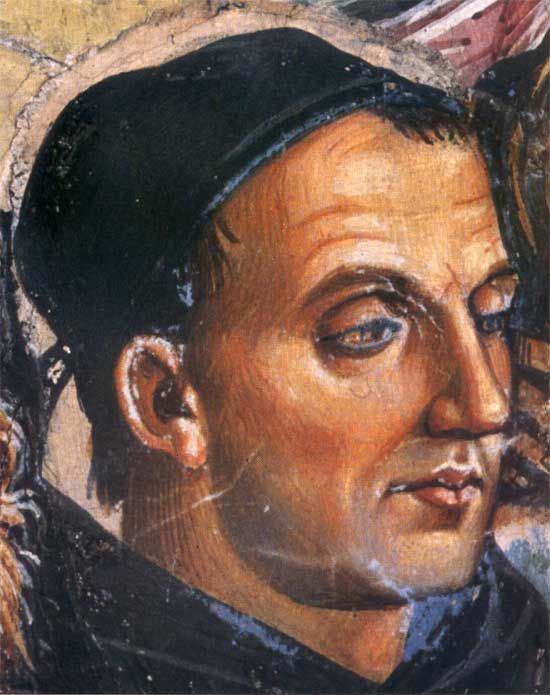
Born Guido di Pietro in 1395, this monk originally took the Saints name of John, so he was initially referred to as Fra Giovanni da Fiesole , where he was first based at the Convent of the Church of San Domenico, Fiesole. This is the massive complex that catches the eye when overlooking the famous view of Florence from the small Franciscan Convent in Fiesole– and is also one of the stops made by the number 7 bus which you can take from Piazza San Marco to this pretty hilltop village.

The lovely view from the Churchyard was sketched by Turner on one of his trips to Italy – this drawing below can be seen by appointment in the library of the Tate Britain Art Gallery in London.
In 1436 Fra Angelico moved down from Fiesole to join the confraternity decorating the Friary of San Marco which had been rebuilt by Michelozzo at the request of Cosimo de’ Medici – who was putting money into the Church as one of his many attempts to atone for what he believed to be his sin of making money through usury.
Cosimo de’ Medici had a large cell reserved for himself at the friary in order that he might retreat from the world and consider his sins – and clearly, if making money was a sin he was bound for trouble, because it was largely through his efforts that the Medici made the money that kept them in power ( give or take a few short evictions!) for over 300 years .
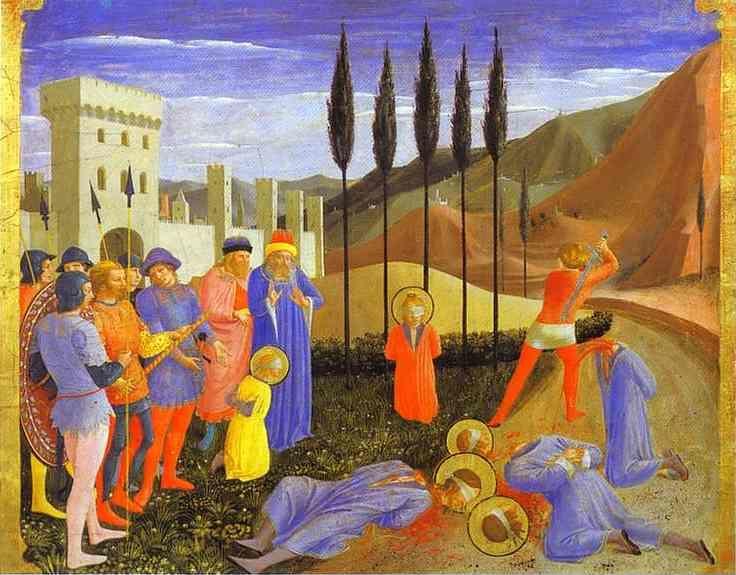
Cosimo had his cell decorated with images of his favourite saints – the Syrian “healers” – or medici – Cosmas and Damian. He not only chose them because he was keen to associate his family name with medicine in preference to money lending but also because he had a twin brother who died at birth who was called Damiano. No doubt Cosimo genuinely mourned the loss of his other half but it did the Medici myth no harm to be associated with popular Saints who had died for their faith. Curiously they seem to have been put to death several times – crucified and stoned in the first painting, burnt at the stake in the second and finally – like other unrepentant Saints such as St Catherine of Alexandria and St Margaret – they were finally silenced forever by beheading.




Also shown are Thomas Aquinas ,St Benedict and Saint Bernard of Clairvaux a Cistercian monk who founded the monastery at Clairvaux and I think the kneeling Dominican kneeling on the furthest right of the picture is poor St Peter Martyr – who was hacked over the head with an assassin’s knife near Milan – Fra Angelico portrayed him a lot in the cells of the monks of San Marco
_-_WGA00616.jpg)
Also in the image are the two thieves – the blond one on the right-hand side of Jesus has repented and seems calm, whilst the one on the left of Jesus – the sinestra or sinister side, is darkly suffering.
Above Jesus’s head is a tablet with the inscription in Hebrew, Greek and Latin which reads “Jesus of Nazareth – King of the Jews”
Around the image on the arch are Old Testament Prophets – they placed between a border of flowers, including Florence’s own symbol of the Giglio, roses and fruits and even the green, red and white border symbolises the patronage of the Medici family.

Finally, at the top of the picture is a Pelican -which I can’t find a large enough copy to use! However known as “the pelican in her piety” these images are often found even before the Renaissance in paintings and mosaics as a symbol of self -sacrifice. This was because they believed that when the female pecked at her own flesh she was feeding her young blood from her own body – whereas, in fact, she was stimulating the regurgitation of food. In these paintings, it is to be seen as a symbol of the body of Christ to be taken during Mass.
Shame to dwell on such an unhappy subject at the end of such a Happy Year, but I hope to help people see these paintings in a new light as a result of a little more knowledge – it certainly helps me to keep interested – and the more you look the more you notice.
Happy New Year everyone!
