

Vittoria Colonna (April 1490– 25 February 1547)
Marchioness of Pescara, poet and muse of Michelangelo.

Vittoria Colonna, by Sebastiano del Piombo, c. 1520
The Colonna were an Italian noble family in Rome with a lot of influence over the Church, even supplying a Pope, – Martin V whose election in 1417 effectively ended the Schism – and the Papal career of Cosimo de Medici’s friend Baldassare Cossa. – in 1431.
Vittoria’s mother, Agnese da Montefeltro , was the daughter of Battista Sforza – famously painted posthumously for her husband Federico da Montefeltro, the Duke of Urbino. Her death-mask portrait below, by Piero della Francesca, (c. 1465–70) is one of the most commented upon paintings in the Uffizi Gallery in Florence.
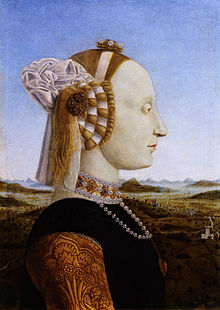
This lady was known to be fluent in Greek and Latin at the age of 10 , and she insisted that her own daughters received the same education as any boy child in the family.
Her granddaughter, Vittoria therefore also benefited from this high standard of education and clearly loved learning!
Betrothed aged four, to six – year old Fernando Francesco d’Ávalos , Vittoria’s hand was sought by many alternative suitors, but even at this early stage she maintained her own mind and when the time came to wed her firm desire was to marry her loving correspondent Fernando – and so she did!

Once married she took as her mentor her husband’s aunt Costanza d’Avalos, Duchess of Francavilla, and became part of her literary group.
Referred to as La Gioconda there have been scholarly suggestions that Constanza could have been the model for non-other than the Mona Lisa!

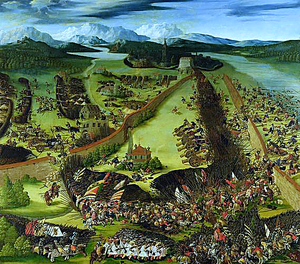
Based on her letters and many stories of the time Vittoria dearly loved her husband, but his early death in December 1525, from wounds suffered at the Battle of Pavia, gave her the opportunity, unusual for the period, to independently develop and maintain her literary contacts and her career .
Later – as a renowned poet – she travelled as an honoured guest from court to court across Italy.
When she first learnt of her husband’s death she was desperately unhappy and tried to take vows to become a nun but her plan was was blocked by Medici Pope Clement VII – possibly because it suited him, and other members of her family including her brother Ascanio, to have a marriageable pawn to create further favourable wealthy alliances!
Vittoria was, however, still her own woman – and withstood their pressure to remarry – in order that she would be able to continue to lead an independent life.
During the Sack of Rome in 1527 , when Pope Clement VII was at his most vulnerable, her husband’s family offered him help to restore the fortunes of the Roman people – however when a little later the French army invaded Naples, the whole house of Avalos fled the peninsula to the sanctuary of the island where Vittoria was betrothed – Ischia.
Whilst living there Vittoria hosted the historian Paolo Giovio who wrote a chapter for his unpublished book “Dialogus de viris ac foeminis aetate nostra florentibus”, which included passages about both Vittoria and her late husband.
Her relationship with Michelangelo began in 1536 when she was aged 46.
She had returned to Rome, where, her intelligence won her the esteem of Cardinals Reginald Pole and Contarini, and the obsessive love and passionate friendship of 61-year-old Michelangelo.

Unusually, as his taste did not normally that way tend and many of his poems are openly homoerotic in nature, the artist wrote some loving sonnets to this woman and was happy to spend hours in discussion with her.
The sonnet below – one of four addressed to Vittoria whilst she was alive is translated by Elizabeth Jennings
To be more worthy of you, Lady, is
My sole desire. For all your kindnesses
I try to show, with all I have of art,
And courtesy, the gladness of my heart.
He also did some drawings of her – one of which is shown below.
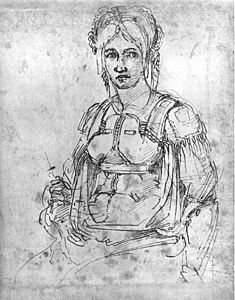
Michelangelo wrote four more sonnets in praise of Vittoria Colonna, after she had died on 25 February 1547 near Rome at the convent of San Silvestro.
A woman in her own right, this strong lady was one of the most popular women poets of sixteenth-century Italy.
I leave you with Michelangelo’s final tribute to her which was read aloud at her funeral
What wonder is it if, when near the fire,
I burned and melted, now that it is cold
I am consumed still with a fierce desire
And turn to ashes, sad and unfulfilled …

Now here’s a lady I didn’t know. More of these Renaissance women please.
Stephen – Your wish is my command! – I am currently reading a book about Caterina Sforza – also known as the Lioness of Forli – she was fearless and definitely worthy of a blog or two!