
The Pearls and Perils of Rome
Let’s get the Perils out of the way first.
I have always been told that the Termini Station at Rome was risky , and that many dodgy people, often working in packs, try to grab handbags or phones from non-vigilant passengers – so I have always been careful and I have got through the terminus unscathed – but not so lucky on this trip!
Unfortunately, although as a result of my experience I will be even more careful, I am unable to offer much advice because I still can’t quite see how they managed to get my purse out of my handbag without me feeling them either close at hand or actually dipping into the bag! I had my hand placed on top of my bag throughout my visit – but as the train guard explained “Sono Bravi!” (They’re Good!) She also told me that a robbery was reported at the station approximately every two minutes, and with 480,000 persons using the station per day thieves have plenty of choice, and I suppose the police are kept too busy dealing with people in crisis to have time to actually prevent the thefts from occurring!
So be aware, and keep all money and possible money containers out of sight and try not to speak anything but Italian as the unsuspecting tourists are the key target. Quite apart from the hassle of losing the money and cancelling credit cards there is also the hazard of Italian Bureaucracy and making a “denunzia” to the Carabinieri to deal with – and I have found that this can involve long queues and most peculiar lectures!
My smartly dressed opponent on Wednesday night , for example, chose to try and harangue me for not being able to present my Carta d’identità – this despite the fact that the loss of this document was top of the list denounced as stolen. To be fair he gave up, albeit reluctantly, when I pointed this out!

The pearls of Rome however, are many and varied, and as the weather was fine for most of the day we chose to walk across the City to many sites and thus saw many other beautiful things on the way.
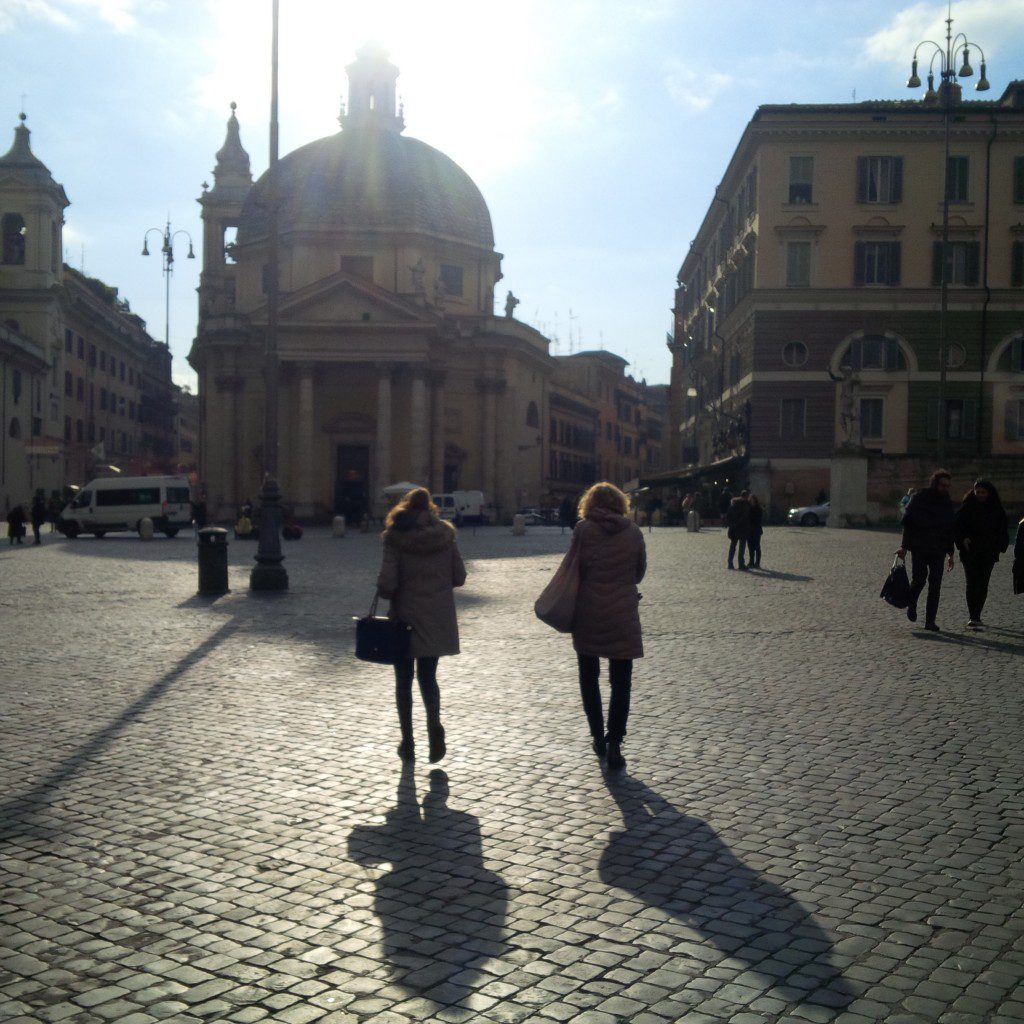
For example we crossed the impressive Piazza del Popolo , with it’s Egyptian obelisk of Ramesses II from Heliopolis that was brought to Rome in 10 BC by order of Caesar Augustus and originally set up in the Circus Maximus. Evidently there was hope for a twin for this obelisk but nothing appropriate was found.
The Piazza does, however, boast two ‘twin‘ churches of Santa Maria in Montesanto (left, built 1662-75) and Santa Maria dei Miracoli (shown in the picture above) which was built 1675-79). Pope Alexander VII commissioned them as part of a monumental design to enhance the entrance of the remarkably straight Via del Corso. The architect of the Pope’s project to enhance this Piazza was Carlo Rainaldi.
The two churches look similar but are not, in fact, identical twins.

We went that way partly to go through the Porta del Popolo, which was an ancient Roman gate of the Aurelian Walls of Rome. The ‘new’ entrance to the Piazza was built by Pope Sixtus IV in 1475 but what we had noticed were the Medici balls on a crest on the external entrance so we went in to try and find out why and when they were added.

This outer façade was commissioned by Pope Pius IV (1499 –1565) who was born Giovanni Angelo Medici, but although he was not particularly connected to the Florentine Medici.- maybe he was connected enough to want to use the family crest? He was Pope from 25 December 1559 to his death in 1565 and initially commissioned the Florentine Sculptor Michelangelo, to do the work. Michelangelo, as was so often the case, didn’t have the time to complete the task so assigned the job to Nanni di Baccio Bigio whose design was implemented between 1562 and 1565.
Once a major entrance to the City this gate was also a toll gate and customs office with two powerful square watchtowers and what look suspiciously like Florentine Giglio garnishing the battlements.




A day in two halves, Penny. We now go by bus to Tiburtina then cab into wherever we are going so we avoid Termini. Last year there was a controversy over whether tourists should be warned. There is strong feeling among authorities in Rome that warnings are not good as they deter visitors. Forewarned is forearmed, I say. And even forearmed does not always work …
I’ll steal your story for my blog.
Hope to see you in F soon. We go regularly but often spur of the moment and too late to organise.
Would be great to meet up again Stephen – Lisa is hoping to do a talk either at new Todo Mondo bookshop or Paperback exchange ( missing BM Bookshop badly!) – will keep you posted! I have also bought a cheap but fortress like handbag especially for such trips!
I shared your experience on my blog – http://wp.me/p4c7cA-74
I guess travellers are getting more and more experienced but a robbery every 2 minutes should put the wind up everyone!
Yes please, keep us in the loop about Lisa’s talks butyl also call you.
Great Blog Stephen – I have also shared on Twitter and Facebook where it has generated a lot of discussion! Would love to meet up when you come to Florence – I am back every month!
Cara ragazza– so very sorry for the horrendous inconvenience of your terminal pickpocketing — and you a truly seasoned traveler — very sobering and I appreciate your reminder to keep vigilant!
What a fantastic photography exhibit you were able to view — such a masterful chronicler of the past century!!!
Can’t wait to rejoin you for your spring cultural arts gita’s!!
Thanks for your sympathy Barbara – I am furious with myself as I usually spot them marking me and avoid this – the worst of it is the nuisance factor of cancelling and reordering cards (mercifully few) I and not being able to get money from the Autobank – but yes take care at all stations – worldwide – but especially Rome!