

I could not ever deny being a huge fan of English writer E.M. Forster – in particular, I love both his Italian themed novels, I think that Where Angels Fear to Tread sums up the Anglo-Italian liaison with frightening accuracy but I was most touched in my schooldays by the love theme of breaking with convention in a ‘A Room with a View‘,
Nonetheless, I have to confess that my all research into the joys of Florence never led me to try and find out more about the pompous Rev. Mr. Eager‘s interest in the artist Alessio Baldovinetti ( 14 October 1425 – 29 August 1499) and his view of Florence from the hills of Fiesole, as shown above. Now, I am fascinated by the sad face presented in his self-portrait below and by some of his works..

Self -portrait of Alessio Baldovinetti
Living in Florence has many advantages when such an interest sparks and some years ago our excellent tour-guide Alexandra Lawrence pointed out the very painting that the pretentious Reverend Cuthbert Eager was referring to when he set the unlikely group of Mr. Emerson, Snr, Miss Eleanor Lavish, Miss Charlotte Bartlett, and the unforgettable young couple-to-be -George Emerson and Lucy Honeychurch, the challenge of finding the exact spot that Baldovinetti had chosen to paint his own view over the Val d’Arno and distant Florence.
No small endeavor considering that the painting was, even then, over 440 years old and the City of Florence had well out-grown its city walls by the time of their visit (circa 1907) I also suspect that Baldovinetti had used some artistic license with the positioning of the stable and the Holy Family?

This painting is the oldest image in the recently refurbished Cloister del Voti at the front of the church of SS.Annunziata in Florence. Once a deserted building that was dedicated to serving the Virgin Mary, in the mid-1200s a group of seven men banded together to form the Order of Servite. and took over the building to continue to promote the cult of Mary. The Church itself and the Cloister of the Voti was redesigned by Michelozzo and redeveloped between 1444 and 1477, partly financed by the Pucci Family.

Most people visit this Cloister to see the Mannerist works of Andrea del Sarto and his two young disciples, pictured above at an elder age, Rosso Fiorentino who painted the Assumption, with some very unflattering portraits of the Roman Soldiers, whilst Pontormo painted a beautiful embrace of Mary leaning towards her kneeling cousin Elizabeth in the Visitation. Their friend, Franciabigio painted the Betrothal of the Virgin. These works were done between 1511 and 1514 together making a group of frescoes of the Life of the Virgin Mary to support the work of the Servites,

In contrast, Baldovinetti’s work was painted over 60 years earlier in 1460, and it does look from a previous age – intriguing nonetheless with its curious pock-marked landscape and the stable in Bethlehem transporting itself so close to Florence! Unfortunately, he also created for himself a problem; Vasari noted in his Lives of the Artists that Baldovinetti’s technique of wall-painting was to begin his compositions in fresco (fresh but quick-drying material) but to then complete them using a secco (dry paint) from a mixture of egg yolk and a liquid varnish. This concept of using varnish was designed to protect the painting from destruction by damp, but sadly, as can be seen in the painting; the parts painted using this method simply fell off the wall – a problem that even the great Leonardo da Vinci struggled with whilst painting his Last Supper in Milan with two similar mixed mediums – with the same resulting damage!
An earlier work, Madonna and Child with Saints was completed by Baldovinetti in 1454, although I know nothing of its provenance I can only imagine was painted to please Cosimo il Vecchio, who was still “ruling” the Republic until his death in 1464. It is clearly a Florentine painting with cypress and laurel trees behind the screen stretched with the latest Florentine fabric – one of the plants having leaves in the shape of a clamshell, the symbol of a virginal birth. Two Patron Saints of the City: John the Baptist and Deacon San Lorenzo stand on either side of Mary and baby Jesus, whilst Cosimo’s favourite saints Damius and Cosimo are hovering with medical tools behind John the Baptist, St Anthony Abbott is carrying his cross as a walking stick as he spent much of his time as a hermit in the desert, and kneeling at the front we have St Francis and St Dominic maintaining social distance from one another as competing mendicants so often did?
Two queries from the painting – could the other Saint be St George? He is holding his red sword with the same preparedness as Donatello’s St George in his niche on the walls of Orsanmichele? I write these Footnotes from Florence Blogs for my own education so if anyone knows for sure please let me know! My other query is the plants perched on the screen – what are they? More of them later!
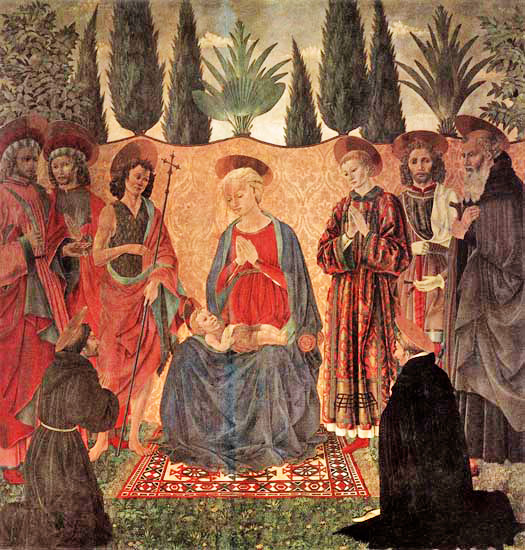
What struck me first about this painting was the carpet, sometimes used as a symbol of recent childbirth, it looks a bit incongruous on top of the lawn sprouting all those delicate Florentine flowers, but it immediately reminded me of Domenico Ghirlandaio’s detailed paintings of such patterned carpets on altars – and guess what? – Baldovinetti was his teacher!

Painted in 1483, the pupil clearly wanted to impress the world and his Tutor with his ability to paint 3-dimensional carpets using shiny paint! There are other paintings in the Uffizi gallery featuring this carpet
So, going back to the unusual plants, I am sure that they have an important symbol as Baldovinetti used something like them again on the sleeves of this Portrait of a Lady in Yellow shown below.- but what are these palm fronds symbolising – the family name?

Baldovinetti very nearly made it into the Cinquecento, dying in the hospital San Paolo, on August 29, 1499. He had remained a working man, occupied with other technical research apart from painting. In particular he became the “go-to” man in relation to mosaic, and between 1481 and 1483 he was employed to repair the mosaics over the door of the church of S. Miniato, – a job that would require a lot of nerve and a good head for heights – and that is just getting up the steps to the Church after the walk up the hill – heaven only knows how it would feel on scaffolding on a windy day!

Alessio Baldovinetti is buried in the Medici church of San Lorenzo, another church worth visiting for the design of the Old Sacristy and many interesting paintings. Very few people know or recognise his name but it seems that much of his style and many of his ideas have been carried forward by other artists across the centuries.

Snr Baldvinetti – I salute you!

Penny
You are not losing your touch, or inspiration, in these times that bring Decameron back to life.
I guess travel is easier for you now while we remain confined to our island continent, possibly into 2022. Our Sep/Oct plans were squashed early and Plan B, Apr/May next year, looks hopeless.
I hope life for you goes on as near as possible to normal and that your writers are still seeking guidance.
Auguri, Stephen
Thank you Stephen for your encouragement- I am ashamed that in such a long period of forced lockdown I didn’t make time to write my Blogs – but there always seemed to be major jobs to do around the house and gardens. I feel so sorry for all of us who have found their life becalmed by Covid-19 and how we have been so restricted to our narrow piece of turf for so long…dependant on the TV for signs of relief, getting some small rewards for good behaviour and then – as in Melbourne -getting put back in their box again. It must end eventually but it will take a long time to reach anything that could be described as “normal” …and before that happens, in the UK we have the impact of Brexit to deal with….. deep despair!