
24.5.12
Allessandro Allori – Allegory , Mannerism and Last Suppers

Hercules and the Muses – this is a classic work by Allessandro Allori – he liked to paint nudes and like his ‘uncle’ Bronzino, and his hero Michelangelo, he liked to paint them in tortured poses!
A prolific painter, and also following in the footsteps of his Mannerist Master Bronzino he also got plenty of work as a portraitist for the Medici family – the generation after Cosimo I , including his son Grand Duke Francesco I and his mistress and later wife, Bianca Cappello di Medici and Don Antonio de Medici, her smuggled-in son.

But I am building a trail of Last Suppers, and I am happy to find that I am not alone in my interest – having run into a couple a few days ago who were also trying to see how many they could see in a week, so my interest in Allori is also in his work on this subject!
Naturally as he was interested in symbolism, his fresco of the Last Supper painted in 1582 for the convent of Santa Maria del Carmine has plenty of symbols – including not just one but two evil cats!!
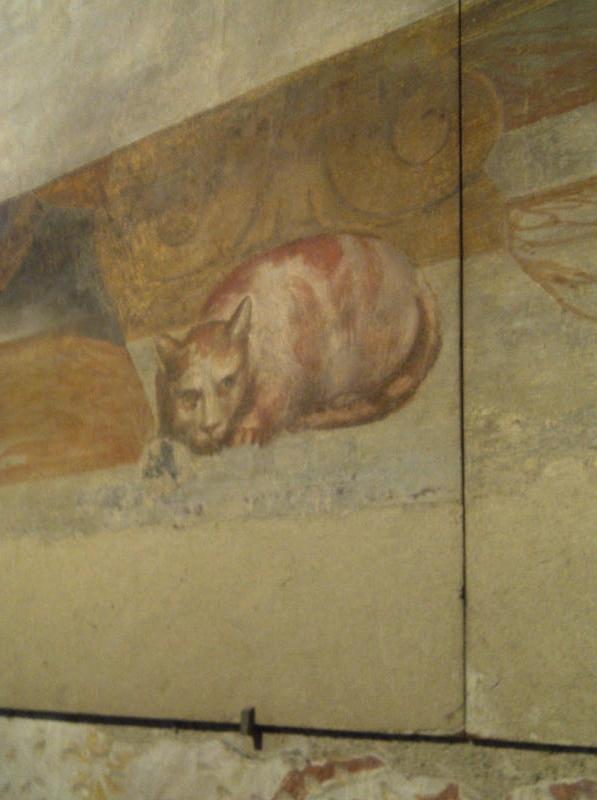
an evil cat skulking under the table!
It is difficult to get the whole of this fresco due to the lighting in the Refectory ( and the position of the sleeping warden shown below!) – but you can hopefully just make out the second cat and the host of symbolic items scattered across the table – and Judas’s expression of “Not me!” whilst clutching his bag of money!
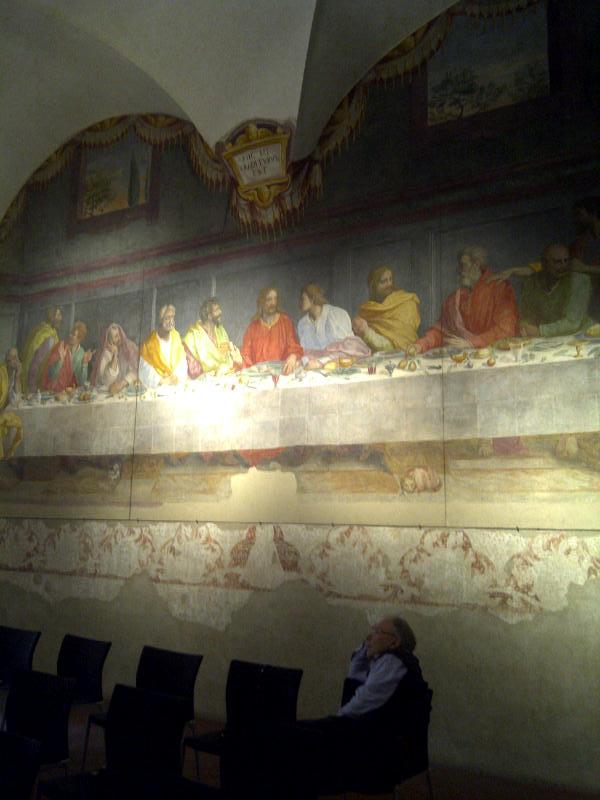
2 evil cats, sunshine at just the wrong point and a sleeping warden!
Below a better image of Judas – next to a rather bemused looking Peter – no aggression, no knife – just stupefaction! Christ appears to have a full chalice of wine in front of him together with bread, salt, olives, lettuce, cherries and other fruit.

just a bit of the other cat and Judas in greeny yellow cloak saying “I never!”
Behind the group two “windows” look out over classic Tuscan countryside and at the bottom of the table is a self -portrait of the artist and a portrait of the the commissioner, who was Father Luke, a Monk from Venice.
A couple of years later, in 1584, Allori began a second Last Supper – this time in oils -for the Cenacolo of Santa Maria Novella – a very different approach and situation – it could have been done by a totally different artist and it took a long time to complete – finished in 1597.

It certainly is a lively painting and it is difficult to see who is who in all this confusion – even when you get as close as you can it is too high to see the details, which is a shame because it is exciting to see a different interpretation and I would like to see more.
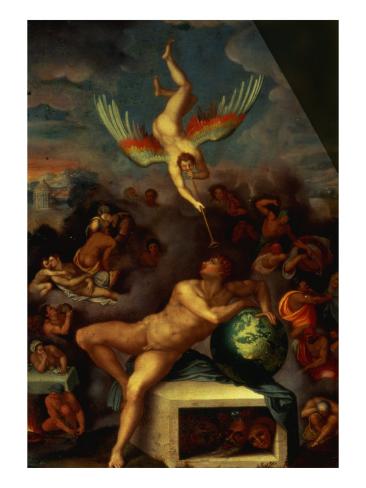
So let’s finish on some more allegory from Allori – the Allegory of Human Life – a dance to the music of time -showing the transitory nature of human existance.

Trackbacks/Pingbacks