
St Andrew – the fisherman from Galilee who became the Patron Saint of Scotland
Post 9
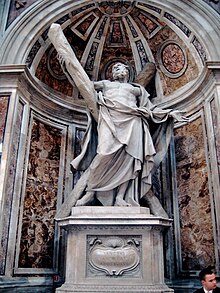
St Andrew’s attribute is a diagonal cross – which explains the Saltire , the National Flag of Scotland , but probably less well known to the Brits is the fact that this Apostle is also the Patron Saint of Ukraine, Russia, Romania, Patras in Greece, Amalfi in Italy, Luqa in Malta, and Esgueira in Portugal – so he is a popular boy! The Saltire – a white diagonal cross on a blue background – is also the flag of Tenerife, the flag of Galicia and the naval jack of Russia

Why the diagonal cross?
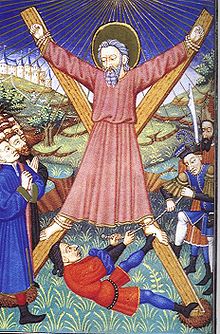
Well, having being sentenced to death for the grave crime of converting Maximilla, wife of the ruler of Patros, Aigeates, to Christianity Andrew, like his brother St Peter , felt he was not worthy to be crucified in the same way as Jesus Christ, so another – possibly even more dreadful – way of crucifying the man had to be thought up to rid the non-Christian world of another turbulent – and successful – preacher!

Legend has it that St Andrew was bound – not nailed – to his cross, which may have meant that although he was an old man of 82 , he took even longer than the average three days on the cross to die – perhaps as many as five days – during which time he continued to preach and converted so many of his audience that they begged Aigeates to show him mercy and release him – Andrew , however, had his own prayer – to die a Christian martyr – answered .

Why is he Patron Saint of all these places?
Well strangely St Andrew seems to have got to even more places after his death than during his life – and his relics seem to have turned up all over the world!
Several legends state that the Relics of St Andrew were brought from Constantinople to the site of the City of St Andrews . However, St Jerome tells us that the relics of St Andrew were taken from Patras to Constantinople in AD 357. Later, in 1461, the remains of the head of Andrew were given to Pope Pius II and kept in the St Peter’s Basilica in the Vatican .
His latest move was in September 1964 when his small finger, the part of the top of his cranium, and small portions and small portions of the cross on which he was martyred were returned by Pope Paul VI , to Patras, Greece where he died,
A few oddments in the form of smaller reliquaries are distributed widely – including the Duomo di Sant’Andrea, Amalfi, Italy; St Mary’s Roman Catholic Cathedral, Edinburgh, Scotland and the Church of St Andrew and St Albert, Warsaw, Poland.
So why Scotland?
During his life a an Apostle Andrew preached along the Black Sea and the Dnieper and Volga rivers as far as Kiev and Novgorod and in Cyprus – but is not -even in legend – reputed to have travelled to Scotland!!
His connection with Scotland is whimsical – the is a legend that states that in 832 AD, Óengus II led a seriously outnumbered army of Picts and Scots into battle against the Angles. Whilst praying for victory Óengus vowed that if he won he would create Saint Andrew as the Patron Saint of Scotland. So when the following morning he saw white clouds forming an X shape in the sky he took this as a good omen that the Saint was on his side!

Emboldened by this symbol of divine intervention Óengus II and his army won the day so the white saltire set against a sky blue background has been on the flag of Scotland – and thus incorporated into the Union Jack – till this day at least – but for how much longer?



Trackbacks/Pingbacks