
Felines and Sealions in Santa Spirito
There is a little museum in what was once the refectory of the Chiesa Santo Spirito.
The building suffered a lot of WW2 war damage – and the oldest fresco on my Chronology of Last Suppers , painted 1343- 1355 by Andrea Orcagna, was almost totally destroyed by a pile of unused trams that had piled against the alter wall.
These two disciples shown below being the last men seated!

At the end of the war the room was turned into museum, and now houses the Salvatore Romano ( no relation to the MadMen!) collection.

This Salvatore Romano was born in 1875 in Sorrento, near Naples.
His ever-increasing interest in art objects developed into a passion for investing in violins, and then other art-works to the extent that he became a renowned antique dealer – and sellers sought him out as a purchaser.
There was already a thriving and irresistible trade in artefacts in Florence so he followed the trail of the expats and moved his business to the city the early 1920’s.
This gave him a central base to maintain his repository of articles, from which he continued to travel around Italy in pursuit of strange or original pieces of antique art – such as this dragon below.

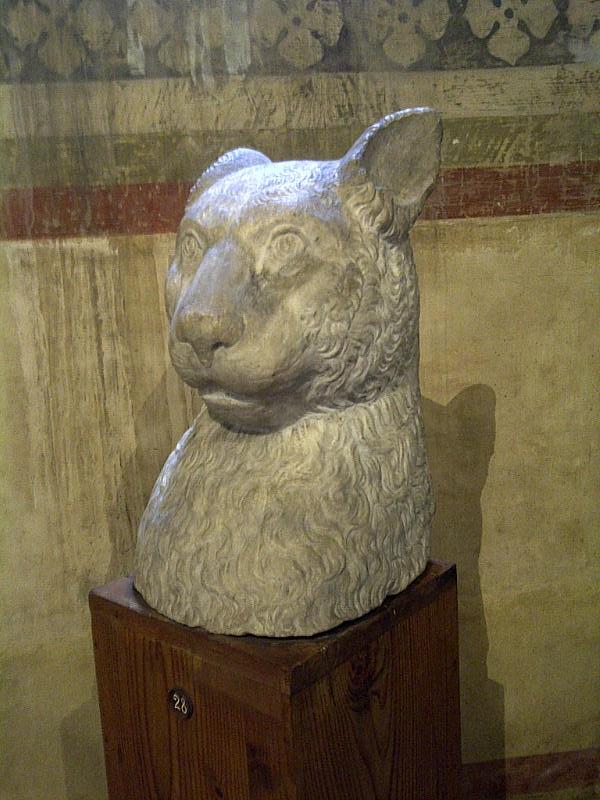
Visiting this museum this morning I was amused by the number of felines Salvatore had collected in this room, but how lovely some of them are?
I love this alert looking lioness dated between 1st-4th century AD – and you can still stroke her in this museum.
Some of the other big cats seem to have withstood the test of time less well – more from weather than stroking I believe – notably this seemingly much more primitive lion from Puglia, which was actually carved so much later – around the 13th Century.

….and this poor gent below – also from the 13th Century who has certainly seen better days!

Finally, on the feline front there are these two delightful Leonicornus – lions with fishy tails, which were marked in the local brochure as Sealions from 13th Century Naples.


Salvatore donated all these treasures to Santo Spirito to before his death on the understanding that he himself would be entombed in a sarcophagus which stands at the back of the refectory – and thus, like an Egyptian God – he would never be parted from his precious collection.
