
I have often mentioned in my Blogs the enormous number of valuable treasures in Florence that are hidden – usually below stairs or in attics around the city – simply because there is not sufficient room in all Florence to display them!
Last month however we were advised of a marvel that had been hidden despite being in full view of the people of Florence and the tourists alike!

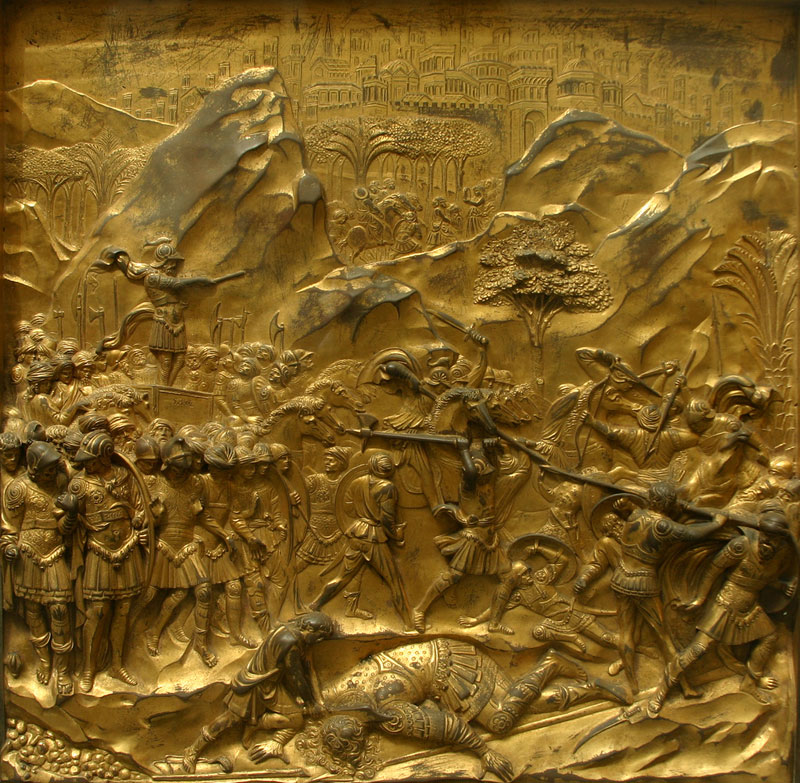
Marco Ciatti – the superintendent of the Opificio delle Pietra Dure has announced that Ghiberti’s first set of bronze doors, most of which are currently on the north door of the Baptistery in the Piazza Duomo but some have already been removed to be restored, were also covered in gold gilt and would have originally shone as brightly as the ones the public flock to see.

It seems that beneath the years of tarnishing through pollution and oxidation of the bronze lies a master-work quite as beautiful as those dubbed “The Gates of Paradise” by Michelangelo.
This was not an easy commission, the work took nearly 21 years to complete. Ghiberti began working on his first set of doors in 1403 and they were put in position at the north entrance of the Baptistery in 1424.
Some of them, such as the expulsion of the money changers shown below , might have a been a bit close to the knuckle for a City beginning to be more famous for banking than the wool trade!

The images are all scenes from the New Testament – stories of the life of Christ and the Acts of the Apostles – the images below is of Pentecost and some of the bronze is visible through the tarnish of time.

In contrast the “New” Baptistery doors – completed in 1442 portrays scenes from the old Testament – perhaps less challenging and therefore more popular – including the story which came to symbolise Florence and her struggle against the might of Rome – David and Goliath!
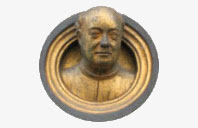
Also included amongst the images of notables of Florence portrayed on the corners of each panel is Ghilberti himself.
Ghiberti became famous in 1401, when only 23 years old, he won the competition for the first set of bronze doors commissioned for the Baptistery of San Giovanni Battista –
Filippo Brunelleschi, already not known for his good humour, was miffed by being a mere runner up and left town in a huff and went to Rome to study the ancient Roman ruins and the Pantheon!
When Brunelleschi came back he had changed profession from goldsmith to architect and his studies in Rome enabled him to design a free standing dome for Florence’s cathedral – the first of such size to be constructed without it collapsing under its own weight – all in all a worthwhile trip!

The famous East Doors of the baptistery were under restoration for 27 years before being established in a nitrogen filled case in the Museum of Santa Maria del Fiore. Thus they will be preserved against the ravages of pollution although as always, something is lost when something is gained, and sadly it will never be possible to get as close to them as was possible whilst they were under restoration.

Most of the Museo dell’Opera di Santa Maria del Fiore (aka the contents of the Duomo) is currently closed, because it too is under restoration whilst they take over additional space previously used by a multi-story car park. This is great news as it will enable us to see many more of the beautiful treasures of Florence that are currently hidden away due to the lack of display space. The front area , which includes the renovated gates, is still available to view – and of course there is still great competition to get close enough to photograph the copies!

This is very interesting, Penny. I missed seeing the restored Ghiberti Gates when they were exhibited at three museums in the U.S. in 2007, I am looking forward to seeing them in Florence.
Coincidentally, during my twenty-five years as head of our university library’s Special Collections Department, I had under my perview a pair of replicas of the Ghiberti Gates (old testament). How they ended up at the University of Nevada is an interesting story. They were cast in bronze in half-the-size of the original by Ferdinand Barbedienne in Paris for Russian Prince Demidov for 100,000 francs. After they were exhibited at the London Universal Exhibition of 1851 they were placed at the entrance of chapel of the Prince’s palace in San Donato (Polverosa). When the Prince’s collection was sold in 1881, the gates were purchased by William Henry Vanderbilt and place in the vestibule of the Vanderbilt mansion on Fifth Avenue in New York. At one time Reno, Nevada was the of Cornelius Vanderbilt, Jr. and may be why his wife donated the Ghiberti Gate copies to the university in 1948. However, the donation remained in storage for the next fourteen years because the university couldn’t find an appropriate place to display them. Finally, in 1962, they were placed in the newly completed library building at the entrance of Special Collections, which houses the library’s rare book and manuscript collections.
In 2004 I was in Special Collections by Gary Radke, who wanted to see the gates firsthand. Gary is a art historian at Syracuse University who specializes in renaissance art and frequently teaches in Florence through Syracuse’s program there. He is an expert on the Ghiberti Gates and wrote the catalog for the 2007 exhibition in the U.S. After his visit with us, he wrote an article about our copy of the gates entitled, “Ghiberti on Fifth Avenue: The Vanderbilt Copy of Lorenzo Ghiberti’s Gates of Paradise.”
Thanks for sharing this history Bob – happy to hear that these special copies of Ghiberti’s panel have found a happy home and are now on display again – it is such a shame that so many beautiful things are kept under wraps due to lack of space!